The debate on the threat AI poses for crypto is mostly just wankery.
We will see AI exploit systems-level bugs far before ECDSA falls. We will see AI discover bugs in systems code, libraries and wallets that enable attackers to steal billions of dollars long before we have to worry about cryptosystems failing wholesale due to new math.
Sure, there's definitely a non-zero possibility that ECDSA might fail wholesale, and the ramifications would be systemic -- all balances on such a chain would be in question. That's why Hoseeb's backup crypto proposal is sensible. Namely, build an alternative cryptosystem onto which one could shift should ECDSA doomsday arrive one fine morning. That's an approach that we will be exploring for Avalanche.
But our focus regarding AI's impact on blockchains ought to center on vulnerabilities in existing software first and foremost. If you think that, say, Ripple's (or insert any other high value low use chain here) under scrutinized code contains no 0-day bugs, difficult for humans to spot but easy for AI to identify, then you're deluded.
My take on this issue, as with all other issues, is pragmatic and oriented towards what matters most today. That said, in the tail risk category, hash-based crypto is really interesting, and we have an active group exploring hash-based alternatives to ECDSA.
Reading the comments of junior mathematicians confirms what many senior mathematicians have been warning about over the past month:
It is becoming clear that people with the intellectual ability to understand these proofs will not be interested in spending their lives training to check LLM logs.
This is the tragic side of what is happening that almost no one — except the actual mathematicians — seems to get.
Either we figure out how to keep people interested in doing mathematics, or in 20 years LLMs will have no one’s work left to recombine into new proofs, and no one interested in reading those proofs.
That would be the thermal death of mathematics.
The argument that “LLMs will read LLM math” is so shortsighted that it makes me want to cry…
Today I call upon the blockchain industry to calmly begin planning for "bunker mode". My personal recommendation is to set in motion a controlled mass migration of assets to fresh addresses, i.e. addresses whose pubkeys remain hidden behind a hash.
Holders, starting with large and sophisticated ones, should consider moving the bulk of their funds to addresses that have never signed a transaction. And when they do sign one, they should also move remaining funds to a new address (possibly generated from the same seed phrase).
Don't rush. While I believe there is cause for action a rushed migration would do more harm than good. Don't panic either. Moving assets to protected addresses is a simple, preventative step which does not require new cryptography or new wallets.
IMO it is now reasonable to brace for the possibility that ECDSA breaks before qday, in the worst case in months not years. By "break" I mean fast private key recovery (e.g. in one week) on available hardware (e.g. a large GPU cluster).
Recent days have been humbling for human mathematical intuition. Long-held, unquestioned hypotheses have fallen. This includes the n log(n) bound for integer multiplication and the 3SUM conjecture. In hindsight, May's unexpected disproof of the Erdős unit distance conjecture was our warning shot.
Yesterday's OpenAI drop made it clear that mathematical superintelligence is upon us. They say there are weeks where decades happen. We are about to live through weeks where centuries of mathematical progress happen. Could our magic 64-byte ECDSA signatures be too good to be true? Was it just security through obscurity all this time?
Elliptic curves feel especially vulnerable to superintelligence. Curves carry rich structure, with room for fancy tricks like Schoof, Frobenius, pairings. (By contrast, hashes are designed to minimise algebraic structure.)
Separately, as Ewin Tang can attest, an efficient quantum algorithm sometimes foreshadows an efficient classical one. We should be open to the possibility of a classical counterpart to Shor that breaks elliptic curves and RSA at once.
Also noteworthy is the striking under-representation of cryptographic breakthroughs among the 722 mathematical results OpenAI published. I've witnessed first-hand the US government censoring academic quantum cryptanalysis results. Backroom interventionism is my base case.
I urge large, sophisticated actors to lead by example. Project11's "risq list" (bitcoin-risq-list.projecteleven[.]com) is a great tracker of exposed BTC pubkeys. Binance, Bitbank, Robinhood, Bitfinex, and Tether have an opportunity to harden their cold storage. Next month I'll address institutions in London in a live Q&A (forum.ethereuminstitutional[.]org/london-2026).
Again, please do not rush. Wallets holding under 50 BTC enjoy partial cover from "Satoshi's shield", i.e. his 20K exposed addresses that hold 50 BTC each. Load-bearing signers like oracles and L2 security councils should consider rotating ECDSA pubkeys with every signed message and/or multi-signing with a hash-based schemes like SPHINCS.
Exiting bunker mode safely will require post-AI cryptography. My inclination is to go all-in on hash-based cryptography and avoid structured mathematical assumptions entirely, whether from curves, lattices, or isogenies. A single battle-tested hash (e.g. from the SHA or BLAKE families) yields plausible post-AI security.
The Ethereum roadmap on strawmap[.]org fully embraces hash-based cryptography with end-to-end formal verification as a response to the quantum threat. Those timelines must now be revisited and accelerated in light of mathematical superintelligence. I'll be pushing for maximum defensive acceleration.
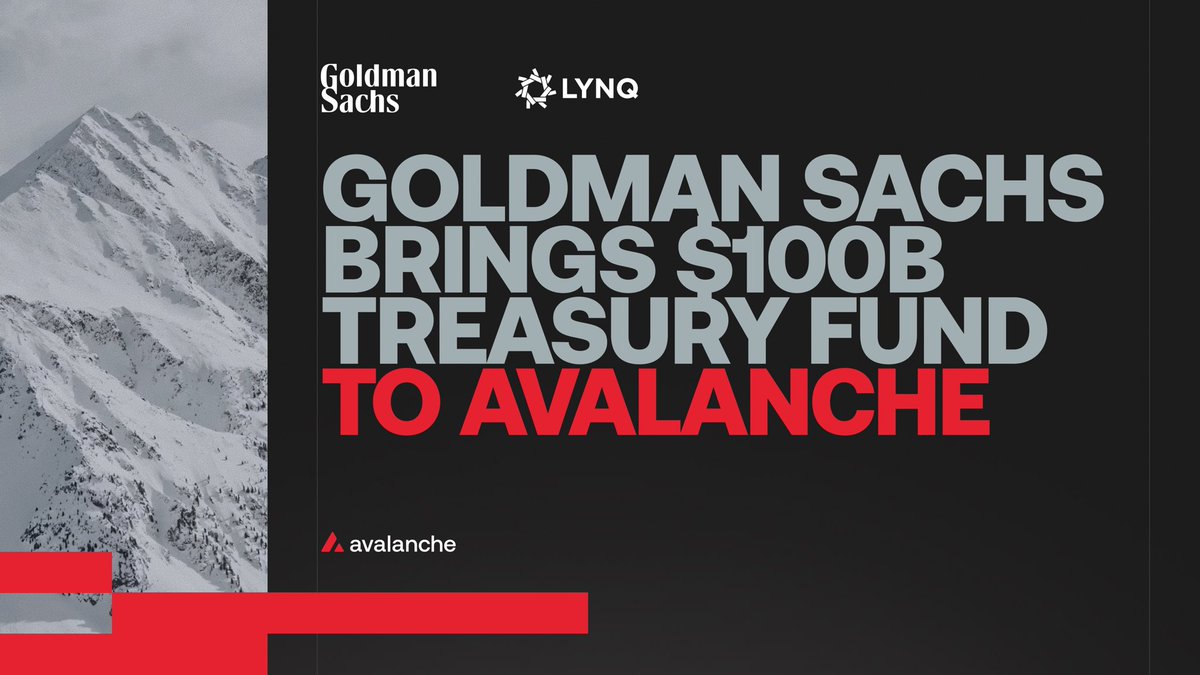
BREAKING: Goldman Sachs is bringing its $100B flagship Treasury fund to Avalanche
The fund will be offered through Lynq, a private, permissioned Avalanche L1 used by 30+ institutional digital asset firms, including B2C2, Wintermute, Galaxy, FalconX, and Fireblocks.
This gives institutions a way to put cash to work between trades and earn yield without leaving the infrastructure they already use.
"Maybe the altcoins actually outperform Bitcoin by 50x." 🤯
@cryptomanran told me a @BlackRock report on AI agents made him think his own altcoin chart may be too conservative.