where i'm at on LLMs:
1. LLMs are NOT going to outmode software engineers, not now, not ever
2. LLMs alone are a dead end for attaining anything like AGI
3. forget about LLMs achieving ASI
4. LLMs will only make good engineers faster, marginally
5. LLMs will remain poor at architecture and design
this is 100% because LLMs cannot reason
and no, generating a bunch of hidden context is not "reasoning"
as always, when the same people are making claims like this, have a look at what they stand to gain
and to them, i warn directly: you are going to fall. hard
Anxiety often happens when your level of intelligence isn't aligned with your level of courage. You know what you can do, but you never do it. That's anxiety.
@wjsidnsusb @mahirosan123@Nzaki0716 Here is a zip file with all the themes:
https://t.co/ybavhH6EhA
I am not hosting the themes on the site, please disseminate the above link :)
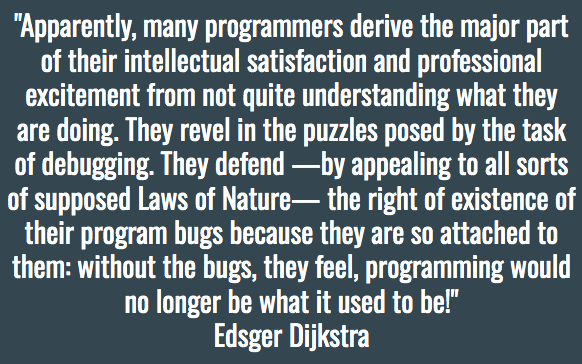
Why many teams refuse to do TDD?
1. Don't know how to write structure-shy tests
2. Don't know how to refactor (plus don't see any value in refactoring)
3. What Dijkstra said
I never paid attention to how free (and malloc) works at least in C standard library. malloc takes size and returns a pointer to the start location of memory you requested (slightly more based on the os page size)
free takes only a pointer and somehow it can tell exactly how much memory that pointer was allocated and free that much exactly.
I asked myself how does free know how much memory it needs to free just from a pointer and I found a nice stackoverflow article.
turns out one implementation at least is to store metadata about the allocation in a fixed header right before the pointer. So free technically walks back X bytes to read the header, find out how much memory it needs to free and calls mmap to remove the virtual memory mapping’s essentially for that process.
this immediately tells me smaller tiny object allocations can really have massive overhead, this can be even further exacerbated with object orientation where we make everything into an object and allocate/dellocate each object individually.
the person answering also mentioned that they implemented an alternative another malloc/free which doesn’t store metadata inline but use fixed size.
This makes me appreciate and also question standard libraries and not blindly use them, even if its the bare bone stdlib
so much to learn…
The answer to the below question is NO.
Artificial intelligence large language models do not seek the truth, nor will they ever understand what truth is. They seek the most popular response to your query, based on training data, the algorithm, and alignment by human workers.
Anxiety is when you want something, but don't make the efforts to get it, and are distracted every day by mindless entertainment instead.
Peace of mind is when you want something, make a clear plan to get there, and actually steadily get there day after day, year after year.
@__mharrison__ It is considered O(N) because we often consider the worst case scenario, in this case the item we're searching for can be in index position N-1, so the algorithm will loop over N item. In the best case, it's actually O(1).