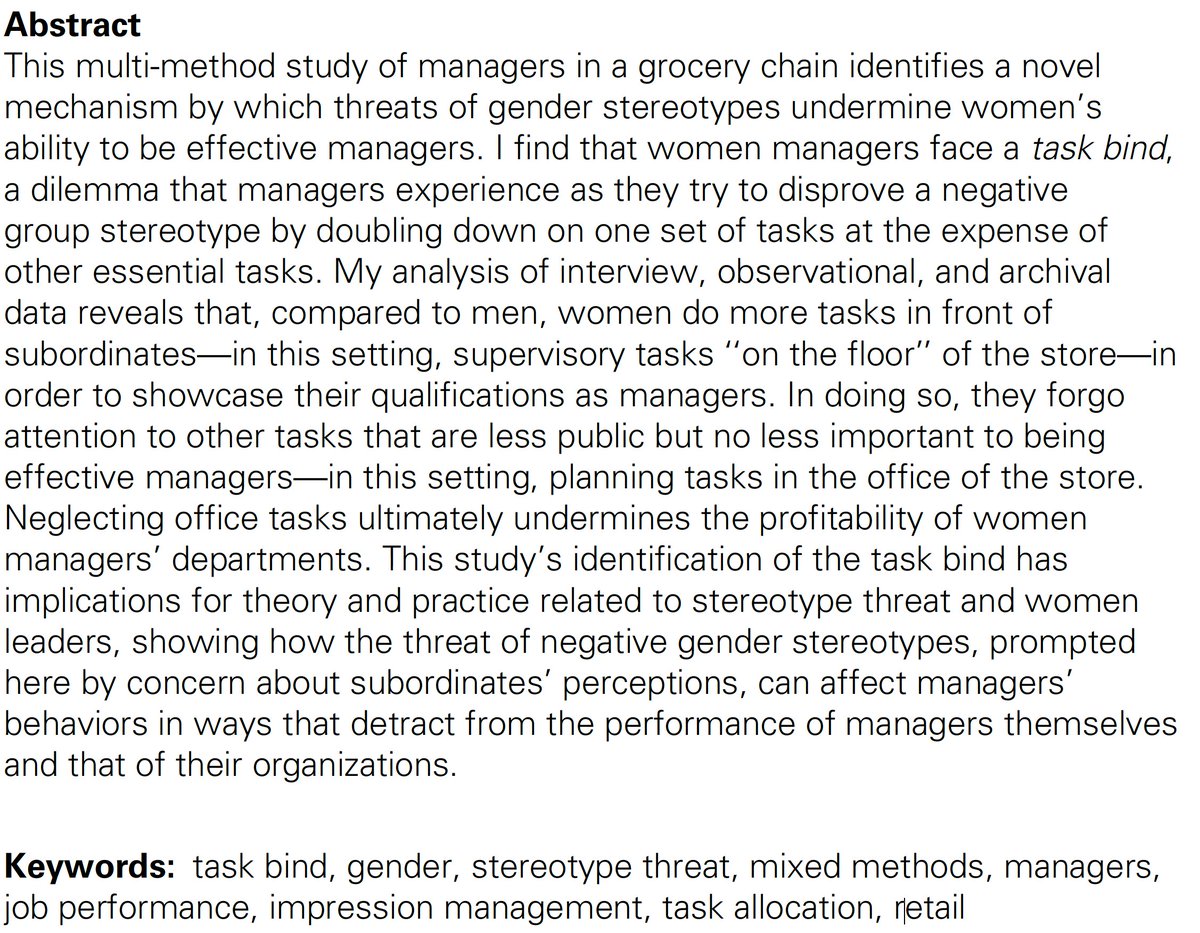
@acfeldberg finds that a “task bind” exists when women managers try to disprove negative stereotypes by spending time on one set of tasks at the expense of others.
https://t.co/rFtdAL195a
I am thrilled to share that my article, which introduces a new way that stereotypes can undermine women's ability to be effective managers--what I call a "task bind"--is now available via open access @ASQJournal. (1/8)
What can organizations do? First, understand that women managers face these challenges. Second, connecting women managers at peer levels may be one way for organizations to combat the performance effects of negative stereotypes and the bind (see article for more). (8/8)
Why do women managers face a task bind? My interviews show that part of the reason is that they feel pressure to show the people they manage that they are competent and capable in roles where they are stereotyped as not being competent and capable. (7/8)
Come be our colleague @HarvardHBS in the OB Unit? We're hiring for a full-time, tenure-track Assistant Professor position, & candidates with research interests in micro- or macro-organizational behavior, or related disciplines (psych/econ/soc/mgmt)
https://t.co/YZ37wuyu7x
Case authors may inadvertently introduce bias to their case through their description of the protagonist. @HarvardHBS’s @acfeldberg & Anthony Mayo highlight the best practices experienced case authors use to describe protagonists’ social identities.
https://t.co/Y45NKAxv1E
In a new op-ed in the @GlobeOpinion, we draw on our recent research to argue that we should redesign institutions and policies to reduce shame and address people in financial hardship with compassion can help break the poverty trap.
https://t.co/mY3gxLSY03