If you work at LSE and support academic freedom then join LSE Academic Freedom now.
If you know someone who works at LSE, pass this on to them.
LSE staff members can join and find out more by going to our website here:
https://t.co/LmiyinBpGH
I’m very happy to be able to announce that the University of Oxford’s Faculty of Law has rescheduled my lecture on Freedom of Expression in the Sex and Gender Debate.
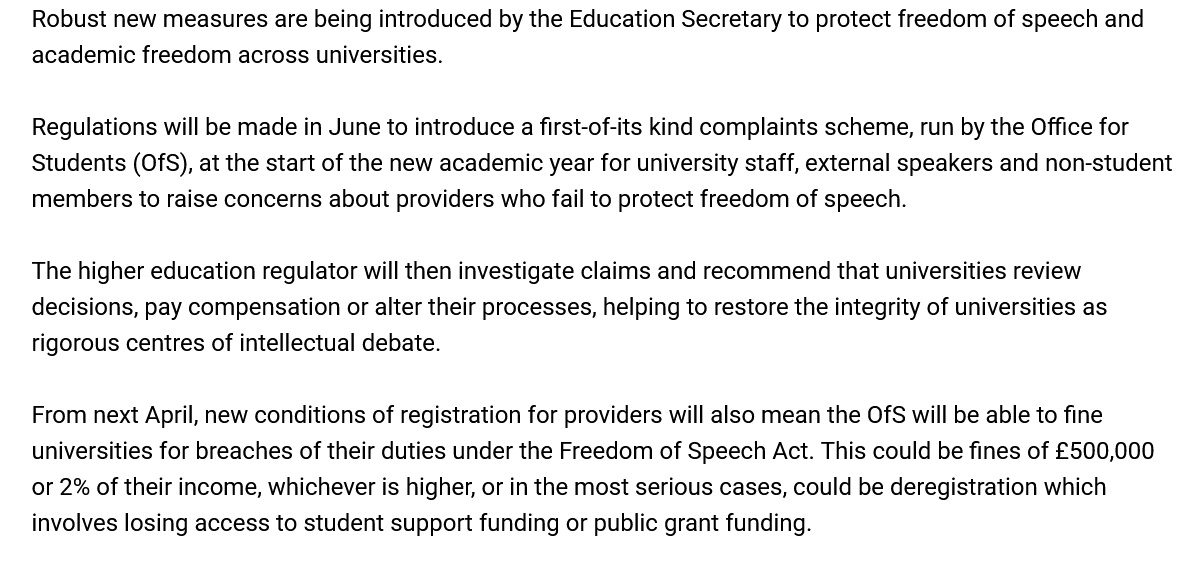
🚨 BIG NEWS: the university #freespeech complaints scheme is going ahead!
The Office for Students (OfS) has just confirmed that commencement regulations have been signed. From 1 Sept 2026, staff, external speakers and non-student members will be able to lodge formal complaints with the regulator. Mandatory free speech conditions follow from 1 Apr 2027.
Make no mistake: this is a major step forward.
The complaints scheme offers something existing, extremely costly routes like judicial review or an Employment Tribunal claim simply cannot: a quicker, free-to-use route to redress when free speech or academic freedom rights are infringed.
Today’s confirmation means the regulatory regime finally has teeth — and senior leaders in the sector will no longer be left to mark their own homework in an atmosphere of backslapping bonhomie.
There are, however, still challenges ahead. The scheme will only be as effective as the cases that come before it. Without some degree of upstream filtering, meritorious complaints may be lost simply because the underlying free speech or #academicfreedom issues are not clearly articulated.
That is where organisations like the Committee for Academic Freedom (CAF) have an important role to play. Ahead of the scheme’s launch, we will be refining our intake and triage processes so we can help academics and others identify the core issues in potential complaints and structure them in a way that reflects the relevant legal and regulatory tests.
Universities should be places of open inquiry and robust disagreement. If the OfS receives a well-formed pipeline of cases, and is willing to act decisively, this scheme could, over time, begin to shift institutional behaviour in a meaningful way.
If you are facing a free speech or academic freedom issue in the higher education sector, or are unsure whether your case may fall within the new scheme, please get in touch with CAF at: [email protected].
Oxford University is facing serious questions over its handling of repeated disruption of public talks by Dr Michael Foran, an associate professor of law and tutorial fellow at Keble College, after trans activists interrupted two events linked to his recent work on sex, gender identity and the legal tensions that have emerged between them.
https://t.co/Wkntw1znJq
Apologies for using Oxford-ese without explanation.
The proctors are not the security guards. https://t.co/MDVITbJ6iq
My understanding is that the proctors took the decision to allow protests inside the lecture theatre. If that is correct, it is extraordinary.
The protesters are not helped to understand that their behaviour is wrong when they are given permission by people in authority. And security guards are unlikely to be able to intervene if the proctors have given permission.
Due to escalating disruptive protests, I have decided to cancel the remainder of these lectures. This is deeply lamentable, but the disruption has undermined the academic nature of this series. Students shouldn't face bullying or harassment when attending academic events.
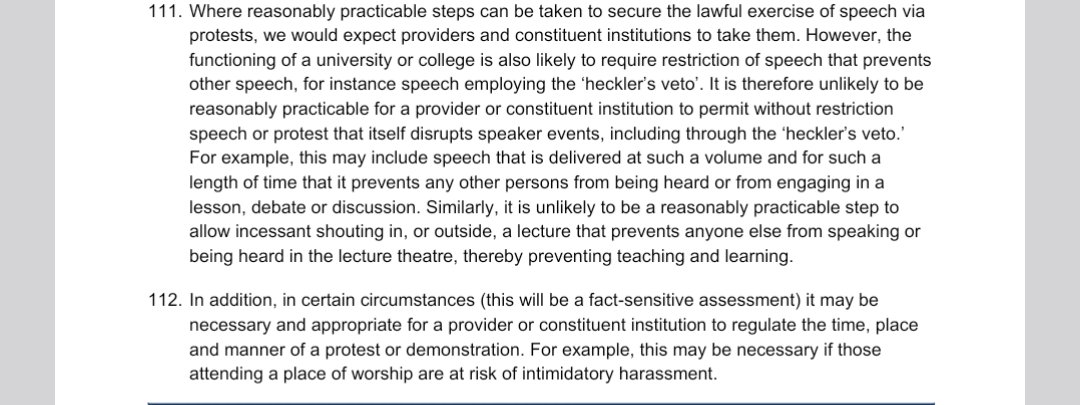
It seems that the Oxford authorities who have allowed these disruptive protests haven't read Regulatory Advice 24, the OfS guidance on freedom of speech, which is quite clear on the need for time, place and manner restrictions on speech employing the ‘heckler’s veto’.
The relevant questions are 1) why @UniofOxford and @OxfordLawFac have permitted this and 2) what they are doing to rectify this violation of the academic freedom of their staff and students.
Due to escalating disruptive protests, I have decided to cancel the remainder of these lectures. This is deeply lamentable, but the disruption has undermined the academic nature of this series. Students shouldn't face bullying or harassment when attending academic events.
There is a story in the witness statement for the “remedy” part of my employment tribunal that concerns Sussex University.
When I was in the process of losing my job at the Centre for Global Development I began to consider other options for my work on tax and international development. I had an offer for funding for the research project I had been working on, if I found a different institutional home so I contacted the senior people at the International Centre for Tax and Development (ICTD) at the Institute for Development Studies at Sussex University who liked the idea of me being an associate there.
I told them about the investigation at CGD over my writing about sex and gender but was reassured that the University "is deeply committed to academic freedom.”
They did say they would want to check that I was not likely to express views “in a way that would seriously upset colleagues working in the gender and sexuality field or generate adverse publicity or reputational risk”.
I wrote back and said that I didn’t think my blogging on sex and gender would generate adverse publicity and I sent them the Equality and Human Rights Commission’s guidance to universities on freedom of expression, and also a “supportive” statement issued by the vice-chancellor of the university defending Professor Kathleen Stock.
A few days later on March 20th 2019 I was told that the Institute for Development Studies had decided I chould not be an associate there on any terms because I was “too controversial”.
Sussex University said in their statement of facts and grounds challenging the OfS decision. "No disciplinary procedure has ever been commenced against any member of staff at the University following a complaint relating to lawful expression of protected beliefs, including gender critical beliefs."
No. They don't need to. Staff just know that it is "too controversial" to express these views in public if you want to keep your job.
1/ Almost three years after the passage of the Higher Education (Freedom of Speech) Act 2023, its complaints scheme provision finally looks set to come into force this autumn. And the new registration conditions will follow next April.
How did we get here? A (long) thread.🧵
Here is the Minister’s statement announcing the implementation of the new complaints procedure for breaches of academic freedom.
https://t.co/pE4Nxv2KG3
Some very good news for academic freedom in Britain. 👇
Universities can now be fined by the OfS for infringing academics’ freedom of expression and academic freedom.
Hypocrisy aside, UCU and Owen Jones are right that university management shouldn’t be policing the use of the words “ancient Palestine”. Although I see why it is tempting to ban the words “UCU and Owen Jones are right” as not worthy of respect in a democratic society, we should be allowed to say them.
LSEAF are very pleased to be co-hosting this discussion and launch of a new book on academic freedom:
Minds that Dare by Paul Frijters. 28 January 6pm.
Details 👇
LSEAF are very pleased to be co-hosting this discussion and launch of a new book on academic freedom:
Minds that Dare by Paul Frijters. 28 January 6pm.
Details 👇
Book launch Minds that Dare organised by @LSESocialPolicy and @acfreeLSE on 28 January 2026.
@FrijtersPaul is a highly esteemed economist known, particularly, for his work in the field of wellbeing. Having held Professorships at universities across the world (including LSE), he and colleagues recently took the bold step of establishing their own academy in a castle in Belgium: Academia Libera Mentis (ALM @liberi_mentis). In this talk, Paul will share his experiences in academia that led him to set up ALM, with the ambition of establishing form of rigorous academic education that encourages independent thought fostered by communal living. He discusses the challenges to academic freedom in traditional institutions that ALM aims to avoid and which have afflicted many of those now participating in this educational initiative. Discussing his newly-published book, Minds that Dare, he reflects on the way forward for academic education that puts academic freedom at its heart.
https://t.co/Agq0DXWDLT
Interview with Larry Kramer, LSE’s Vice-Chancellor, on freedom of expression in universities and the need for universities to not “take positions on matters that do not directly affect the university itself”.
Very worth reading. @lsenews.
https://t.co/8gfPRTlGbC
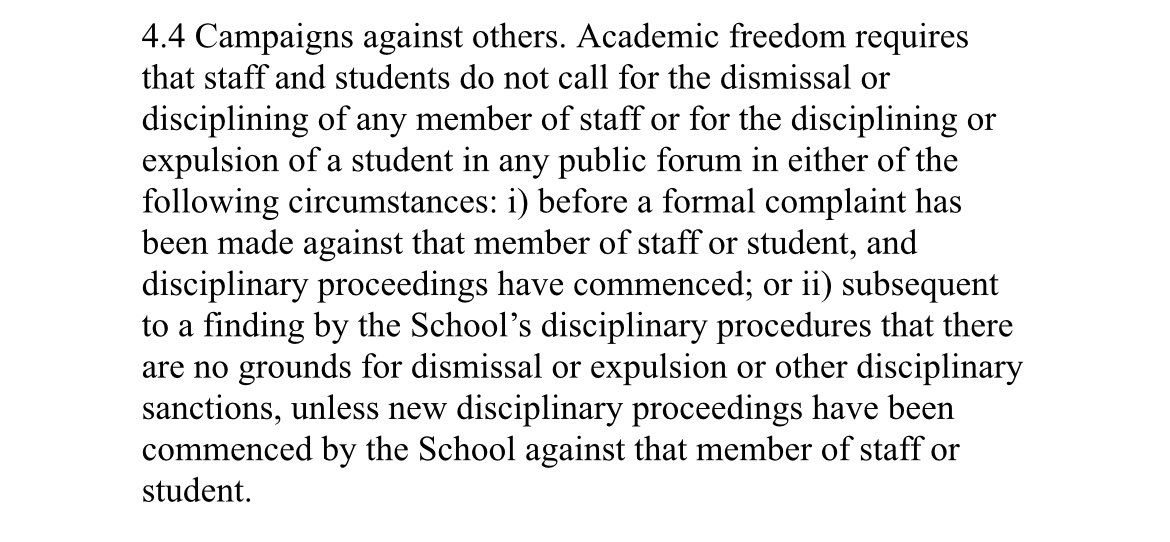
Another campaign to sack an academic for doing their job. If students or staff at Abertay are involved in this campaign they should be disciplined.
See our Draft Code of Practice on AF, para 4.4:
https://t.co/kni8Q5KyjV…
Dr Stuart Waiton says he has received emails and calls from people demanding he be sacked from his university role over the speaker session. https://t.co/MstB5ai2cw
#BREAKING news is finally out of the worst case of 🇨🇳 interference in UK academia I have ever seen - reported today in the Guardian (front page) and BBC. I’ve worked on this with Prof Murphy for two years, and here is the shocking summary:
1️⃣ PRC agents visited @SheffieldHallam Beijing recruitment office, demanding that all @LauraTMurphy research on forced labour cease. Prof Murphy has led the world in her Xinjiang research, exposing labour abuse in China, especially in the renewable sector.
2️⃣ PRC blocked Hallam’s Uni website and email access in China, cutting off communication with students as leverage.
3️⃣ Hallam engaged directly with, and complied with the demands of, PRC operatives. THE FORCED LABOUR LAB WAS SHUT DOWN. MURPHY WAS TOLD SHE COULD NOT WORK ON CHINA. Grant funding was returned.
4️⃣ The Uni told Prof Murphy that she couldn’t work on China for other reasons, like the difficulty of obtaining insurance, and the fact she was operating remotely.
5️⃣ In fact, FOI and Subject Access Request documents reveal that the true motivation: fear of losing
Chinese students and associated income.
____
The case represents an unprecedented capitulation of UK academic freedom to foreign state coercion, with implications for all universities reliant on international student income.
UK universities make a loss on every domestic student. They are exposed to authoritarian influence through their dependence on foreign fees. The Hallam case shows that they cannot defend academic freedom alone.
The Government must create some kind of values-based backstop to assist universities under threat or coercion. Guidance on how to deal with foreign states is clearly needed. A reporting channel for universities is essential, and more help to defend academics against lawfare (which Professor Murphy was swamped with) is overdue. Let this be an opportunity and a threshold moment.
And can we finally put an end to the ludicrous notion that our academic freedoms are somehow immune to the influence of the authoritarian Party-State upon which they increasingly rely?
We need to wake up, realise what’s at stake, and protect our institutions.
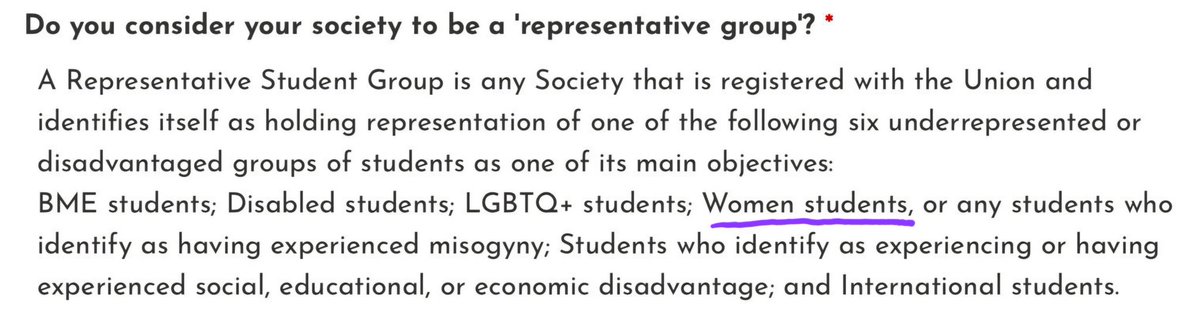
We applied on 21/10/25 to be registered with the University of Cambridge Student Union. We have yet to receive a response. A successful application would allow us access to Freshers’ and Refreshers’ Fair Stalls, society promotion, and increased ease of use of University of Cambridge facilities.
@YourCambridgeSU@Cambridge_Uni