👀 "“The number 35% should have come from a good bottom-up assessment. That is what the heart of the COP is.” While increasing electrification is critical, Khanna is right, the PA was always meant to be a stakeholder lead, mutually ratcheting system, not another top-down target.
Good arguments! Yet, there may be causal reasons for higher shares of renewables in rich countries. First, they could afford massive subsidies (in part because they are rich and in part because they impose higher taxes and fees in the grids to fund the transition). Less necessary today, these subsidies propelled the OECD countries ahead of others. Second, higher electricity prices are essential for renewables profitability.
The Russian Federation demands that the door to NATO be closed forever, that arms shipments to Ukraine be halted, that the alliance’s armed forces be withdrawn to their 1997 positions, and that Europe be stripped of its nuclear protection.
The *New York Times* has revealed Moscow’s core demands, as set out in a new negotiating document:
The alliance must officially rule out any further eastward expansion (which would permanently block Ukraine’s accession) and cease all military activities in the territory of Ukraine, Eastern Europe, the South Caucasus, and Central Asia.
Russia demands an end to the supply of all Western weapons, military equipment, or military-related goods to Ukraine.
Moscow states that it would have no objection to Ukraine joining the EU, provided that Kyiv does not participate in the bloc’s common defense policy.
Russia has effectively renewed an ultimatum from five years ago: NATO must withdraw its armed forces and bases from its eastern flank (specifically from Poland and the Baltic states).
In addition to the long-standing demand that the U.S. abandon the practice of sharing nuclear weapons in Europe, Putin has added a new condition: France and the United Kingdom must rule out the use of their own nuclear arsenals for the defense of other European states.
Furthermore, Europe was supposed to hand over all virgins to Russia. This addition was subsequently struck out.
As an overseas Chinese who has worked on China’s energy transition and energy security for more than two decades, I’m tired of German commentators selectively using China and mis-represent China to fit a green narrative.
Yes, China is building vast amounts of wind and solar. But unlike the permanent subsidy model some Germans still defend, China ended national feed-in tariffs for new solar and wind projects from June 2025. After more than twenty years of government support, these technologies are expected to compete in the market.
At the same time, China is adding more coal capacity than the rest of the world combined, and building more nuclear reactors than the rest of the world combined.
My generation and older generation of Chinese still remembers food and energy insecurity. We do not take modern industrial prosperity for granted. China’s approach has always centered on securing energy and food supply in a changing climate — not on treating intermittent renewables as an ideological end in themselves.
That pragmatic multi-source approach is the actual story about China, not the misleading version currently circulating in Berlin by wind and solar lobbyists.
Could not agree more. @IEA would catalyze far better global energy understanding by making its data public. I have one recent paper & two in-progress papers that would have benefited greatly from this. Same is assuredly true for researchers globally, especially in less-studied regions.
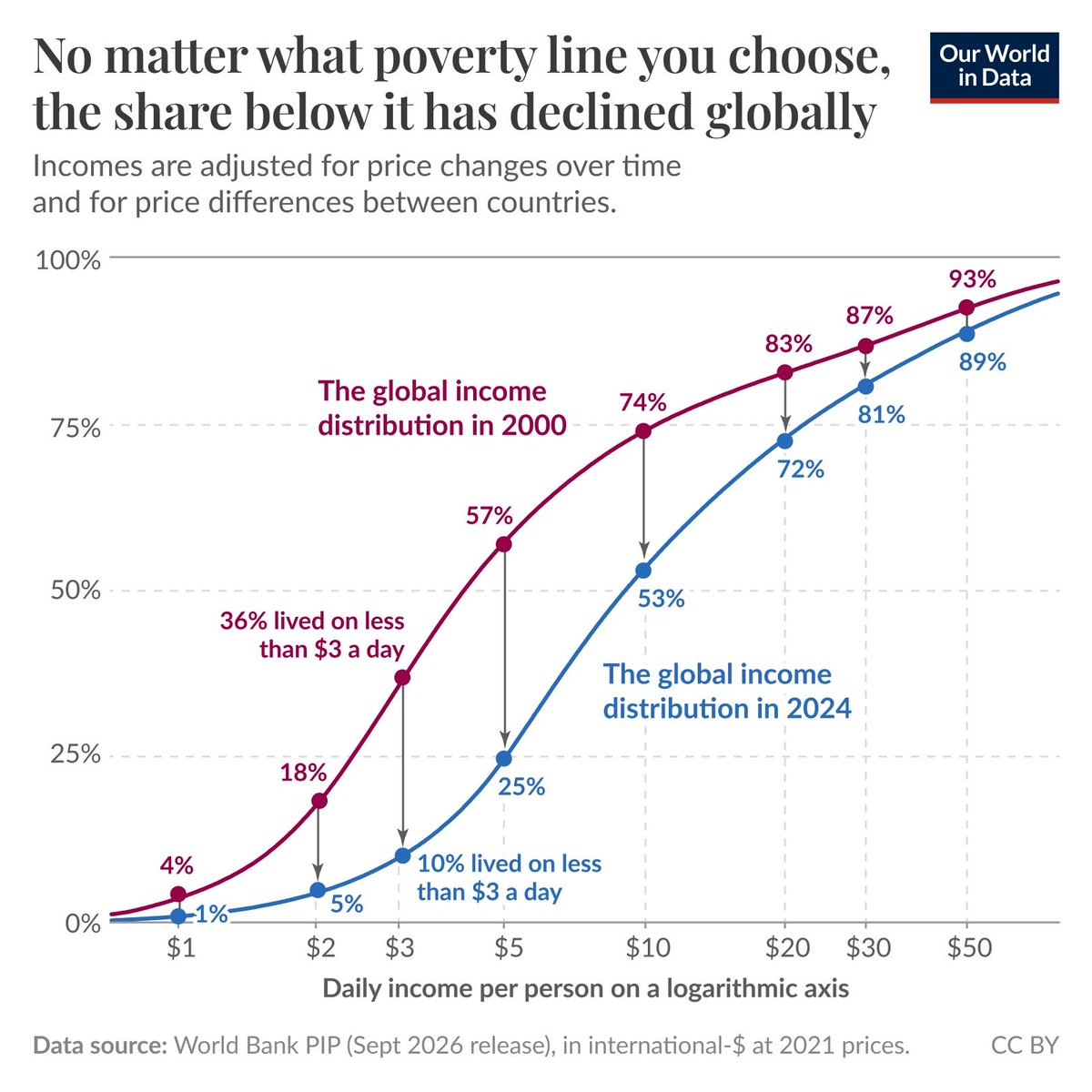
A good news chart. Fewer folks live below the poverty line regardless of how exactly you define it. Economic growth is an essential ingredient to lift people out of poverty.
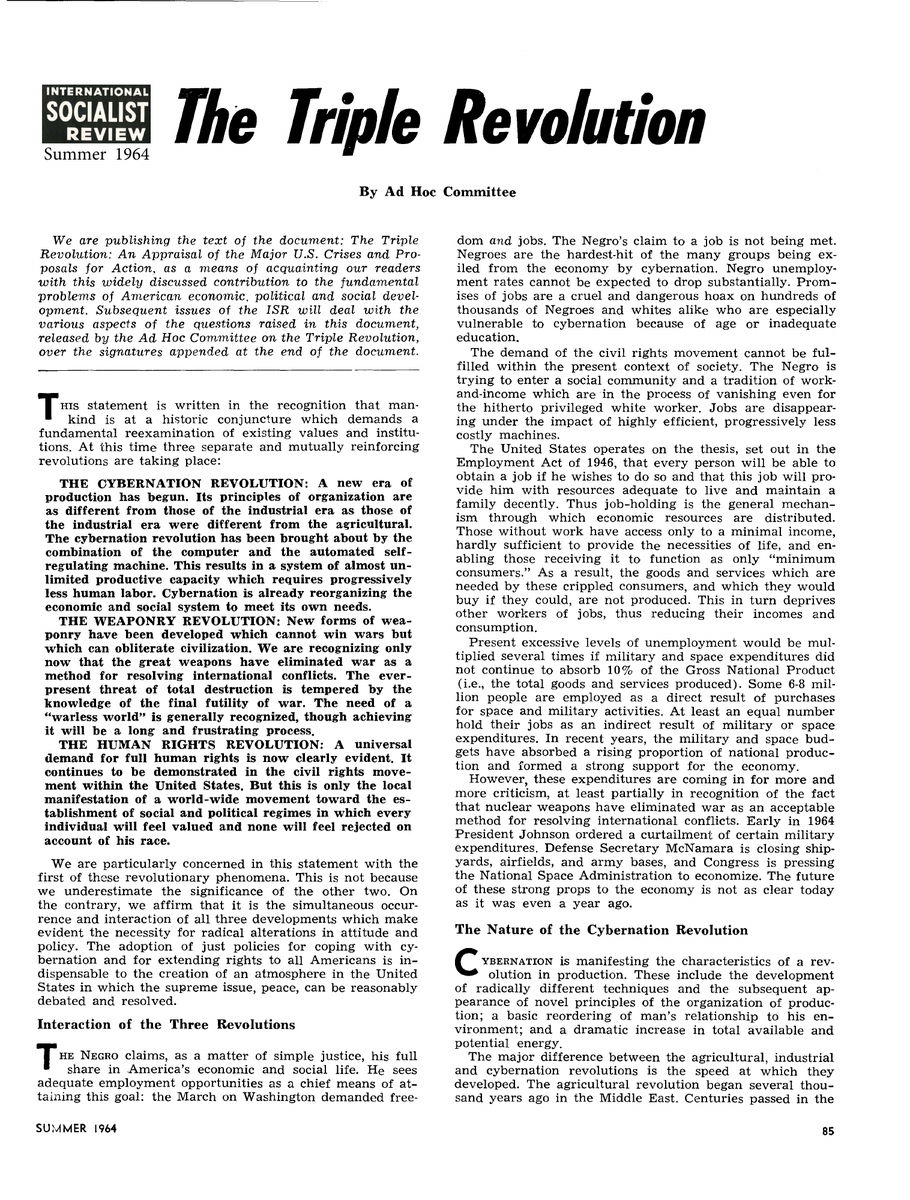
8/10 These fears weren't just that 1950s thing either. When computers arrived in the 60s, a committee warned of the “cybernation revolution.”
Its 1964 statement, The Triple Revolution, argued that “the traditional link between jobs and incomes is being broken.”
“THE CYBERNATION REVOLUTION: A new era of production has begun. Its principles of organization are as different from those of the industrial era as those of the industrial era were different from the agricultural. The cybernation revolution has been brought about by the combination of the computer and the automated self-regulating machine. This results in a system of almost unlimited productive capacity which requires progressively less human labor. Cybernation is already reorganizing the economic and social system to meet its own needs.”
Last Friday evening (16 October), I suspended the 65th Plenary Session of the IPCC in Addis Ababa. The work of this Plenary hasn’t finished. We will reconvene the plenary at the earliest opportunity.
Read more: ⬇️
Because it runs an energy only market with lots of solar, wind, & batteries (with some gas & nuclear), Texas is a laboratory for where we might arrive with a renewable plus batteries system; maybe $0.05-0.1 /kWh peaks? I’m curious where the average price is trending.
I often see people argue that clean energy is not reducing emissions, because it just adds to rather than replaces fossil fuels. This argument is deeply misguided – clean energy built since 2005 has displaced 23 billion tons.
I dive in over at The Climate Brink (link below)
We are primates, with a third of our brain devoted to vision. Graphics are the best way to communicate quantitative, spatial, and causal information, but they are as hard to master as stylish prose. Here's an excellent guide to data visualization by Saloni Dattani @salonium https://t.co/tnXYMKKRYA
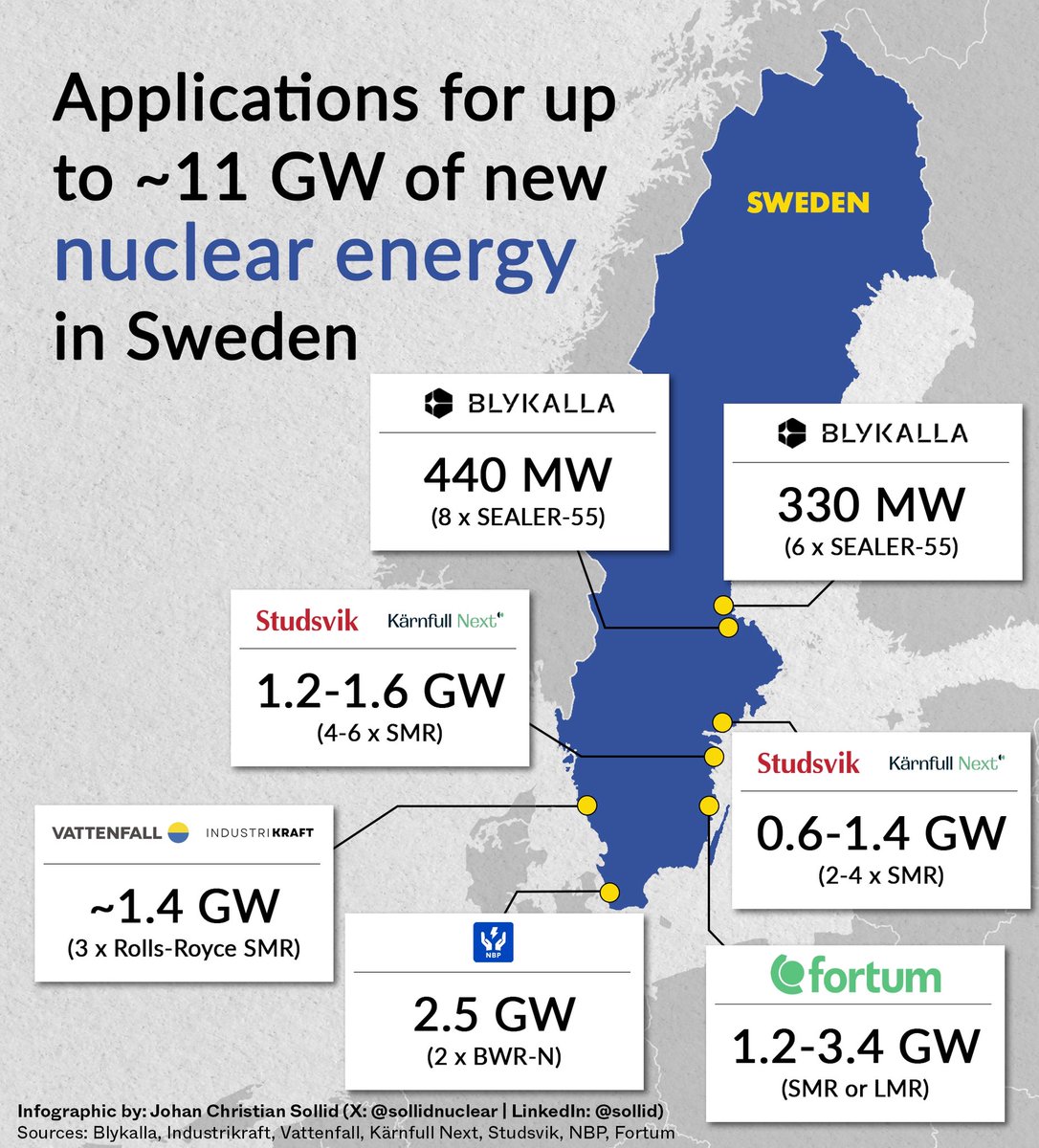
Sweden’s nuclear applications now cover up to ~11 GW, potentially exceeding the government’s 10 GW ambition for 2045 💥
Last week, I posted an updated map showing applications covering up to ~8 GW of new nuclear capacity in Sweden. I thought this would be the last update in a while. Turns out, I was wrong the very next day. Now I’m starting to run out of space on the map.
Fortum-owned NuCore Energi has now applied for state aid for a new nuclear project in Oskarshamn with a potential capacity of 1.2-3.4 GW.
And today, another one of the projects moved significantly forward.
Studsvik has selected GE Vernova Hitachi and Samsung C&T as strategic collaborators for its ReFirm programme. The first project is now planned around four BWRX-300 reactors with a combined capacity of approximately 1.2 GW.
This takes the maximum capacity covered by applications for new nuclear in Sweden to around 11 GW. That is now above the 10 GW level the Swedish government has used in its nuclear roadmap for 2045.
There's now a total of seven proposed sites in the pipeline:
1️⃣ Videberg Kraft at Ringhals has applied for state aid for new nuclear. Rolls-Royce SMR has since been selected as supplier, with the project planned around three 470 MW reactors with a combined capacity of around 1.4 GW.
2️⃣ Kärnfull Next – a Studsvik company, has applied for site approval in Valdemarsvik for 4-6 SMRs with a total capacity of around 1.2-1.6 GW. Both Valdemarsvik and Nyköping are included in Studsvik’s ReFirm state-aid application and is one of two possible locations for the first 1.2 GW BWRX-300 project by GE Vernova Hitachi Nuclear Energy and Samsung C&T Corporation.
3️⃣ Blykalla has applied for both site approval and state aid for its project at Norrsundet. The project consists of six SEALER-55 reactors with a combined capacity of 330 MW.
4️⃣ Studsvik has applied for site approval at its existing site in Nyköping for 2-4 light-water reactors with a total capacity of around 0.6-1.4 GW.
5️⃣ Nordic Baseload Power AB has applied for both site approval and state aid for new nuclear at Barsebäck. The project consists of two large-scale boiling water reactors with a combined capacity of around 2.5 GW.
6️⃣ Blykalla has applied for site approval for a second reactor park at Untra in Tierp municipality. The project could consist of up to eight SEALER reactors with a combined capacity of up to 440 MW. No state-aid application has been announced for this project so far.
7️⃣ Fortum has applied for state aid for a new nuclear project at Oskarshamn covering 1.2-3.4 GW. The reactor technology has not yet been selected, with Fortum working with EDF and Westinghouse Electric Company and Hyundai Engineering & Construction Co.,Ltd. on large-scale reactor alternatives and GE Vernova Hitachi on the SMR alternative.
The ~11 GW figure is the maximum capacity covered by the different applications, so it obviously does not mean that all 11 GW will be built.