A business doesn't have to reinvent an industry to become valuable.
Sometimes the opportunity is in a problem people already have, and a gap existing products haven't filled.
That's how PlanEase started. Market research turned a simple idea into a business that eventually got acquired.
Some founders spend more time negotiating a $500 software contract than a $5M acquisition offer.
And I wish I was joking lol.
You'll spend three days trying to get a 20% discount on your CRM.
Argue with a contractor over an extra $1,000.
Compare five different hosting providers to save $200 a month.
Then someone offers you $5M to buy the company you've spent the last seven years building.
And suddenly you're making the biggest financial decision of your life.
You've probably never sold a business before.
You don't know what's normal in an LOI.
You have no idea whether a 20% earnout is reasonable.
You're trying to figure out working capital adjustments, escrow, and whether you should stay involved after the acquisition.
Meanwhile, the buyer might have acquired 10 companies already.
They know exactly what they're doing.
And you're learning everything as you go.
A small difference in deal terms could cost you hundreds of thousands of dollars.
That's a pretty expensive time to figure things out.
I've been on both sides of acquisitions, and one thing I've learned is that founders spend years becoming experts at building and selling their products.
Very few spend much time learning how to sell the actual company.
Which is understandable.
You're busy running a startup.
But when someone finally offers you life-changing money, you want to make sure you understand exactly what you're agreeing to.
You've already done the hard part by building something worth millions.
Don't wing the part where you actually get paid.
P.S. thinking about selling your startup? Our team will help you understand what your business is worth, prepare it for buyers, and guide you through the entire acquisition process. Meet the team here: https://t.co/6hqLR8REAe
🔥 New Startup Listed 🔥 SaaS | AI fiction studio for stories, role-play, images and video, all in one place | $29.6k TTM revenue
Asking Price: $97k
Contact the seller here: https://t.co/aLJmBSxb7L
Vincent’s business was performing at its best when he decided to move on.
The hard part wasn’t finding a reason to exit. It was making sure the company could keep running without him.
That meant better systems, cleaner books, more automation, and months of preparation before the listing ever went live.
By close, the buyer needed very little help taking over.
Find out how prepared your business is for an exit: https://t.co/e3Yv79Vh4G
Imagine owning a startup worth $3M and having trouble getting approved for a mortgage.
Welcome to entrepreneurship lol.
You've spent six years building a SaaS company.
It's profitable, growing, and you've got customers paying you every single month.
A buyer might happily write you a $3M check for the business.
But you walk into a bank to buy a house and suddenly you're explaining why your income looks different every year.
The bank wants tax returns.
You explain that you reinvest most of your profits back into the company.
They ask about your salary.
You tell them you pay yourself $80K because you'd rather put the money toward growth.
And now you're trying to convince someone that you're financially stable enough to borrow money.
Pretty funny considering you own a multimillion-dollar asset.
But this is something I think a lot of founders overlook.
You can build an incredibly valuable company and still have very little personal liquidity.
Your net worth looks great on paper.
Meanwhile, almost everything you've worked for is tied up in one business.
And unlike publicly traded stocks, you can't just sell a few shares whenever you need cash.
There's a reason founders sometimes decide to sell even when their companies are doing great.
At some point, turning a portion of your life's work into actual money in the bank starts looking pretty attractive.
And I don't blame them one bit.
P.S. thinking about selling your startup? Our team will help you understand what your business is worth, prepare it for buyers, and guide you through the entire acquisition process. Meet the team here: https://t.co/6hqLR8REAe
🔥 New Startup Listed 🔥 SaaS | AI dictation that gives doctors finished text in any app. 151 paid subscriptions (15 Nov 2026) | $20.6k TTM revenue
Asking Price: $72k
Contact the seller here: https://t.co/IrWkTWT7Ri
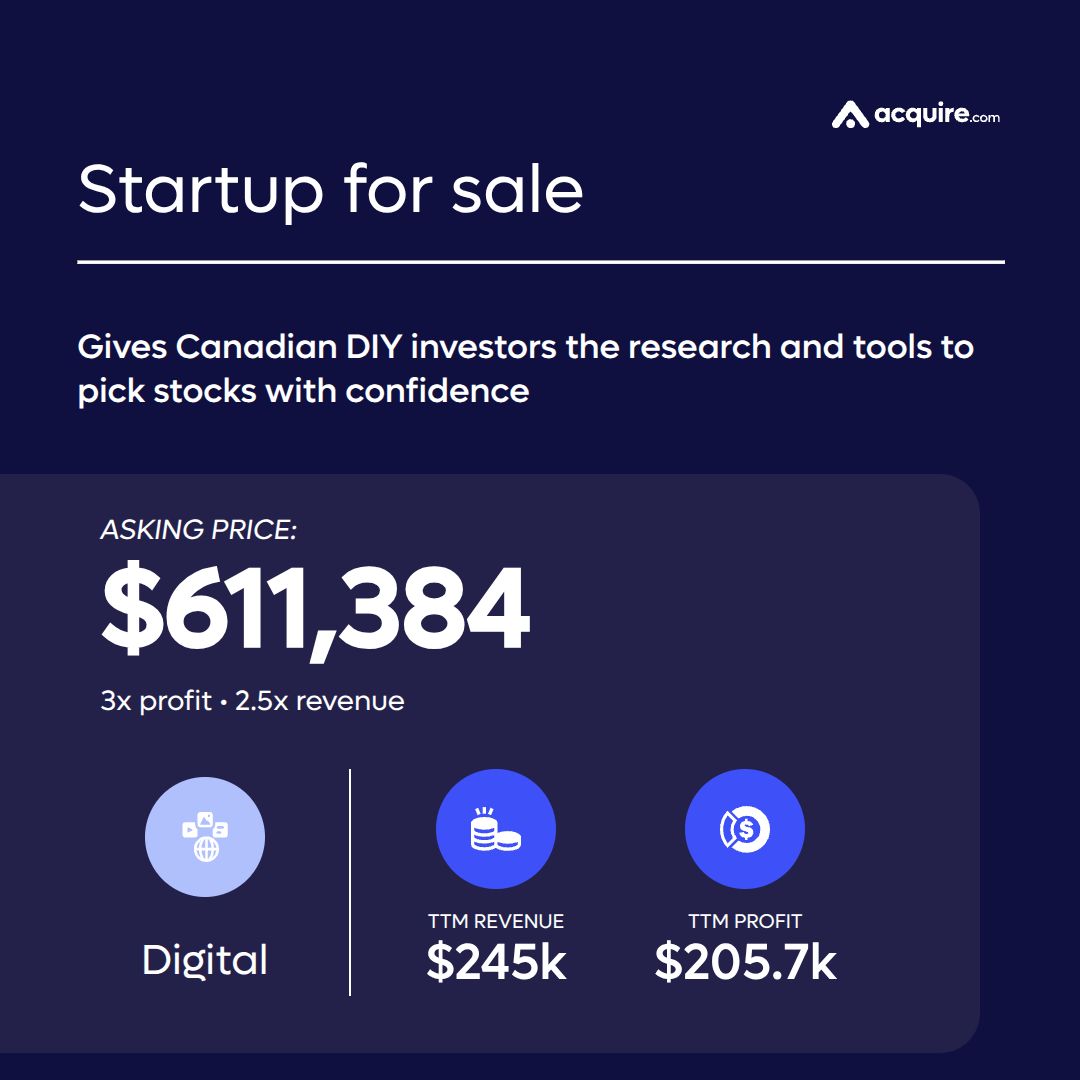
🔥 New Startup Listed 🔥 Digital | Gives Canadian DIY investors the research and tools to pick stocks with confidence | $245k TTM revenue
Asking Price: $611.4k
Contact the seller here: https://t.co/ei1zVwiu9q
A deal can look great on paper and still get messy in diligence.
Buyer fit. Terms. Documentation. Timing. That’s where momentum is won or lost.
Experienced M&A advisors can spot issues early and keep the deal moving.
If an exit is on your radar, talk to the Guided by Acquire team before you list: https://t.co/e3Yv79Vh4G
The most expensive thing a founder can own might be a startup they refuse to let go of, even when running it makes them completely miserable.
I've met founders running businesses that make $300K, $500K, even $1M a year in profit.
They've been running the same company for 8 years.
They don't enjoy the product anymore.
They're tired of managing employees.
Every Monday feels like another round of problems they've already solved 100 times.
But they keep going.
Because selling feels like quitting.
And after spending nearly a decade building something, walking away is a pretty difficult decision.
Here's what I find interesting.
Let's say your startup makes $500K a year in profit and someone offers you $2.5M to acquire it.
You could take that money, pay your taxes, invest the proceeds, and go build something you're actually excited about.
Or you could spend another five years running a business you've already mentally checked out of.
Maybe you make more money by keeping it.
Maybe the company doubles in value.
But what about the opportunity cost of those five years?
What could you have built with that time, money, and energy?
I think founders sometimes forget that they're allowed to be done.
You can build a successful company, make a bunch of money, and decide you want to do something else.
That's a pretty incredible position to be in.
And selling a business you spent years building is a hell of an accomplishment.
P.S. thinking about selling your startup? Our team will help you understand what your business is worth, prepare it for buyers, and guide you through the entire acquisition process. Meet the team here: https://t.co/6hqLR8REAe
🔥 New Startup Listed 🔥 Digital | Real-time EU scrapers for Pokémon, sneakers & collectibles, built for resellers | $141.6k TTM revenue
Asking Price: $180k
Contact the seller here: https://t.co/MvaVvFW2Aa