People don't always stay with a product because they love it. Sometimes they stay because they know exactly how to use it. The real competitor isn't always another product but the user's fear of coming out of comfort zone and having to learn again. #productmanagement
Anand is a USA-return hardware engineer.
He worked with some of the best companies in the US.
But he decided to come back home and build in India.
He designed this filter coffee machine from scratch.
We tested it.
And it works really well.
The design is also incredibly well thought out.
Our role was to help him find the right moulding tool maker to take the product forward.
And now, we're excited to see this go into production.
This is the kind of founder we want to work with more:
Indians who go abroad, learn from the best, come back home and build for India.
Build in BHARAT. 🇮🇳
@anandbalakrish
this is f*cking gold
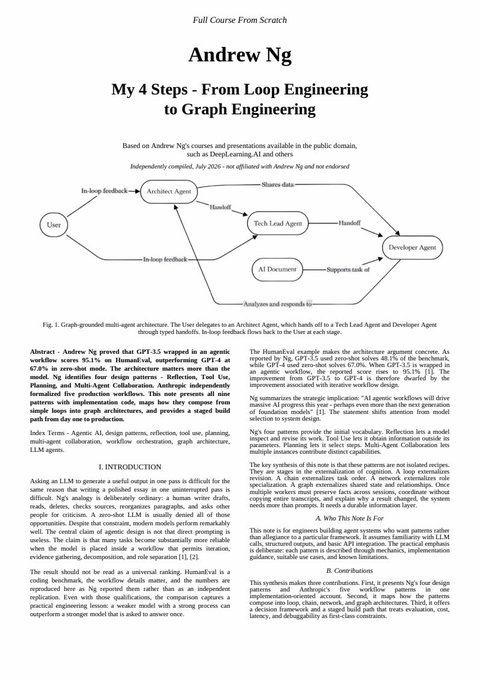
Andrew Ng put the whole loop-to-graph shift on one page.
Loop engineering was the last thing everyone learned. Graph engineering is what it turns into, and the whole thing changes the moment you stop running one loop and wire several into a graph.
I dropped it into my setup. The very first run was different.
Not a little better. A different kind of output.
Claude stopped handing me an answer and started handing me work a second agent had already torn apart.
Bookmark it before your feed swallows it.
Read it now, then check the guide below.
Google just released a free 2-hour course on full Graph Engineering.
How to go from one prompt to 100 agents running inside one graph:
17:44 - Build your first AI agent
39:30 - Run agents with loop engineering
1:12:38 - Turn agent loops into graphs
1:34:26 - Build agents that throttle themselves
1:55:05 - Orchestrate the full multi-agent system
Most people build one agent and stop there.
Google is teaching the full stack:
Prompt → Agents → Loops → Graphs → Multi-Agent Systems
Single agents are the old workflow.
Self-regulating agent graphs are the new one.
This 2-hour watch is worth more than most paid agent engineering courses.
Bookmark and watch it today
Then read the full architecture below ↓
Ex-Google Jeff Dean just released 1-hour lecture on full AI engineering: LLM → prompts → agent teams → graphs from 0% to 100%:
0% → 1:45 - LLM from scratch - that made Google
30% → 17:22 - how to actually use AI models
65% → 30:03 - prompt engineering
100% → 52:35 - one human coordinating 100 agents
this is 27 years of AI in Google compressed into one hour, by the person who lived it
watch it today - then read how to build graphs in the article below ↓
🚨A STEVE JOBS LO ECHARON DE APPLE
Y años después, en el MIT, soltó una charla de negocios de 60 minutos tan cruda y sin filtro que todavía nadie ha superado.
Sin discurso corporativo.
Sin pose.
Sin imagen que cuidar.
Solo la verdad brutal del tipo que ya había construido apple y estaba a punto de volver a hacerlo aún más grande.
Deja el scroll.
Esta noche mira esto en vez de Netflix.
Guárdalo. Vas a volver a él más de una vez.
ANDREW NG JUST OPEN-SOURCED HIS OWN AI COWORKER.
Stanford CS adjunct faculty. former head of Google Brain. 1,758,130 people follow him for AI.
the repo is called OpenWorker. what comes back isn't a chat - it's finished work.
13,267 stars. 17 days old. MIT.
what it does:
- you name the outcome you want
- it breaks that into steps and works across your own files
- 25+ integrations
- mention OpenWorker and a session opens on your desktop, the answer comes back in the thread
- runs on a schedule
- any model: OpenAI, Anthropic, Gemini, DeepSeek, Kimi, Grok and so on
your keys, tokens and conversations stay on your machine. the only cloud piece brokers OAuth.
-> https://t.co/ZASr40EKAE
everyone else is selling you an assistant that lives at their place. this one lives at yours.
save this before the next task you were about to do by hand.
Google Brain founder, Andrew Ng:
"Prompting will die in 6 months.
Loops and Graphs are what's replacing it."
In 2 hours, he shows exactly what the best engineers already build instead, and how to start building it yourself.
The missing piece most people skip: how to connect those loops into a graph that compounds every time it runs.
Watch it, then read the full guide on loops and graphs below.
Conocí a un Prompt Engineer que factura 1,2 millones de dólares al año.
Le pregunté cómo escribía prompts tan brutales…
Me mandó un curso gratis de Anthropic de solo 2 horas.
Lo terminé anoche.
A mitad del curso me quedé congelado.
Llevaba usando Claude mal todo este tiempo.
Completamente mal. 😳
Si usas Claude (aunque sea de vez en cuando)…
guarda este post.
Te va a cambiar para siempre cómo hablas con la IA.
Sam Altman (CEO of OpenAI):
"You no longer need to write prompts."
In just 38 minutes, he explains how to use ChatGPT at a level that most people can't even imagine.
It's a talk he gave to Stanford students. A friend sent me the recording last night.
After watching it, I realized I was only taking advantage of about 15% of what this tool can really do.
Watch it in full and then read the guide I leave below on how to create a system that prompts itself.
Follow @AnishJaitwar for more
Anthropic engineer:
"You're not supposed to prompt Claude. You're supposed to build a system that prompts itself."
In 45 minutes she shows exactly how Anthropic builds agents that remember, fix their own mistakes and get smarter with every run.
This beats any paid course on agents I've seen.
Watch it, then read the guide on building loops below.
instead of watching 2 hours of Netflix tonight, watch this Stanford lecture given by Anthropic engineers
it's the clearest explanation I've seen of how AI agents actually work
useful whether you've never touched AI in your life or have been building with it every day
i took the key ideas and turned them into a practical guide, with ready-to-copy prompts
watch it, then read the guide below on how to build a system that improves itself
In 1950:
SC list had 607 castes, today it has ~1200
ST list had 241 tribes, today it has 744
So where these castes are coming from?
If even after 70+ yrs, not a single caste has been uplifted via reservation, that itself shows "Reservation is a failed policy".
#EndReservation
I agree with her.
Over the last 1 year, I was observing BJP slacking.
Being a BJP supporter, I was disappointed that I might have to vote NOTA in 2029.
But, what these anti-nationals have done during the protest,
I know how important it is for India to continue with BJP.
If BJP isn't there, these greedy tukde tukde bastards will tear apart our country.
The cockroches didn't worry me.
What worried me was the unity between separatists, khalistanis, anti-socials, leftists etc.
Between India and its destruction, stands only one party - BJP.
We, millenials have seen this story in the past, in 2014, in 1997.
The genz hasn't seen the true face of leftists and Congress.
They will learn with time.
They think BJP is not working as it should.
They don't even realize how BJP has rescued India from the jaws of bankruptcy.
If anyone can read numbers, they can see what kind of ressurection BJP has done with PSUs, banks, OMCs.
If you compare it with the state UPA left it in, it's so much better. UPA had destroyed public sector - India's developmental backbone.
Please, the young people in your early 20s,
read history before you vote in 2029.
INC is not the party you think it is.
Analyze the facts. Read the numbers.
You will understand.
P.S: I am not paid media. I am not Godi Media. I am not andhbhakt. I am a well educated independent person, who has seen the pros and cons of both governments.
Arnab Goswami delivers a BOMB explosion! 🔥
Deep State funding of protests fully exposed as he demands hard answers from Abhijeet Dipke & team.. How did the American Embassy know in advance every detail of the mass mobilisation?
No more hiding. The truth is out. Republic is unstoppable!
#ArnabGoswami #AbhijeetDipke #CJPProtest #funding #RepublicWorld
The recent NEET controversy isn't just about a paper leak. It's a systems design problem.
One of the lessons from building software at scale is simple.
Any system with a single point of failure won't scale.
We've known this for decades. Large-scale Internet systems and modern software are built around this principle.
I think it is time we apply the same thinking to India's largest entrance examination.
The debate shouldn't stop at who gets punished after a paper leak. It should be about how we design a system for a entrance taken by more than 2 million students.
Good systems don't assume nothing will go wrong. They assume failures, bad actors and paper leaks will happen. The goal is to ensure one failure doesn't invalidate the entire system.
Here is one possible approach.
1. Distributed question paper setting
Instead of one national question paper, every state prepares a question paper. So every state has a role to play.
The papers are then randomly assigned to another state. Tamil Nadu's paper could go to Assam. Karnataka's paper could go to Punjab.
No state knows where its paper will finally be used.
Instead of one organisation becoming the single point of failure, responsibility is distributed.
2. State-based ranking
Students are ranked within their state for the state quota seats.
India can still have an overall topper, but admissions for state quota happen through the state rank list.
Every system has tradeoffs. So does the current one.
Q: Won't different states prepare papers with different difficulty levels?
Every year already has a different paper with a different difficulty level. Perfect uniformity has never existed.
The question is whether we should optimise for perfect uniformity or for a system that is resilient at India's scale.
Q: Won't students lose the ability to study in another state?
No.
Even today, around 85% of government medical seats are filled through the state quota. Only about 15% are filled through the All India Quota.
If most government seats are already filled through state quotas, why should the entire country depend on one question paper and one national ranking?
Q: Does this address the concerns raised by states like Tamil Nadu?
Many states, including Tamil Nadu, have argued for abolishing NEET. Whether that happens or not is a separate political debate.
If a common national entrance examination is here to stay, perhaps we are asking the wrong question.
Instead of debating NEET vs no NEET, can we decentralise the design of NEET itself?
Every system is a tradeoff.
The question isn't whether a system is perfect.
The question is which tradeoff scales better for India & What are the biggest trade-offs you see with a approach like this?
One thing is clear: the Delhi protesters want to plunge India into chaos, and stop the nation's progress. We must defeat this malicious agenda, which is aided and abetted by powers that want to destroy India.
We have a vibrant democracy and elections are the proper way to express our collective judgment.
Demands from the CJP stage :
1. Restoration of Article 370
2. Release of Umar Khalid
3. Mock Lord Rama
4. Ban RSS
5. Genocide of Brahmins (WTF)
6. FREE Kashmir
7. UP election Pitch
8. Modi's resignation
9. Scrap the New FCRA law