Important Questions:
1.Did they use computers at all to figure out which ballots to audit?
2. How many of those ballots came from mail in ballots, early voting and Election Day voting?
3. Were they actual paper ballots, or digital images of ballots that were audited?
4. What computers were used to aid the auditing process?
@mrosazza Actors and actresses are some of the least educated people in our society. Many never graduated high school; Very few graduated from college…which of course, isn’t saying much anyhow.
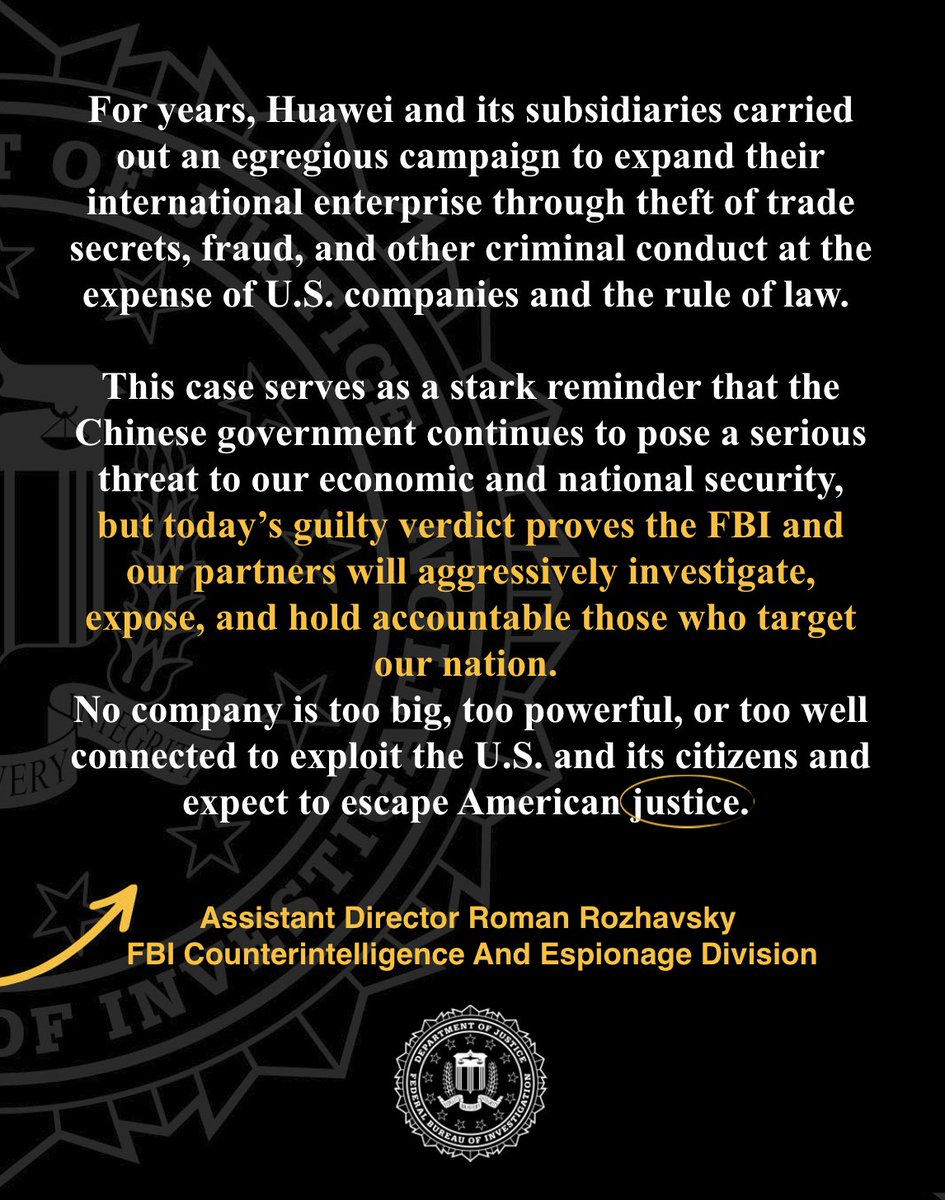
#NewsAlert from @NewYorkFBI: Chinese Tech Giant Huawei and Subsidiaries Convicted of Sanctions Violations, Fraud, Conspiracy to Steal Trade Secrets, and Money Laundering
As proven at trial, Huawei Technologies Co., Ltd. and several of its subsidiaries, including Chinese subsidiary Huawei Device Co. Ltd. (Huawei Device) and U.S. subsidiaries Futurewei Technologies Inc. (Futurewei) and Huawei Device USA Inc. (Huawei Device USA), engaged in a decades-long scheme to enrich Huawei and grow its telecommunications business, including in the United States, through criminal activities.
Read more about this #FBI investigation: https://t.co/bfBUmVjQf0
Crazy coincidence. Also a coincidence that Covid hit exactly 6 months before a presidential election, and was a great reason and opportunity to push for mail in ballots, and people were not allowed socializing, or go to church, or talk about things…
Also a random coincidence that Klaus Schwab put out a book called “The Great Reset” about worldwide government control over society.
@brivael@BrunoGaia2024 If you spend too much time in the “far right” bubble, when you try to go back to talk to the people on the left, everything they say will sound like unintelligent, irrational gibberish. Because it always was, all along, gibberish.
Socialists treat the economy like one pie. In their heads, the pie fell out of the sky onto the table, and the only problem left is that some greedy kids grabbed bigger slices than others.
Let me explain this in a way even a socialist or a five-year-old could understand.
Comrade, nobody found that pie. A baker made it. He paid for flour and an oven and worked all morning before the first slice existed. The baker bakes again tomorrow only if he keeps enough of the reward to make another pie worth the trouble.
Now cut his pie into equal slices for everybody and take it away from him, and the baker learns something: baking is a lousy deal. The next day fewer pies will show up, and a while later none will. Your "fair" division ends up dividing nothing.
When a baker gets better at baking, he takes no slice away from other people. He bakes more pies with the same effort, and the whole table eats better. Trade works the same way. When one kid swaps an apple for a friend's cookie, both kids walk home happier, and no pie got smaller.
According to the World Bank, the number of people living in extreme poverty fell from around 2.3 billion in 1990 to 811 million, while the world added billions of people. If the economy were a fixed pie, every new mouth at the table would have thinned everyone's slice. Instead, each new mouth came with hands, and those hands baked.
The Soviet Union spent nearly seventy years trying to slice the pie evenly and ended up with empty shelves and long lines for bread. Take the bakers away, and what remains is a table with an empty plate and a crowd of hungry grown-ups arguing over how to divide it.