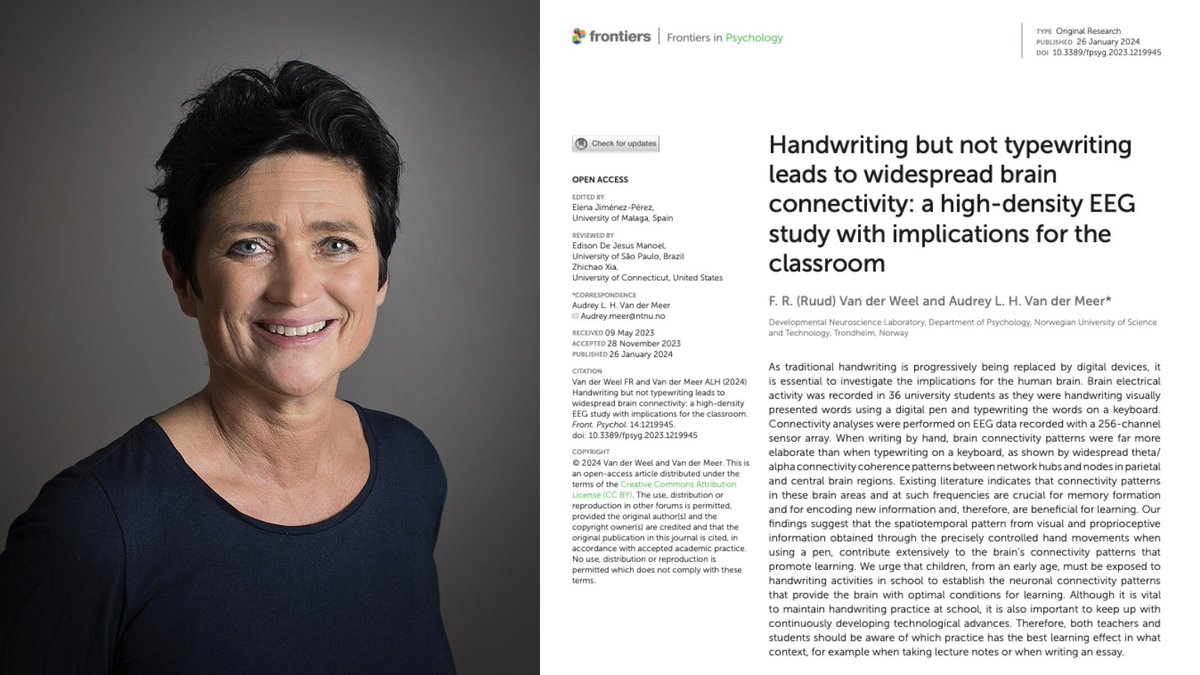
A Norwegian neuroscientist spent 20 years proving that the act of writing by hand changes the human brain in ways typing physically cannot, and almost nobody outside her field has read the paper.
Her name is Audrey van der Meer.
She runs a brain research lab in Trondheim, and the paper that closed the argument was published in 2024 in a journal called Frontiers in Psychology. The finding is brutal enough that it should have changed every classroom on Earth.
The experiment was simple. She recruited 36 university students and put each one in a cap with 256 sensors pressed against their scalp to record brain activity. Words flashed on a screen one at a time.
Sometimes the students wrote the word by hand on a touchscreen using a digital pen, and sometimes they typed the same word on a keyboard. Every neural response was recorded for the full five seconds the word stayed on screen.
Then her team looked at the part of the data most researchers had ignored for years, which is how different parts of the brain were communicating with each other during the task.
When the students wrote by hand, the brain lit up everywhere at once.
The regions responsible for memory, sensory integration, and the encoding of new information were all firing together in a coordinated pattern that spread across the entire cortex. The whole network was awake and connected.
When the same students typed the same word, that pattern collapsed almost completely.
Most of the brain went quiet, and the connections between regions that had been alive seconds earlier were nowhere to be found on the EEG.
Same word, same brain, same person, and two completely different neurological events.
The reason turned out to be something nobody had really paid attention to before her work. Writing by hand is not one motion but a sequence of thousands of tiny micro-movements coordinated with your eyes in real time, where each letter is a different shape that requires the brain to solve a slightly different spatial problem.
Your fingers, wrist, vision, and the parts of your brain that track position in space are all working together to produce one letter, then the next, then the next.
Typing throws all of that away. Every key on a keyboard requires the exact same finger motion regardless of which letter you are pressing, which means the brain has almost nothing to integrate and almost no problem to solve.
Van der Meer said it plainly in her interviews.
Pressing the same key with the same finger over and over does not stimulate the brain in any meaningful way, and she pointed out something that should scare every parent who handed their kid an iPad.
Children who learn to read and write on tablets often cannot tell letters like b and d apart, because they have never physically felt with their bodies what it takes to actually produce those letters on a page.
A decade before her, two researchers at Princeton ran the same fight using a completely different method and ended up at the same answer. Pam Mueller and Daniel Oppenheimer tested 327 students across three experiments, where half took notes on laptops with the internet disabled and half took notes by hand, before testing everyone on what they actually understood from the lectures they had watched.
The handwriting group won by a wide margin on every question that required real understanding rather than surface recall.
The reason was hiding in the transcripts of what the two groups had actually written down.
The laptop students typed almost word for word, capturing more total content but processing almost none of it as they went, while the handwriting students physically could not write fast enough to transcribe a lecture in real time, which forced them to listen carefully, decide what actually mattered, and put it in their own words on the page.
That single act of choosing what to keep was the learning itself, and the keyboard had quietly skipped the choosing and skipped the learning along with it.
Two studies. Two countries. Same answer.
Handwriting makes the brain work. Typing lets it coast.
Every note you have ever typed instead of written went into your brain through a thinner pipe. Every meeting, every book highlight, every idea you captured on your phone instead of on paper was processed at half depth.
You did not forget those things because your memory is bad. You forgot them because typing never woke the part of the brain that would have made them stick.
The fix is the thing your grandmother already knew.
Pick up a pen. Write the thing down. The slower road is the faster one.
The research behind this is wild. Your kitchen sponge has the same density of bacteria as human stool. German scientists found 54 billion bacterial cells per cubic centimeter inside used sponges in 2017. Yours is sitting right next to your sink.
Sponges are the perfect home for bacteria. They are wet, warm, full of food bits, and never fully dry between washes. Across all 14 sponges, the team found 362 different types of bacteria. The most common species include strains that can make people sick.
In 2011, the public health group NSF International swabbed 30 things in 22 American homes. The dirtiest object in the entire house was the kitchen sponge. It was dirtier than the toilet seat. 75% of the sponges tested positive for the kind of bacteria that includes Salmonella and E. coli.
Microwaving does not clean the sponge. The 2017 study found microwaved sponges had higher amounts of the smelliest, most harmful bacteria. Heat kills the weak strains. The strong ones survive and refill the sponge with no competition for space.
A 2021 Norwegian study compared kitchen sponges to dish brushes. In brushes, Salmonella was wiped out within three days because the bristles dry out between uses. In sponges, bacteria climbed to about a billion cells per sponge. The lead researcher told CNN that one kitchen sponge can hold more bacteria than there are people on Earth.
Three things actually work. Switch to a dish brush, because brushes dry fully between uses while sponges stay wet for hours. Replace your sponge every one to two weeks. Never leave it sitting wet in the sink. Norway and Denmark already do this by default, but most other countries don't.
The detergent is fine. Your sponge is the problem.
NEW: Youth sports is now costing parents as much as $25,000 a year.
Private equity and corporations are turning a childhood pastime into something only the wealthy can afford.
Youth sports has become a $40 billion industry, and the steep costs are crushing American families.
France made this wastefulness illegal cause it’s cruel and only causes more waste issues. Any food market or restaurant over 400 square meters has to donate all their good unsold food to charities and are fined if they do anything like this. That law should be applied everywhere
Remember when he used to make content like paying the adoption fees for all the animals at shelters and not leaving until every animal got adopted? Or when he would make videos just going to Walmart to buy everything homeless shelters asked for? That’s what made him popular and why people liked him. Now he just makes borderline psychological torture videos for fun and doesn’t even give everyone money anymore.
BREAKING: Just five minutes before Trump's announcement to halt the attacks on Iran, massive trades reportedly hit the market.
In one move, $1.5 billion in S&P 500 (ES) futures was bought while $192 million in oil (CL) futures was sold.
These orders were 4–6x larger than anything else at the time.
The trader seemingly made huge gains.
Unusual.
Americans seeing their honeypotted FBI Director partying and chugging beers like a clout obsessed bltch while the Epstein Files have been buried, the case has been closed, and the pedophiles are still out there trafficking children.
My mom has a little notebook where she writes down every movie she watches and a few of her thoughts about it. I told her about Letterboxd & she said "does everyone need an audience for their hobbies now?"
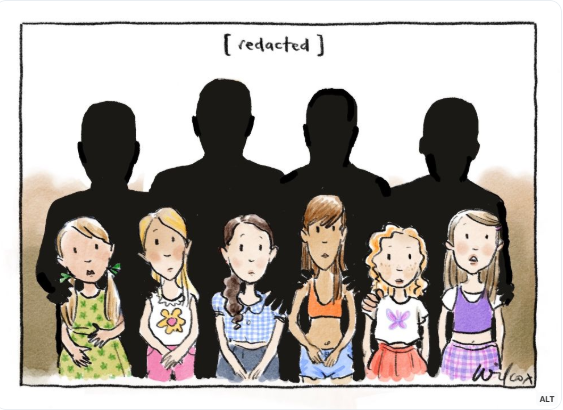
Yall do realize the kids in elementary school , middle and high school are also reading the Epstein files wondering why the fuck the adults aren’t protecting them.
Pretty telling that Cathy Wilcox has become a more effective political commentator with her powerful sketchings than most of her non-cartoonist colleagues who expend thousands more words every week but somehow manage to say very little or gutlessly avoid the issues altogether.