Hey folks! Excited to share that the CFP for our new HAIC conference is out. Help us spreading the word, submitting your work, and joining us for the conference! ❤️ ❤️
Looking at OpenAI releasing hundreds of mathematical results, I think we really have to lead with empathy here.
When you’ve spent years learning a craft, whether it’s writing code, creating illustrations or doing mathematics, and suddenly a lot of what you do seems to be a prompt away, of course that’s disorienting. Your craft is how you define yourself, what you’re proud of, where you find flow, sometimes the thing that gives your day meaning. It’s a huge part of your identity.
And I get how this can lead to a pretty nihilistic feeling, like you wake up one morning and think, okay, if everything can just be prompted into existence, what am I supposed to do now? What am I getting better at? What is all this effort for?
Software engineers have been grappling with this for a while, and I expect more people will experience it as AI keeps accelerating. Writing a book, creating a movie, maybe someday helping solve a disease, more and more things we’ve spent our lives learning could feel a prompt away.
I think that progress is amazing, and I’m 100% confident we’ll find harder problems to work on and new crafts to fall in love with. But knowing that intellectually doesn’t make the sense of loss disappear, especially when the change happens this fast and feels this brutal.
We can celebrate the breakthroughs and still care about the millions of people trying to figure out where they fit and what gives their life meaning in a world becoming this intelligent. “You can do more now” might be true, but people also need time to process what they feel they’ve lost.
We’re excited to announce the inaugural Human–AI Interaction Conference (HAIC 2027), taking place June 27–30, 2027, in Washington, DC (CFP coming soon at https://t.co/x6U5oKIP2n). HAIC focuses on translational impact, turning human–AI research into meaningful real-world impact.
This is my thesis: no one uses AI. I repeat, absolutely no one. We live in a bubble.
Even among my friends who pay for it, when I ask them to open ChatGPT and show me their queries, it’s the same handful of basic things.
Most don’t even know they can upload a photo and ask questions about it. Connecting Gmail so an agent can read and send emails blows their minds. An agent opening a browser and checking them into a flight? They’ve never even heard of it.
The massive challenge right now is adoption, and then getting people who already signed up to actually use what they’re paying for. Most have absolutely zero clue what’s possible.
Imagine the compute shortage when everyone starts using AI like the top 1% of users do today.
@AustinZHenley@ShriramKMurthi I'll never forget that one of the participants in the Mercury system's user study telling me that they would "religiously use the app on the toilet". There's definitely a market for ToiletDevs.
https://t.co/CYLyqDSQCv
Excel has quietly been Turing complete for a long time. Nice to see it now edging toward "AI complete"—SGD, attention, next-token prediction… all in cells.
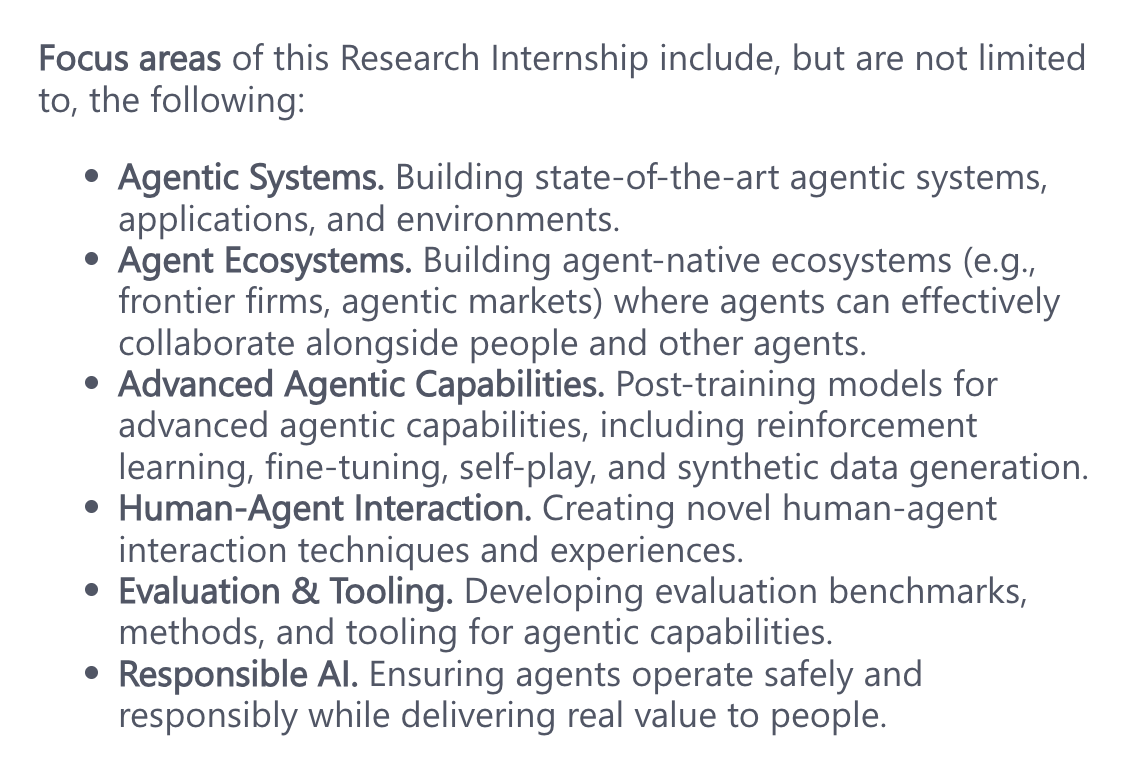
📢 AI Agent Internships at Microsoft Research AI Frontiers
If you want to work with me/our team apply below!
PhD student in CS/STEM + strong programming skills are a must.
https://t.co/sZ88oAU2eZ
What kind of AI does the world really want?
At @MicrosoftAI, we’re working towards Humanist Superintelligence (HSI): incredibly advanced AI capabilities that always work for, in service of, people and humanity.
And to do this we have formed the MAI Superintelligence Team.
@jdzamfi@bryanhaoenwang It's easy for me to imagine this paper being recognized years from now as being a flagship example of the movement toward "interfaces for navigating the unknown". Excellent work!
🎉Congrats to the 126 early-career scientists who have been awarded a Sloan Research Fellowship this year! These exceptional scholars are drawn from 51 institutions across the US and Canada, and represent the next generation of groundbreaking researchers. https://t.co/MO8q8eABH4
📢Hiring fully-funded PhD/Postdoc/MS interested in the broad human+AI research topic.
- How do humans work with humans (#CSCW)?
- How to design AI to support humans work with humans (#HumanCenteredAI)?
- How does AI work with humans? (#HumanAICollaboraiton)
I'm traveling at #cscw2024 from Nov 11 to 13, and at #EMNLP2024 from 13 to 16. Talk to me in person! or, you can also contact me via this form
https://t.co/kuS2EHvknc
@IanArawjo Koji Yatani's reference website on Statistical Methods for HCI Research is sufficient for most use-cases. It's also a stellar educational resource.
https://t.co/XT9mrn6eTh.