Learn Linux Hands-On: Local Port Forwarding via SSH 🧙♂️
- Access an internal debugging port through a tunnel https://t.co/MDF50NVC8G
- Reach a private VPC service via a bastion host https://t.co/1ghaTgBluO
- Reach a whole VPC through an SSH SOCKS proxy https://t.co/WsZMTDMlu0
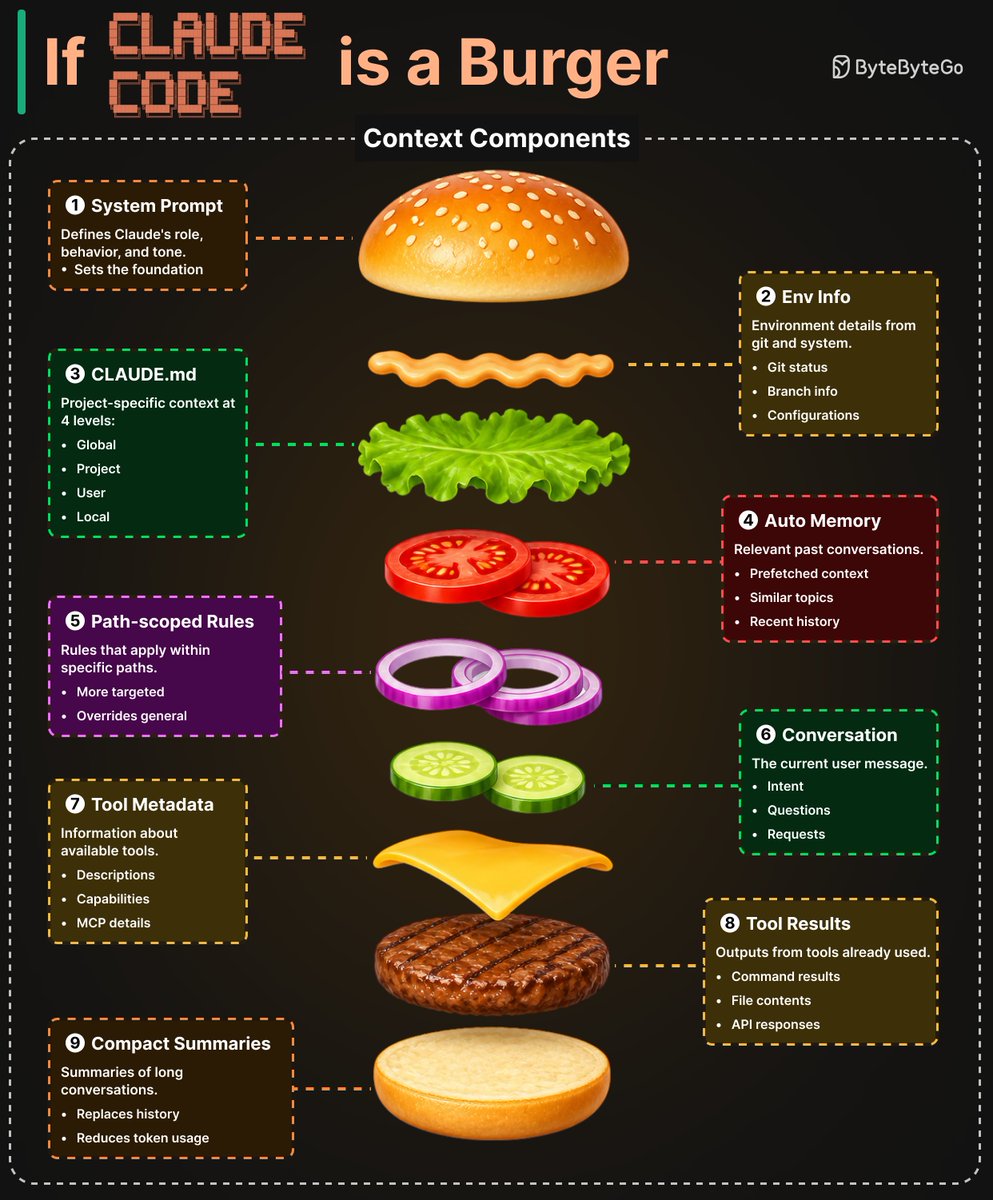
If Claude Code is a burger...
Before each model call, Claude Code assembles a context window from 9 distinct sources.
Think of it as a burger, each layer adds something different.
1. System Prompt: Defines Claude's role, behavior, and tone. This sets the foundation.
2. Environment Info: Git status, branch info, and current date. Pulled in via getSystemContext()
3. CLAUDE.md: A four-level instruction hierarchy: managed → user → project → local. Plain-text Markdown, so users can read, edit, and version-control everything the model sees.
4. Auto Memory: Contextually relevant memory entries prefetched asynchronously. An LLM scans memory-file headers and surfaces up to 5 relevant files on demand.
5. Path-scoped Rules: Conditional rules that load lazily when the agent reads files
6. Tool Metadata: Skill descriptions, MCP tool names, and deferred tool definitions.
7. Conversation History: Carried forward across iterations.
8. Tool Results: File reads, command outputs, and subagent summaries.
9. Compact Summaries: When history grows too long, older segments are replaced by model-generated summaries.
Everyone thinks AI is a paradigm shift.
That everything we've learned about building software in the last 20 years is for boomers.
I disagree. That's why I built Claude Code for Real Engineers.
It's a 2-week cohort that teaches AI Coding from first principles, all the way from requirements gathering to delegating to AFK agents.
It's the best course I've ever built.
It starts in 2 weeks, and for this week only it's 40% off.
https://t.co/PRTVBpP2oX
Good blog from @neciudan. It's great overview of the current state of JS and where the language is headed. Definitely worth a bookmark for your next dev break ☕️.
What's actually new in JavaScript (and what's coming next) https://t.co/W3ENeGvPAc
⚡Embedded Rust in Production 2025
- A list of embedded Rust projects used in production, as compiled by Anthony James Munns
- Includes both embedded linux as well as bare-metal/RTOS usage of Rust
- Not an exhaustive list, based on public info
https://t.co/mQ7OdO7F8A
@devsecurely explains how CORS enables cross-origin resource requests, enhancing functionality while ensuring security. Learn to configure CORS policies and set up secure rules to protect your website.
https://t.co/reEN9x3hTp
#web#softwaresecurity#cors
I'd never ask this question in an interview. The #1 leetcode question for interviews explicitly requires solving it in O(n).
That's why leetcode is bad. It makes you blindly believe that O(n) is faster, while in the real world, hashmaps and sets are always non-zero cost.
Cloudflare serves around 20% of the web with 46 million requests a second.
Surely they must have a lot of data.
Where do they store it?
Plain old PostgreSQL. 🐘
Around 15-20 clusters of them.
Each cluster consists of 3 servers split into two regions.
The primary region is where the writes go, and the secondary is the region which replicates this data asynchronously and serves reads.
Within those servers exist many databases owned by different people - they essentially offer multi tenancy. And as you know, multi-tenancy comes with a lot of challenges:
🤨 How do you decide which physical cluster a new tenant goes into?
As they say in CloudFlare - it’s more of an art than a science! 🎨👨🎨
Think twice. Deploy once. 👌
But it depends on a lot of questions that get asked, like:
• Is your data the source of truth, or can it be repopulated from elsewhere?
• How sensitive is the data? (PII, etc)
• What’s the expected traffic pattern - read heavy or write heavy?
• How long do you need to store the data for?
• How are your apps opening connections? (connection hungry apps can take a lot out of postgresql)
• What is the growth projected to be?
🐙 Well-Connected DB
Each connection in PostgreSQL is a new OS process.
This makes connections expensive!
As such, Cloudflare has to gatekeep the number of connections - and it does so, via PgBouncer. 🛡
🐬 PgBouncer pools a maximum server-side connections which it then allocates across tenants.
From there, it forwards queries to HAProxy, which load balances across Postgres’ primary and read replicas.
🆙 High Availability
The latency of an offline database is infinite.
To keep high availability, CloudFlare uses the Stolon cluster manager to replicate data across Postgres instances and elect leaders/failover under high load scenarios.
Health is tracked via a local health check on each node that periodically heartbeats to a distributed store like etcd.
🦏 Thundering Herd
When apps get redeployed, they re-initialize all their state and connect to the database at once. This can be costly, as they compete with other tenants for the same shared underlying physical resources.
Cloudflare implemented a way to handle this in their own fork of PgBouncer - it supports granular load shedding by either throttling or outright killing existing user connections.
🌞 No Clouds
CloudFlare does NOT run on the cloud. They deploy on bare metal instances in their own data centres without any virtualisation whatsoever.
As such, they hit some unique challenges here too:
• 🔥 natural disasters / cooling issues
e.g if your data centre in Portland overheats due to hot weather, your performance slows down.
You can say your “db is running hot”, but bad puns aside - your data infrastructure should be resilient to that.
• ⚡️ network partitions
It’s a lot of work to get to the bottom of diagnosing a network partition. You have to test connectivity between a lot of components.
Instead of being reactive, CloudFlare is proactive and runs chaos tests to test their distributed system’s behaviour in the presence of such partitions. 👌