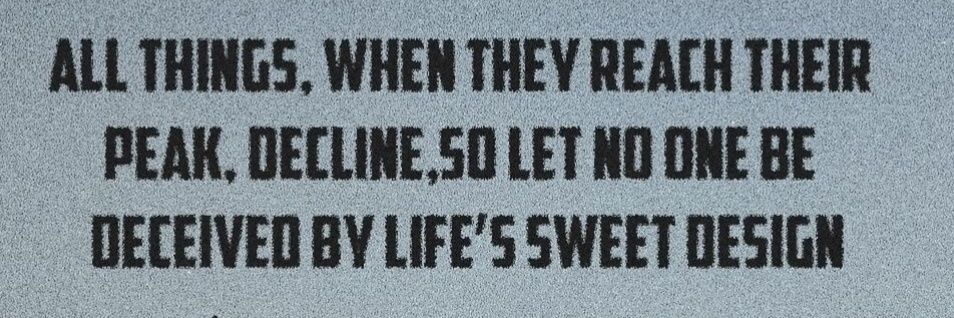
Khamenei was not removed against his will.
He ran the dismantling of the proxy network himself.
More of the IRGC command tier and more of the Shia armed network was destroyed while Khamenei was alive than in the six months after he died.
Qassem Soleimani was killed in January 2020.
Ismail Haniyeh was killed in Tehran in July 2024, inside Iran, at a state occasion, and Iran answered with JUST a mere statement.
Yahya Sinwar was killed in October 2024,
the Hezbollah command tier went the same year,
and the nuclear scientists went across the same period.
Every one of those losses happened while Khamenei held full authority to respond, and I said in the original exchange that every response was a press release and a promise of retribution that never arrived.
That record is now six years long.
If Khamenei was the obstacle to giving up the proxies, the giving up should have started after he died.
It had finished well before.
His death did not start a process that had been blocked, it closed one that was nearly complete.
There is a problem in arguing both halves of this.
The original accusation was that I take the mundane outcome, de-escalation and a return to managed tension.
But then the Supreme Leader of Iran was assassinated so both cannot be true at the same time.
Either the ordinary outcome arrived, or the single most extraordinary event available happened.
This is binary thinking; when you can't hold two paradoxical ideas as simultaneously being true.
A dead Supreme Leader fits both readings. Which for the record, I do not think he was killed.
Nevertheless, the killing by itself distinguishes nothing.
What distinguishes them is what the successor did with the office. Mojtaba was chosen by the Assembly of Experts on March 3 2026 and installed on March 8, and within weeks,
he authorized terms the faction whose name he carries had refused for three decades.
The proxies were not rebuilt, the IRGC did not get its autonomous authority back, and Iran moved toward KSA and UAE rather than away from them.
Every specific prediction attached to your sincerity argument failed. Khamenei sacrificed every general and scientists he raised over six years with absolutely no significant retaliation.
An 87-year-old with no personal future to protect is the one figure in the system who can carry out a change he will not live to see finished, because he carries none of the career risk that makes younger officials refuse. Khamenei had nothing left to lose personally and everything to lose watching the Islamic Republic collapse under sanctions.
The picture of Iranian leadership as ideologically pure and untouched by outside arrangement has a problem at a foundational level.
Khomeini spent his last exile at Neauphle-le-Chateau outside Paris from October 1978, with press access and an open line to Tehran that no cleric in exile receives by chance.
Carter, Callaghan, Giscard d'Estaing and Schmidt met at Guadeloupe in January 1979 and concluded the Shah could not be saved.
Carter sent General Robert Huyser to Tehran that same month to keep the Iranian military from mounting the coup that would have stopped Khomeini's return. The generals stood down, Khomeini landed in Tehran on February 1 1979, and the Islamic Republic began in conditions Washington helped set.
Khomeini was the enemy American foreign policy needed just as much as the alliance it needed with Israel.
Both of those policies are simultaneously coming to an end now and everyone can see it.
I said both were coming to an end back in October 2024.
And nothing has been truer since.
Before sentencing Omar al-Mukhtar to death, the Italian judge asked him:
— Did you fight against the Italian state?
Omar al-Mukhtar: Yes.
— Did you encourage people to fight against the Italian state?
Omar al-Mukhtar: Yes.
— How many years did you fight against Italy?
Omar al-Mukhtar: About 20 years.
— Do you regret what you did?
Omar al-Mukhtar: No.
— Do you know that you will be executed?
Omar al-Mukhtar: Yes.
Surprised, the judge said:
— It is very sad for a man like you to meet such an end…
Omar al-Mukhtar replied:
— On the contrary! This is the most beautiful way for my life to end.
The judge then offered to acquit him and send him into exile if he wrote a declaration ordering the resistance fighters to end their struggle. Omar al-Mukhtar responded with his famous words:
“These fingers, which testify in every prayer that there is no god but Allah and that Muhammad (peace be upon him) is His Messenger, can never write anything false! We do not surrender: we either win or die. Even if we die, we win, while you lose. The bitter truth is that you will understand this only when you die—and by then, it will be of no use to you!”
@PsxAnalysis Your updates regarding PSX stocks with the help of such elaborate charts has been very helpful. If possible,please share updates in form of such charts in future too.
Vladimir Putin was put in charge of Russia at the end of 1999,
to protect the men who had just sold the country for parts.
But within four years, he had jailed the richest one, forced two others out of the country, and taken the oil back.
Not many know this. Because the West has done a fantastic job painting a very different picture of Putin.
To understand him, you have to know what the 1990s did to Russia. Prices went up about 2,500% in 1992, and everything an ordinary family had saved was worth nothing within a year.
Life expectancy for Russian men fell from 64 to 57, which normally only happens in a war, and there was no war.
By 2000, 42 million Russians were officially poor. Nearly a third of the country.
None of this was an accident. Western advisers helped design it, and the International Monetary Fund lent Russia money on the condition that it kept going. In 1995 the government handed twelve of Russia's biggest companies to a small group of bankers for about $800 million all together, a tiny fraction of what they were worth.
So when Russians who lived through that hear Western leaders talk about freedom and open markets, they do not hear an idea. They remember the years their money became worthless, their factories were given away to men who became billionaires overnight, and their fathers died at 57.
President Boris Yeltsin and the people around him chose Putin because they thought he would be easy to manage and would leave the new owners alone.
In July 2000 he called those owners into a room and told them they could keep their companies as long as they stayed out of politics.
One of them refused.
Mikhail Khodorkovsky was the richest man in Russia, he funded opposition parties, and he opened talks to sell a large piece of his oil company to an American oil giant. He was arrested in 2003, his company was taken apart and absorbed by the state, and two men who owned television channels left the country. Nobody needed the rule explained twice.
Then, Putin paid Russia's debts instead of borrowing more. In 2006 he cleared the last of the old Soviet Union's debt in a single payment of $23.7 billion, years ahead of schedule, and kept government borrowing low for fifteen years after that.
He also ruled that whenever oil sold above a set price, the extra money went into a national savings account instead of being spent. Poverty fell from nearly a third of the country in 2000 to 7% by 2024.
Much of that was oil getting expensive rather than anything clever, but Russia stopped being a place where men died at 57.
What the West misread about him had nothing to do with communism or empire. Putin wanted Western money, Western machines, and Western customers.
What he would not accept was a deal where foreigners owned the oil fields, the oil was priced in somebody else's currency, and the payments ran through somebody else's banks, because that hands the other side a switch they can turn off whenever they want.
He said this out loud at a conference in Munich in 2007, and Western officials heard it as a threat rather than as information.
Ukraine was not a surprise either. In April 2008, NATO announced that Ukraine and Georgia "will become members." Two months earlier, America's own ambassador in Moscow, William Burns, who later ran the CIA, had warned Washington that Russia would not negotiate on this and would treat it as a military threat.
Washington went ahead anyway. Russian troops were in Georgia by August.
Russia took Crimea in 2014. The Minsk agreements were supposed to settle the fighting that followed in eastern Ukraine, and Germany and France signed them as the outside powers who would hold both sides to their word.
In December 2022 Angela Merkel, Germany's chancellor at the time, said the real purpose of Minsk had been to buy Ukraine time to prepare. France's president then said the same thing days later.
So who came out ahead in this Ukraine war?
European factories ran for thirty years on cheap Russian gas that arrived by pipeline, and it is gone. Somebody blew up the Nord Stream pipelines in September 2022, Denmark and Sweden closed their investigations without charging anyone, and no country has ever been held responsible.
Europe now buys American gas that arrives frozen on ships and pays far more for it. Its chemical and fertilizer plants are shutting or moving abroad, many to the United States, and its governments are buying weapons again, mostly from the American arms companies that spent twenty years selling into the Middle East.
Russia had $300 billion of savings sitting in Western accounts, and it was frozen in Belgium. Every central bank outside the West watched that and learned their money can be taken.
Russian oil goes to China and India now, sold at roughly a quarter below the market price, and the refineries buying it keep that difference.
Russia's central bank has interest rates at 14%, which crushes anyone who needs to borrow, and expects the economy to grow by close to nothing this year.
Russia also sold 44 tonnes of gold in the first six months of 2026, after twenty-four years of buying it and almost never selling. The spendable part of that national savings account has fallen from $113.5 billion in 2022 to $51.6 billion. He is paying for this war by selling the savings he built to prove Russia could never be starved out.
How the war ends is also already written down.
In December 2025 Zelensky published a peace plan with twenty points worked out with Washington, and eighteen of them were agreed.
The two that were not agreed are who controls the Zaporizhzhia nuclear power station, and who controls the Donbas region.
On the power station, the American proposal is that the United States, Russia, and Ukraine each own a third, with Americans running it.
On Donbas, the American proposal is that Ukrainian troops leave the part they still hold and the area becomes a free economic zone. Russia calls that same land a demilitarized zone. Two names for one thing, so both governments can sign without admitting what they gave up.
And about 40% of Ukraine's mineral wealth is buried under land Russia already occupies, including two of its four large lithium deposits. Ukraine's own government values what sits under occupied ground at more than $350 billion.
Putin has publicly invited American companies to come and mine those exact deposits with him.
So this does not end with America taking the minerals and Russia taking the land, because the minerals are under the land. Russia keeps the land, and pays for the world accepting that by letting American companies dig up what is underneath.
Ukraine is the only country at that table that owns less in every version of the plan.
@LongshotIbrahim I wouldn't insist &never did, but in my dental school days, majority of our teachers advised us to always introduce ourselves as Dr. *our name*, so on&so forth, and yes, it did & does help in getting people to respect/regard/take u seriously, somehow.
Dear @joerogan I am afraid you have been fed a pack of nonsense by this lady. She is wrong on every single one of her "facts". I have been to Afghanistan 5x & have the evidence, should you like to discus it ([email protected]) @Aafiamovement
The 'boys' are onto their favorite trick,yet again-make a mess out of everything, and when things start getting out of hand, blame everyone but themselves. Whether its '71,' 88, 2008 or 2022 or 2026, its the same playbook. Not that civilians, especially political bigwigs, are 1/2
Even young women are not spared from protesting against killings in #AJK at Kashmir solidarity march in Lahore.I never thought I would live to see the day when Pakistani police will arrest those protesting against violence in https://t.co/APa1O0yZ7a the UN Pakistan has consistently protested against atrocities by Indian authorities against Kashmiris.What will we say now?
BLA terrorists are stopping vehicles in Balochistan to extort money from drivers. these activities expose the group's criminal methods. Behind its claims of "freedom," the group's actions are to revolve around extortion, spreading fear, and targeting innocent civilians.
#Balochistan #BLA #CounterTerrorism #NationalSecurity
#WATCH: Students and residents of Pakistan’s capital, Islamabad, protest in solidarity with Kashmir on Friday, following weeks of unrest and clashes between protesters and law enforcement in Azad Kashmir. https://t.co/QDqsWIHq6u
Commander Farooq who fought in Afghanistan jihad against Soviets and then in Kashmir jihad against Indians has been killed by his own army. A microcosm of where the current regime and military have gone.