Marc Andreessen (@pmarca): Airbnb could have been boutique booking software. Uber could have been taxi dispatch software. Tesla could have been self-driving software.
They decided to take over the entire industry instead:
"Silicon Valley between 1950 and 2010 was primarily just in the tools business.
You'd build a tool like an operating system or a disk drive, sell it to people, and they'd figure out what to do with it.
Then something changed.
Alternate universe Airbnb is just boutique booking software. A tiny little business building spreadsheet software. But Brian Chesky decided: we're going to go into the hospitality business and compete with hotels directly.
Uber and Lyft in the old world were just taxi dispatch software. In the new world, they're full transportation providers.
Tesla in the old world would have just been software for self-driving cars. In the new world, it builds the entire car.
Facebook, same thing. Prior to Facebook, if you built online ad software, you were selling it to media companies. Mark said: no. We're just going to beat the media company. We're going to build the entire thing.
That was the pivot point when the Valley's ambitions went from just building tools to going directly into incumbent industries.
And then AI makes that crystal clear. The winning AI companies are raising billions, tens of billions, in some cases hundreds of billions of dollars.
The old world of $10,000,000 or $50,000,000 — where VCs tap out — is just not relevant anymore."
As an ex-Viv (w/ Siri team) eng, let me help ease everyone's future trauma as well with the Fundamentals of Assisted Intelligence.
Make no mistake, OpenAI is building a new kind of computer, beyond just an LLM for a middleware / frontend. Key parts they'll need to pull it off:
Persistent User Preferences:
- The biggest unlock of assistants has always been to deeply understand what someone wants in the most specific way.
- This is the "wow" moment where computers stop being scary and start feeling truly helpful.
- We did this in 2016 on Viv (https://t.co/aQSbFfRNde) when our AI knew what you liked for each and every service you used via Viv and mixed that in with context like what kind of flowers you told us your mom liked.
- This will need to include access to your personal information to infer preference as well.
External, Real-time Data:
- 50% of the utility of an LLM comes from the base training and RLHF fine-tuning; but much more comes from extending its available data with external sources.
- Zapier, Airbyte and others will help, but expect deep integration with 3rd party apps / data pipelines.
- "Chat w/ PDF" is a tiny, tiny part of this. If you're only building that, think much bigger.
Actual Computing on a Virtual Machines:
- Context windows are limiting, so AI providers will continue benefiting from running tasks directly on a Python or Node/Deno virtual env so it can consume huge amounts of data just like a computer today can.
- Today these are short-lived envs used by Data Analyst / Julius, but over time they'll become a new type of Dropbox where your data is persisted long term for additional processing or cross-file inference / insights.
Agent Task / Flow Planning:
- Planning can't function without intent. Understanding intent has always been a holy grail, and LLMs finally helped us unlock what we spent years approximating at Viv with NLP tricks.
- Once intent is accurate, planning can start. Creating an agent planner is incredibly nuanced and will take significant integration with user preferences, 3rd party data sets, knowledge of compute capabilities, etc.
- The bulk of the real magic of Viv was the dynamic planner / mixer that would pull all these data and APIs together and generate both a workflow AND dynamic UI on top of them for a normal consumer to execute.
An App Store of Experts:
- Apple initially made the mistake of building a closed app store; then realized they could monetize a cornucopia of creativity if they opened it.
- Regardless of OpenAI saying they're focused on ChatGPT and only ChatGPT, it's inevitable they'll rescope it and enable a long tail of specialized assistants.
- Builders will be able to compose multiple tools together into workflows that can specialize
- And AIs over time will be able to auto-compose these tools together as well, learning from the builders that came before them.
Persistent, Contextual Memory:
- Embeddings are helpful, but they are missing fundamental parts like context switching, conversational centroids, summarization, enrichment, etc.
- Most of the cost of LLMs today comes from prompts, but as history and persistence is embedded and the inference cached, this will unlock the ability to have long term memory with pointers to critical subjects, topics, feelings, tone, etc.
- Core memory is just the beginning. We still need all the rich information our minds conjure when we think about a past sunset, a breakup, a scientific understanding, or sensitive context for people we interact with.
Long Polling Tasks:
- "Agent" is a loaded word, but part of the intent is to have tasks that can be scheduled and self-completing regardless of the time horizon required.
- E.g. "Let me know when flights from Montréal to Hawaii are less than $500"
- This will require coordination of compute across API providers, as well as virtual envs in the cloud.
Dynamic UI:
- Chat is not the final, end-all interface. There's a reason apps have affordances like buttons, date pickers, images. It simplifies, clarifies.
- AI will be a copilot, but to be a copilot it'll need to adjust to what works best for a given user. The future is personalized as optimizations require it, so UI will be dynamic.
API & Tool Composition:
- Expect AIs to generate custom "apps" in the future where we can build our own workflows and compose together APIs, without waiting for a big startup to do so.
- Fewer apps and startups will be needed to generate frontends, and AI will be better at composing an array of tools and APIs together coupled with a gas fee / tax.
Assistant-to-Assistant Interaction:
- There will be countless assistants in the future, with each assisting humans and other assistants towards some greater intent.
- Alongside this, assistants will need to learn to interface across text, APIs, file systems, and other modalities used both by agents / startups and humans as integration flows deeper into our world.
Plugin / Tool Stores:
- Specialized assistants can only be made possible by composing tools, APIs, prompts, data, preferences, and much more.
- The current plugin store is super early days, so expect much more work to come, and expect many of those plugins to be rolled in-house as they become more mission critical.
And this is just a 10 minute brain dump; much, much more is needed behind the scenes including internet search and scraping, community (for intent, building, RLHF, etc), dynamic API generators and connectors, gas fees, tool builders, ingestion via glasses / earbuds / etc. If you think it's too late to be in AI, just know the above is about 25% of what it'll actually take, with much more to come as we iterate and get even more creative.
We're in the early days of building parts of this at @FastlaneAI but with a different understanding: OpenAI will never be the best at everything. So we want to let you use the best AIs in the world, regardless of who builds them (that could be you!). Come join the fun!
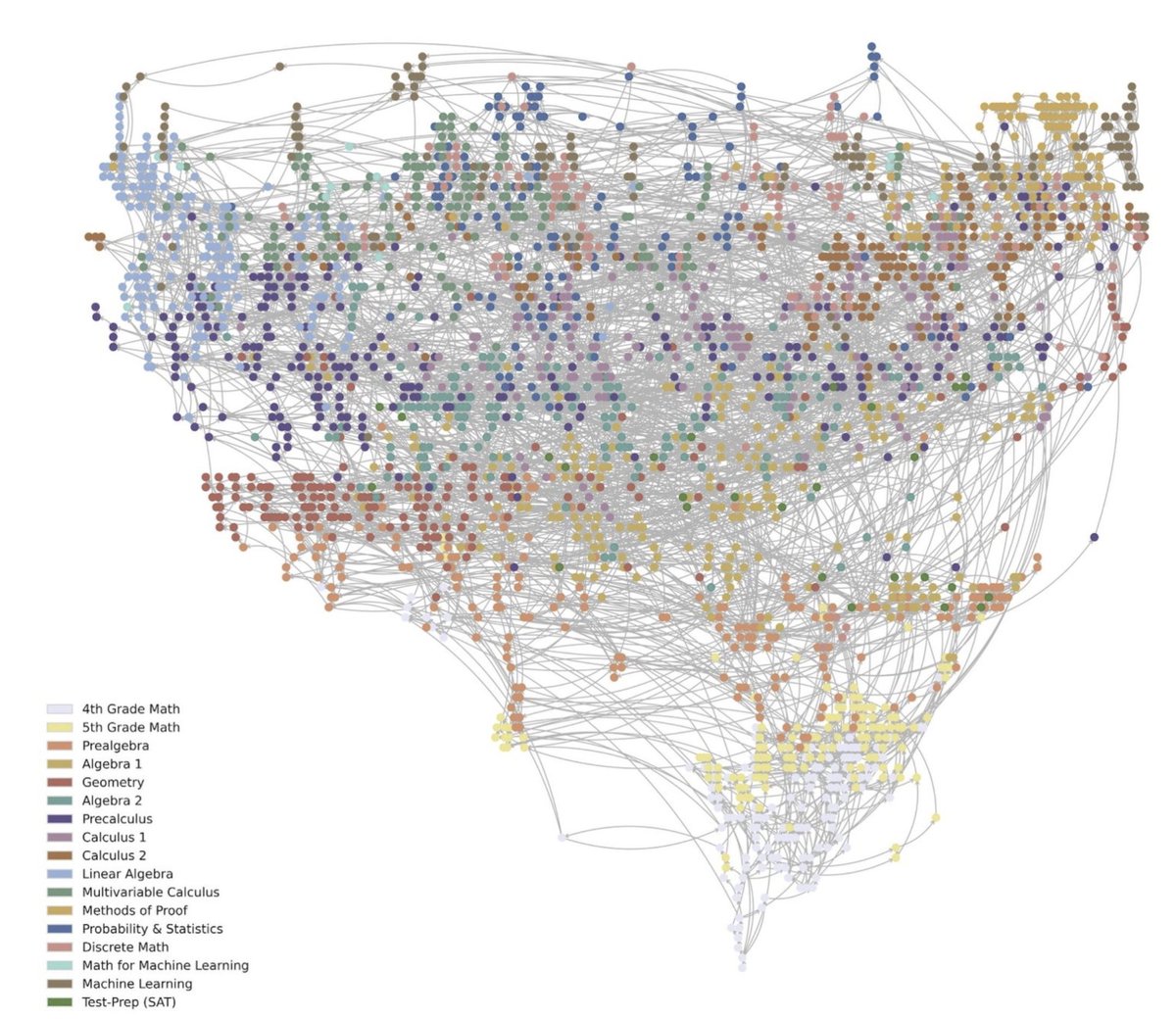
For anyone wondering how a third-grader can complete six years' worth of math in a single year AND score a 5 on the AP Calculus exam.
This knowledge graph spans 3,000 math topics, from 4th grade to the university level, providing the perfect basis for mastery learning.
Students can go as fast or far as they want! There are no restrictions whatsoever. The only requirement is that they must demonstrate mastery of each topic before moving on to the next.
Kids are capable of incredible things when given that kind of freedom and support.
@JohnApplebyLD@spikedonline No, most people DO NOT. You live in a bubble.
Furthermore the government is not mandated to restrict the freedoms of some people due to the feelings of most people; they have constitutional mandates that state exactly the opposite.
@komonews WA state supreme court willing to ignore both the ballot initiative and the State constitution. 5 seats are up for grabs in the election.
https://t.co/ib6NmRxhFf
It’s insufficient protection against the ballot initiative passing and being ignored.
Everyone needs to know the names of the Supreme Court candidates likely to uphold both the initiative and the constitutional protections against income taxes.
The latter is needed to again challenge the unconstitutional capital gains tax, and future unconstitutional taxes.
https://t.co/iqDKwX9Zd8
@shiri_shh Land isn’t running out of room, it’s running out of frontiers and spaces free from harassment by socialists, communists, NIMBYs, politicians and other parasites.
You use both, obviously. You must validate at the edges, you must validate all the way down the stack.
JWTs signed by both client and server FTW, all modern clients have easy PKI and probably a Secure Enclave.
Signed data structures for anything important, multi-factor signing for the real important and multi-party signing for the uber important.
Dude literally solved brain to computer communication for paraplegic like conditions, yet some math and economic illiterate envious asshole still wants to hate.
Solve one problem you peon, not all problems require wealth to solve, and the majority of problems are not solved by wealth, certainly not wealth alone.
JEFF BEZOS JUST EMERGED FROM STEALTH WITH A $41 BILLION AI STARTUP CALLED PROMETHEUS
$12 billion raised. Valued at $41 billion. Coming out of stealth today.
The backers: Bezos personally, JPMorgan, BlackRock, Goldman Sachs, DST Global, and Arch Venture Partners.
The mission: do for engineering and manufacturing what large language models did for text.
Bezos is calling it an "artificial general engineer." Instead of training on words from the internet, Prometheus ingests data from the physical world to accelerate the manufacturing of skyscrapers, smartphones, jet engines, and everything in between.
In Bezos' own words: "Something that today was going to take 100 engineers 10 years to build, if you can change that to taking 10 engineers one year to build, you're just going to get way more things built."
This is Bezos' first CEO role since stepping down from Amazon in 2021. He's co-leading it with Vik Bajaj, former Google X executive.
(Source Semafor)
I just got back from SF and I FEEL INSPIRED.
I spent 5 days with frontier AI model teams, AI startup founders, and 3 billionaires.
My takeaways:
1. I had lunch with 3 billionaires. All of them are buying SaaS companies and rebuilding them agent-first. They were deeply inspired by Bending Spoons and Ryan Cohen's eBay deal. Buy the company, cut the headcount, rebuild the tech, add agents, add features, make more valuable experience, raise prices.
2. The frontier model companies are hungry for usage data from the field. They can see API calls and token counts. They can't see the actual workflows. If you're deep in a niche using these models in ways the model companies haven't seen, that understanding is incredibly valuable. Usage intelligence is the new alpha.
3. Consumer AI is massively underbuilt. Every billboard in SF is either B2B inference infrastructure or vertical agent companies. The entire city is optimized for enterprise. Meanwhile you have companies like Cal AI doing $50M ARR in 18 months as a consumer app. I met with a cool few teams doing consumer AI (@paulscherer / @ekuyda)
4. MCP came up in literally every conversation. The companies exposing their product as MCP endpoints are getting pulled into deals they never pitched for. The ones that aren't are becoming invisible to agents. This is the new SEO. If agents can't find you, you don't exist. Building products for agents is the new zeitgeist in general.
5. Not uncommon for hot seed rounds to be $25-50 million valuations. I saw a Series A at $450 million
6. If I had a dollar every time someone mentioned "forward-deployed engineer" this trip I could have funded a seed round. It's the hottest role in SF right now. The person who sits between the agent and the customer, making sure everything actually works.
7. The mood around open source shifted. A year ago it felt like open source was chasing the frontier models. Now founders are telling me Gemma and DeepSeek are good enough for 80% of what they need at a fraction of the cost. The "which model do you use" conversation is being replaced by "which model for which task." Model loyalty kinda feels dead.
8. Voice agents came up more than I expected. Multiple founders told me voice is the interface for the next billion users. The billion people who will never type a prompt will absolutely talk to one.
9. The Obsidian community in SF is weirdly intense. Multiple founders showed me their vaults unprompted. Like showing someone your home gym. It's a flex now. The quality of your knowledge base (second brain?) is becoming a status symbol among builders.
10. Maybe it was just the people I met but the age of the founders is shifting. I met more founders over 40 this trip than any trip before and more founders under age 21 than ever before. Founders getting older and younger at the same time.
11. I spoke to a lot of fast-growing startups, VCs and frontier models who are hiring content creators right now.
12. The restaurant scene in SF is actually better than it's been in years. Founders are going out more. Alcohol is out, not surprisingly.
13. SF doesn't feel like the only place anymore. We all have access to the same frontier models. We all read the same X feed. A founder in NYC or Lagos is calling the same APIs as a founder in SoMa. So in the past it felt like SF was always lightyears ahead, doesn't feel that way anymore. It's okay not to live in SF and have BIG DREAMS.
14. The coworking spaces in SF are half empty but the coffee shops are packed. People want to be around people. I had a few startup ideas here....
15. Walking around the Mission I noticed something: the street-level businesses, the taquerias, the barbershops, the laundromats, none of them use any AI at all.
16. I heard the phrase "agent debt" for the first time. Like technical debt but for agents. When you hack together an agent workflow fast and never clean it up, the system prompts conflict, the memory gets polluted, the tools overlap. 6 months later the agent is doing weird things and nobody knows why lol.
17. Met a few people who carry two phones now. One for personal. One that's basically an agent terminal running Telegram or iMessage connections to their agent fleet.
It's always amazing to get that dose of inspiration in SF. I FEEL INSPIRED.
But I'm so happy to be back home, locked in and building.
We're 12-18 months into a shift that will take 15 years to play out. The urgency in every conversation was real.
What an incredible time to be building.
@jakethornton@ililic Accept a 40 character password on signup, a 20 character password on login, and ensure the max password length is stated as 16 characters but is actually 14 characters.
List the disallowed special characters as the allowed ones.
@jmwind Do people not realize you mount a lot already in file systems? Like no, it’s not a funny word.
Reminds me of the guy who always laughed when I talked about sharding.