Over the past week, I’ve been overwhelmed by the love and support of friends, industry colleagues, and people I've never met. Thank you to everyone who has shown kindness to my family and me. It means the world to me.
I came to the United States 53 years ago, and becoming an American citizen is one of the greatest gifts and proudest moments of my life. NVIDIA has been my life’s work. Building it into the company it is today alongside my colleagues has been a privilege and an honor. Nowhere but in America could a company like NVIDIA be possible. I love our country, and I love NVIDIA.
I did not live up to the standards expected of everyone at NVIDIA, and I have made serious mistakes in my personal life. I created problems for the Board that I deeply regret. I own my mistakes completely, and I am committed to cooperating with the Board’s independent investigation.
Since my departure, I’ve seen an outpouring of calls from NVIDIA’s employees, investors, business partners, and customers for me to return as CEO. Many continue to reach out to me directly as the company navigates complex technology, market, competitive, and geopolitical dynamics. NVIDIA is a once-in-a-generation company. If the Board of Directors decides that my return is in the best interest of our shareholders, our employees, the company, and America, I would be honored to answer these calls and return as CEO.
Thank you again to everyone who has shared their good wishes. I am profoundly humbled by your support. To my family: I love you, and I will spend the rest of my life being worthy of yours.
Jensen
Announcing a major milestone achieved by my team @GoogleDeepMind: we have proven key security properties of the machine code underlying the Signal messaging protocol. This is the first time the actual production code of a widely deployed protocol has been formally verified – by any method, with or without AI – and at this depth.
More than a research breakthrough, it’s a prime example of how frontier AI can be a force multiplier to counter the speed and scale of modern cyber threats.
Formal verification offers a higher standard of security; however, it’s extremely complex and time consuming, which is why in many cases it’s considered to be impractical. Similar efforts could take teams decades of combined effort. We did it in a month’s time.
Using AlphaProof Code, Google DeepMind's new agentic framework for formal verification that runs on LLMs including Gemini Carbon, we verified the Signal protocol down to the actual code running on devices. This milestone lays the groundwork for a future in which vital systems, from medical device firmware to power grid software, ship with mathematical proof that their protections work.
Reaching that future will take continued research from our community. In that spirit, we're open-sourcing our formal specifications and verification artifacts so others can build on this work.
On a personal note, this moment is of deep significance to me. I started my own research journey more than two decades ago as an intern working on checking the consistency of complex software systems. Seeing this grand challenge made practical with modern AI is extraordinary.
I'm extremely proud of my team members: Swarat Chaudhuri, Andrew Ferraiuolo, Anton Kovsharov, Tej Chajed, Sam Schlesinger, Karn Seth, Jonathan Katz, and Charles Sutton for taking on this grand challenge and delivering, and grateful to the Signal team for their partnership.
https://t.co/kN1eRYQ8fF
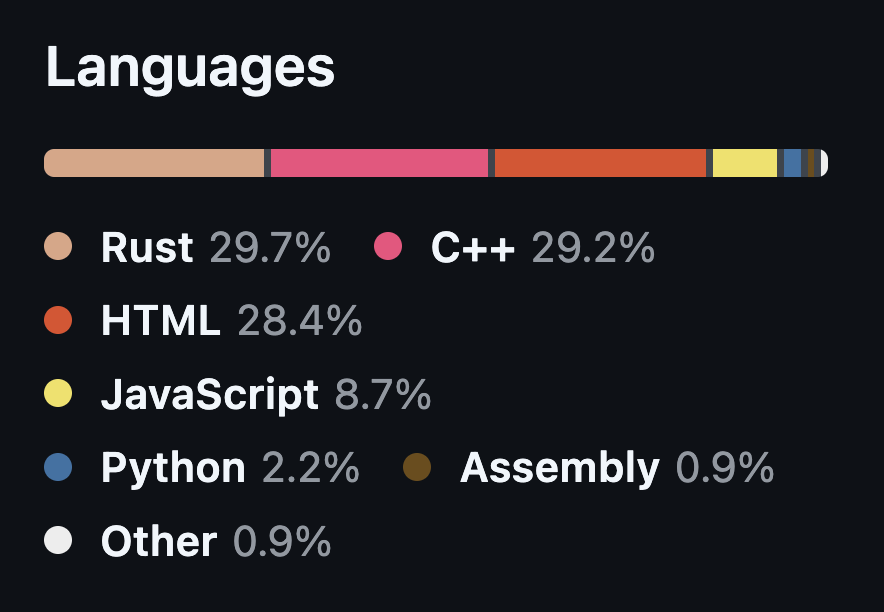
As of today @ladybirdbrowser is now a Rust project with some legacy C++ that we'll continue porting over 🤓
We've made incredible progress on concurrency in our engine since adopting Rust. I believe "CSS off the main thread" is a game-changer for browser responsiveness, and we're pushing forward on it!
On the safety side, it feels great to reduce our exposure to all the classic C++ traps, both temporal and spatial. One less (but very large) thing to worry about as we enter the most hostile computing environment mankind has devised: the web...
HydraDB is a distributed graph database, written in Rust.
Store graphs on S3-compatible object storage and scale query workers independently, without moving the graph itself.
13k+ stars
https://t.co/Wgwp5FpuVT
git-cliff is a changelog generator, written in Rust.
Turn Git history into release notes with Conventional Commits or custom parsers, then tailor the output with templates.
12k+ stars
https://t.co/OCtU1jXCI8
genact is a fake terminal activity generator, written in Rust.
Fill your terminal with simulated builds, downloads and boot logs. All the drama of a busy computer, without the work.
12k+ stars
https://t.co/QNECTvXSVw
Onefetch is a command-line Git information tool, written in Rust.
Get a quick overview of a local repository's languages, contributors and code statistics, entirely offline.
12k+ stars
https://t.co/du5EbiZ9pV