There's a sign at Meta's headquarters in Menlo Park. On one side it says Meta. On the other, facing away from the road, it still says Sun Microsystems. When Facebook moved into the former Sun campus, Zuckerberg kept the old logo on the back of the sign as a reminder of what could happen if they stopped innovating.
Last Friday, Salesforce announced that Heroku is entering "sustaining engineering." No new features, and no new contracts. Maintenance mode. We all know what that means.
When I started in tech, Heroku was the platform you used to build new projects. Every startup, every hackathon, every bootcamp ran on Heroku. It was the obvious choice.
What killed Heroku was getting acquired.
More specifically, getting acquired by a parent company whose interests were not aligned with those of its customers. Salesforce bought Heroku in 2010 for $212 million. From the outside, it looked like game over for anyone building in the same space. Who competes with Salesforce's resources?
The truth though, was that Salesforce bought Heroku as a cross-sell tool for their enterprise accounts. Tod Nielsen, Heroku's CEO from 2013 to 2016, said Salesforce "did a great job of expanding Heroku within corporates," but "what they gave up was all the 'cool kid' innovation." The small developer, the person who actually made Heroku what it was, stopped being the priority the day the deal closed.
So the platform froze. Docker, Kubernetes, serverless, edge computing… all the latest advances in cloud. Heroku shipped none of it. Then in 2022, they killed the free tier. Every future engineering lead who would've discovered Heroku on a weekend project went somewhere else instead.
Five years after the acquisition, Vercel was founded. Vercel built Next.js, an open-source React framework, then made the platform the natural place to run it. And they kept their free tier. All of the hobbyists, students, startups… Heroku handed them that entire pipeline.
Vercel grew revenue 82% year-over-year through 2025 and recently raised at a $9.3 billion valuation. Over 40x higher than Heroku’s exit value.
When the incumbent in your space gets acquired by a big enterprise company, you can often predict what comes next. The acquirer optimizes for enterprise revenue, the product freezes, the community drifts. And the acquirer doesn't notice for years because the sales machine allows enterprise contracts to keep growing... for a while.
The unlimited resources come with new priorities, and those priorities will slowly pull them away from the thing that made them good.
Heroku is now the logo on the back of the sign. Vercel is well on its way to IPO.
If your biggest competitor just got acquired, it could end up being the biggest opportunity yet.
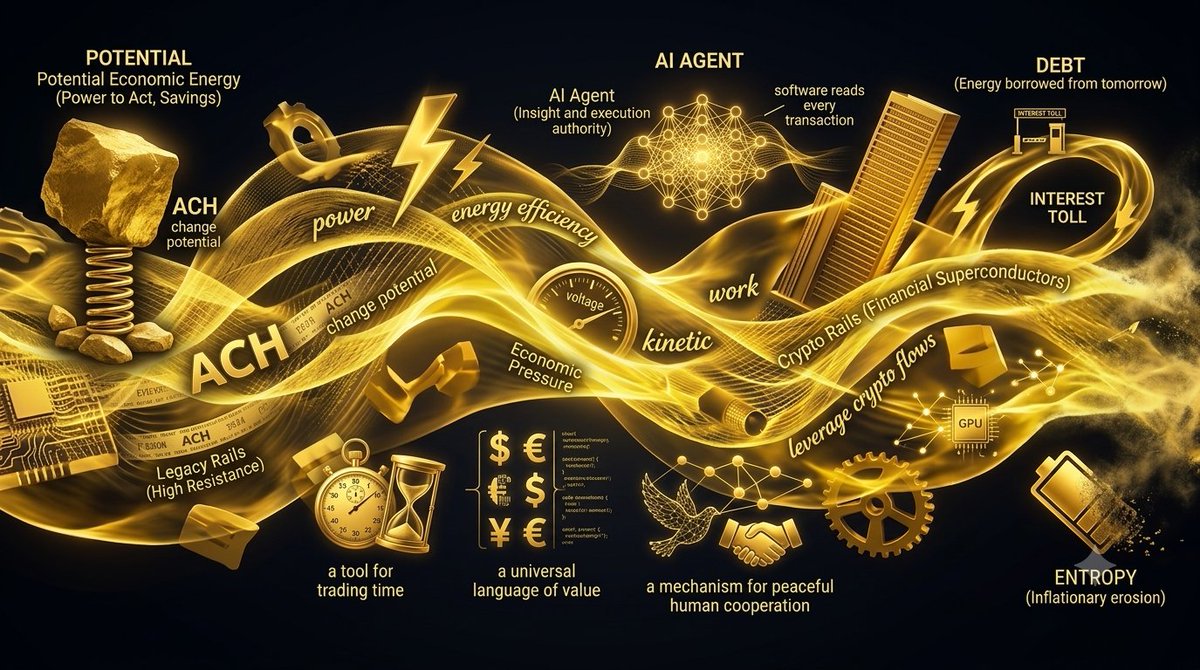
What is money? If you ask an AI chatbot that question, it will probably say something like: money is a unit of account, a store of value, and a medium of exchange. While that's technically accurate, it misses the point. Money is a fundamental primitive of society, just as energy is a fundamental primitive of physics. Fundamentally, money is economic energy.
And like any energy, it leaks. Not just to inflation, but to the quiet stuff: redundant subscriptions, vendor contracts drifting above market, finance teams burning their time recording the past instead of directing the future. Physics has a word for that waste. Entropy.
This is the lens that made @tryramp click for me. Ramp is an economic energy company. Every product does one of two things: maximize the energy a business has, or minimize what it loses to entropy. Cards, bill pay, procurement, treasury, stablecoins all aimed at getting more real work out of every dollar.
All of it is powered by better financial intelligence. We’re building agents that show you where money leaks, identifies efficiency gains, and redirect the flow in real time. Intelligence that maximizes the financial energy of a business. This is the next frontier in finance, and we’re just getting started.
Deeper dive into my full framework of money as economic energy, here:
https://t.co/wReKkkrPh1
Earlier this year I decided to find the most AI-forward company in finance & tech. That search led me to Ramp. We're building next-level technology that’s actually changing the way businesses function, and today we’re announcing our $750M Series F at a $44B valuation.
We announced one piece of that future yesterday with Stack, the AI operating system for accounting firms, a $150B industry in itself.
And there is a lot more to come. You may know Ramp from our corporate cards and expense management solutions, but they’re just the tip of the iceberg. Inside the company, the future of corporate finance, banking and accounting are already taking shape.
Ramp is one of the fastest-growing companies ever, and growth is accelerating at scale. We have over 70,000 business customers, many millions of users, over $1B in revenue and we're generating operating cash flow. It's one of those companies you watch and wonder: how do they do it?
I've been asked by many friends about how Ramp operates. Well, it’s an unyielding commitment to product velocity, relentless customer focus, an insanely high talent bar, and the willingness to take big bets that disrupt its own offerings. Ramp has reinvented itself multiple times since its founding, and has done so again over the past year. Ramp is truly AI-pilled. I’ve never seen anything like it. AI is infused into everything we do, and we're the company transforming finance with AI.
Oh, and as one of the leading companies in using AI, we’re hiring more humans than ever. If this excites you, let's talk. But be warned, as was explained to me very clearly, we only hire builders!
I joined Ramp to build the future of Finance. And it's working.
https://t.co/PT4uUjOeVU
Most companies slow down at scale.
Ramp is accelerating.
70,000+ businesses now run on Ramp. AI agents are becoming part of the finance team. And @RampLabs is shipping frontier experiments every week.
Today: $ 44B.
The next chapter of finance will be agentic and we’re building it.
Say hello to the AI operating system that learns your accounting firm's routine work, then autonomously runs it.
Reconciliations, journal entries, transaction coding, the whole close. Your team only touches what needs a human.
This is Stack. Build it once, run it forever.
Underrated excerpt from $FIG earnings
CFO - "We are also investing in first-party models trained on Figma's design corpus to improve performance on design-specific tasks while reducing cost."
This is huge
While the labs are all over the place, Figma has a chance to ship a frontier design-focused model
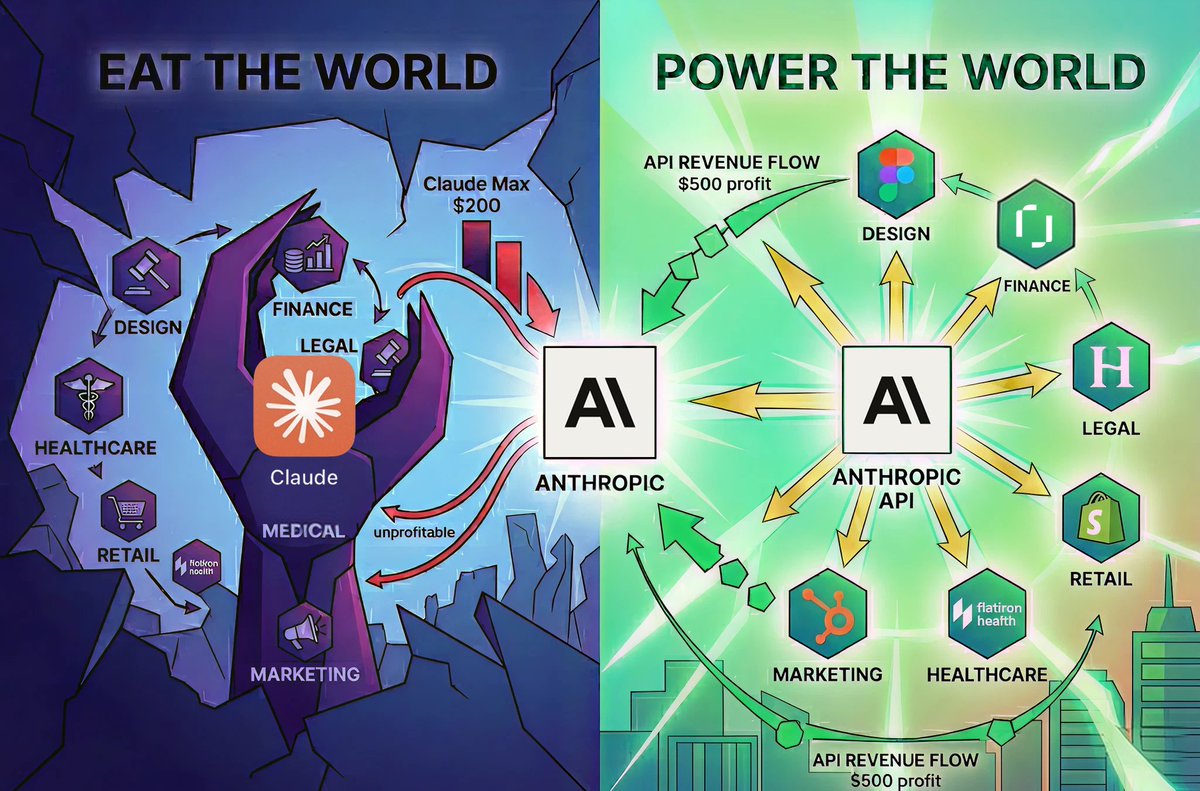
Each time Anthropic releases an industry-specific plugin for Claude, the market reacts violently.
My conspiracy theory: this is a very intentional product strategy, but the point is not to replace SaaS companies with these plugins that “Sherlock” other products. I don’t think they expect, or even want, most consumers to seriously adopt Claude for everything.
The point is to scare other companies into competing with Claude and building AI products as fast as possible.
When Anthropic adds these proofs-of-concept to Claude, it demonstrates that Claude could absorb parts of other products. So, every software must rush to embed more AI into their workflows, agents, copilots, automations, etc. Which, conveniently, means spending more money on Anthropic API compute. And that is how Anthropic really makes their money.
Consumer Claude is Anthropic's loss-leader. If it were to replace everything for users, compute costs per user would explode (even more than they currently are), and monthly prices would have to skyrocket to prohibitive levels in order to maintain Anthropic's business. But since Anthropic's API makes money on a usage basis, their revenue from other businesses' usage can scale much more smoothly. It's up to that other business to make their unit economics work.
For other software companies, this may still be good news. It means that even though it may seem like Claude is trying to make them obsolete, they're likely to only go so far, leaving room to build a more tailored, complete product set for customers. So there is still a ton of room to win, especially if you operate in a compliance-heavy space like legal, healthcare, finance, etc. The challenge is still solving for what Claude won't solve, and doing so profitably.
As for Anthropic, the strategy is brilliant. This is how they will absorb not only their own massive war chest of VC funding, but funnel everyone else’s back to themselves as well.
Each time Anthropic releases an industry-specific plugin for Claude, the market reacts violently.
My conspiracy theory: this is a very intentional product strategy, but the point is not to replace SaaS companies with these plugins that “Sherlock” other products. I don’t think they expect, or even want, most consumers to seriously adopt Claude for everything.
The point is to scare other companies into competing with Claude and building AI products as fast as possible.
When Anthropic adds these proofs-of-concept to Claude, it demonstrates that Claude could absorb parts of other products. So, every software must rush to embed more AI into their workflows, agents, copilots, automations, etc. Which, conveniently, means spending more money on Anthropic API compute. And that is how Anthropic really makes their money.
Consumer Claude is Anthropic's loss-leader. If it were to replace everything for users, compute costs per user would explode (even more than they currently are), and monthly prices would have to skyrocket to prohibitive levels in order to maintain Anthropic's business. But since Anthropic's API makes money on a usage basis, their revenue from other businesses' usage can scale much more smoothly. It's up to that other business to make their unit economics work.
For other software companies, this may still be good news. It means that even though it may seem like Claude is trying to make them obsolete, they're likely to only go so far, leaving room to build a more tailored, complete product set for customers. So there is still a ton of room to win, especially if you operate in a compliance-heavy space like legal, healthcare, finance, etc. The challenge is still solving for what Claude won't solve, and doing so profitably.
As for Anthropic, the strategy is brilliant. This is how they will absorb not only their own massive war chest of VC funding, but funnel everyone else’s back to themselves as well.
$FIG reports earnings on 5/15. It's down 90% since the high post-IPO, on a narrative of AI disruption.
I'd imaging Ramp's data captures more of Figma's target market than other data sets. If this data is indicative, Figma is one of the fastest growing vendors out there, bucking the disruption narrative. @arakharazian it would be really cool to see fastest growing by spend!
Not financial advice - DYOR
@arakharazian and the Economics Lab team at @tryramp have been publishing some awesome data lately. With 50k+ businesses on the platform, this data set serves as a sort of proxy for where business spend is going across the overall market.
I built a little terminal dashboard on top of their public API! Play around with it here: https://t.co/Fuvt7RJJMF
Some examples of what you can see:
1. How are the different AI providers' market share changing over time?
2. Which software vendors are growing the fastest?
3. Which vendors have the highest adoption and how is it changing?
4. Click or search for a vendor to see its statistics
...and much more!
The way things are going, in a few years’ time, digital interfaces will streamed pixel by pixel directly from diffusion models. All code-based constraints on software will go away. Each individual will be able to access their own personal AI environment from basically any display on earth, streamed from the cloud in real time. There will not be as large a need for personal devices as they converge on simple portals to the hive mind.
Hosted agents like Perplexity Computer are already heading this direction, and generative UX has been a hot topic for a while now. Frontier models can already write frontend code in real time to give users interactive elements to chat interfaces. But that’s just level 1. Fast, reliable, fully nondeterministic interfaces will be the next big unlock for software.
Imagine every pixel on your screen, streamed live directly from a model. No HTML, no layout engine, no code. Just exactly what you want to see.
@eddiejiao_obj, @drewocarr and I built a prototype to see how this could actually work, and set out to make it real. We're calling it Flipbook. (1/5)