Hear me out on this one.
If you think through how a Strategic Bitcoin Reserve could actually be built at scale, a U.S. government bailout of $MSTR during a distressed unwind starts to look like one of the only realistic windows where it could happen quietly, at meaningful size, and at a severe discount to other sovereign buyers.
In that kind of scenario, the U.S. government steps in under the justification of financial stability, the liquidation pressure in Bitcoin gets neutralised, and the BTC exposure sitting inside Strategy is effectively absorbed at depressed prices. Shareholders would obviously take the hit, but the broader market gets what it cares about most in that moment: no forced multi-cycle sell-off of a huge BTC stack into weakness.
What makes it interesting is how different the optics are compared to the U.S. government announcing direct accumulation. Open-market Bitcoin purchases at scale would be challenging to execute politically. It would be framed as speculation with public money, market distortion, and a government openly taking a position on an asset. They also wouldn’t want to look like Saylor, buying publicly, risking being front-run or buying short-term tops, both of which would invite severe scrutiny.
A rescue narrative is the opposite. It’s “preventing contagion”, “stabilising markets”, “managing risk”. Same end state in terms of exposure, completely different framing.
And once you look at it through that lens, it all starts to make more sense. Wall Street’s comfort with Strategy, the @SECGov turning a blind eye, even the silence around the leverage structure… it all reads differently if you assume optionality exists in a crisis.
Maybe it happens. Maybe it doesn’t. But if there ever was a clean way for a sovereign to accumulate that much Bitcoin at severely competitive prices without openly saying it, a forced unwind like that is probably the only scenario where it could even be disguised as something else.
Perhaps this is a key “Strategy” for the U.S. government to become the “global leader in cryptocurrency” and to continue plans for a Strategic Bitcoin Reserve, as has been stated by Trump and Bessent at the WEF this year.
@AtlasPool_io@Public_Pool_BTC Have you worked out the numbers where it's affordable for you to fund at 100k to 1mil miners and/or EH levels? The next era would be 6-7 figures of devices on your pool.
The thing is: if you maximize trying to make everyone happy, you end up optimizing for the lowest common denominator. That's not good taste. Good taste is opinionated and it upsets many people when confronted with it. Makes it very difficult to build good taste as a product.
Block 949508 was mined with a 1.72E difficulty, which is 12,984.15x over the network requirement of 132.47T. This is only the 15th E level block mined.
https://t.co/g16ODOM5Lz
@chrishabig@tatumturnup There are fewer hashes of P or E difficulty than T, because there’s less non-zero space. Just as there are more G diff hashes than T.
Any address can theoretically be in the Coinbase for any block, given the right nonce. These “hardest” blocks are those which could, in essence, be blocks in the far future when the difficulty is thousands or millions of times harder than it is now. They represent such improbable odds even for far future blocks.
Chutes Chat got a rebuild.
What's new:
→ Web search built in
→ Image generation
→ Image editing
Same access to 60+ open-source models, mid-conversation model switching, and inference from $0.01/M input.
Live at https://t.co/pSdxWXOKoA
Progress! < $10/hr to pre-train a 20b MoE. Not too bad.
8 VMs, each with a single l40s GPU, spread across Poland, France, and the USA, with a few extra 4090s and a 5090, training a 20B MoE @ 6s/step (I also had it fully functional with only 4090s, just slower)
Should have results soon, then we can try this out on a much, much larger model!
In celebration of the KBox preorder at https://t.co/fLQIzx0Syb we'd like to start a global Free contest!
Just share this post,
Include your idea for a casing design,
What you'd name it,
And the winner will receive a free KBox in that custom skin!
*submissions close April 29th*
How does Subnet 64 verify that miners are running the GPUs they claim to be running?
Most decentralized compute networks rely on trust. Subnet 64 verifies every GPU before it serves a request.
Every GPU on the network gets validated by GraVal, our open-source validation library.
The GPU runs device-info-seeded matrix operations. Validators check that the results match the expected output, and that 95% of the claimed VRAM is available for those operations.
Spoofed GPUs and GPUs with partitioned VRAM fail the test.
The encryption layer adds a second check. Chutes encrypts every request with keys only the exact GPU advertised can decrypt. Reroute to a different GPU on the same server and decryption fails. The runtime drops the job.
Miners who underperform lose traffic, and miners who try to cheat get caught by validators running cross-verification on the outputs.
All of this runs at 100B+ tokens per day.
https://t.co/yeAlcy4BzO
@justh0dl Yea. Each item in the list feels cluttered after the over achievement, so I want to clean that up - could expose the comparison to current diff in a hover.
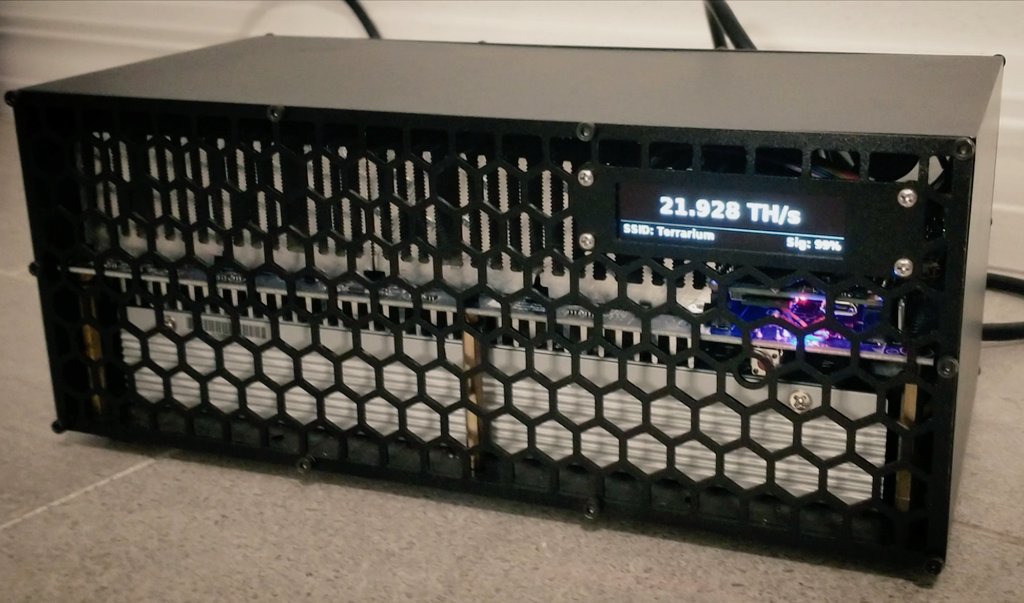
8 blocks. 25 BTC. >$2 million dollars.
Mined from bedrooms, garages, and closets
with open source hardware you can build yourself.
The home mining revolution has begun. Join us.
I really enjoyed researching and writing this article about the best (highest difficulty) Bitcoin shares ever. It's a fun read... enjoy!
https://t.co/JBpaYCgidM
Did you know we've had BTC blocks with hashes that are tens or hundreds of thousands times rarer than what the network required?
https://t.co/g16ODOLxW1