There's been a lot of discussion on Hyperliquid's margin design. I’ll address some flaws in the common arguments and explain Hyperliquid's first-principles based approach to improving the system. To my knowledge, this is the first such design in margining systems.
Perhaps other teams will find it useful for their own logic. Like good theories in physics, the best margining design is simple, canonical, explainable, and works in a wide variety of pathological scenarios.
1. The conclusion of some people has been that there needs to be a centralized force that detects and limits malicious behavior. This completely violates the purpose of defi and everything Hyperliquid stands for. This forces users back to a web2 world where the platform has the final say. True decentralized finance is worth it, even if it is 10x harder to build. Just a few years ago, no one believed DEX/CEX volumes would reach its ratio today. Hyperliquid is leading the charge here and has no intention to stop.
2. Some assume that copying approaches from CEXs will work in defi. The most common suggestion I've seen is per-address margin requirement fraction scaling with position size, as CEXs only offer higher leverage for smaller positions. However, this doesn't work to prevent manipulation attempts on a DEX because a sophisticated attacker can easily open positions on many accounts. Nonetheless, this will help somewhat reduce the impact of "organic whale" positions and is on the list of features to implement.
3. Another suggestion is to implement some features that severely limit usability of the platform in exchange for safety. For example, if unrealized pnl is not withdrawable, many attacks are not possible. Indeed, Hyperliquid pioneered isolated-only perps for illiquid assets which feature this safety mechanism. However, this change would have a crippling effect on funding arbitrage strategies, where unrealized pnl from Hyperliquid needs to be withdrawn to offset the loss on other venues. Real user needs are a top priority in system design.
4. There were also suggestions to innovate on design by having margin settings based on global parameters. However, liquidation prices need to be deterministic functions of price and position size. If global parameters such as open interest were added as inputs to margin requirements, users would lose confidence in the ability to use leverage at all.
So what's the answer? We all want defi, but a permissionless system must be robust to manipulation at all scales.
The answer lies in understanding the true problem with large positions: they are difficult to mark. The first order approximation of mark price times size breaks down when market impact approaches maintenance margin. It's impossible to accurately simulate market impact because book liquidity is a path-dependent function of time and actions of other participants. Without simulating market impact, it can be possible for liquidation to be a low-slippage way to exit at a price that is unfavorable to the liquidator.
Therefore, Hyperliquid's margining system update has the following desirable property: any liquidated position is either a loss relative to entry price, or at least a (20% - 2 * maintenance_margin_ratio / 3) = 18.3% loss relative to the last margin transfer out (using an example of 20x leverage). An organic 20x user who makes 100% return on equity after a 5% move will still be able to withdraw the majority of the pnl without closing the position. However, by introducing separate margin requirements between transfers and opening new positions, profitable manipulation attempts require moving the mark price almost 20%. This kind of attack is infeasible from a capital perspective.
Finally, I'd like to point out that the mark price problem also solves itself as market makers continue scaling up on Hyperliquid. It's quite possible that the trader yesterday could have lost money in aggregate. $1.8M pnl longing on Hyperliquid could have been more than offset when pushing the price on other venues, or using other accounts on Hyperliquid. HLP took over an undesirable position, losing $4M. The only market participants who definitely made money in aggregate are the market makers. With millions of dollars of pnl to be made in the span of minutes, it's becoming clear to sophisticated participants that Hyperliquid is one of the venues with the best flow. As liquidity improves, it will become more and more expensive to dislodge prices. So while the margining system improvements will go a long way, the allure of easy pnl attracting market makers will provide an independent source of robustness over time.
The future is decentralized.
Hyperliquid.
🪃 @bimabtc x @hourglasshq 🪃
We're thrilled to announce our partnership with Hourglass to unlock new Bitcoin-backed stablecoin opportunities through innovative integrations. Together, we’re building the future of structured products and yield strategies.
Here’s what’s coming...
1️⃣ Mint USBD with PTs as Collateral: Leverage Hourglass Principal Tokens (PTs) to mint USBD, unlocking liquidity without giving up your yield potential.
2️⃣ Strategy Vaults for YTs: Deploy USBD in dedicated strategy vaults to market-make Yield Tokens (YTs) on Hourglass.
3️⃣ Long-Term Lockup Vaults: Maximize stability and returns with lockup vaults for USBD depositors or LPs, driving deeper liquidity and resilience.
4️⃣ Structured Products for Points Markets: Explore innovative structured products tailored for points markets, bridging DeFi with advanced Bitcoin-backed solutions.
This collaboration brings together the strengths of Bitcoin liquidity from BIMA and time-based DeFi innovation from Hourglass to empower users with unparalleled financial tools.
Stay tuned for updates as we roll out these integrations. The future of DeFi is here!
Don't under-load consensus.
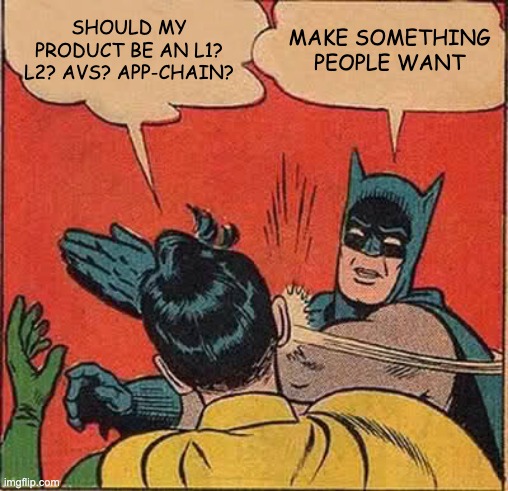
People always ask what we're building — is it an L1? An L2? An AVS or app-chain?
The lines between these things have gotten pretty blurry.
An L1 is a distributed state-machine that maintains a ledger with consensus. Typically slow because nodes gossip state changes (though newer designs only gossip tx ordering and defer execution).
An L2 rolls up state changes into batches and posts them to an L1. It’s faster because it avoids coordinating every state change via full consensus. Instead, a single sequencer handles it, and fraud proofs can undo malicious activity—but there’s no slashing.
An AVS is a computational module secured by a blockchain—if a node runs it poorly, they get slashed.
If an L2 sequencer can be slashed for fraud, is it an AVS?
If an AVS maintains state and posts it to a chain periodically, is it an L2?
If an L2’s sequencer rotates based on consensus, is it an L1? How much does sequencer rotation impact performance improvements?
If an L2 posts state roots to multiple chains, is it a chain-of-chains?
If a purpose-built execution environment is EVM-equivalent but mainly for one app, is it an app-chain? If it gossips changes between nodes, does that make it an L1 or L2?
The most important is to make what people want, as fast as possible. Focus on the essential features, launch ASAP, and avoid reinventing wheels (like consensus) unless your wheel is 10x better and absolutely necessary.
As we are starting to see, points systems are double-edged swords. 🗡️
A project can move fast, iterate, and experiment with incentive models. Community building can start without blocking on a token launch.
But they also introduce ambiguity and heighten expectations.
The key ingredient to building a successful points system is to nail communication. Answer questions like:
- What does the project stand for?
- What are the core values of the community?
- Who what kind of participants do you want to include/exclude?
Token designs are like Rorschach tests. Some people will see long-term-aligned community building mechanics. Others will see low-float supply control tactics.
Every design is a result of hundreds of micro-tradeoffs. The nuances are hard to explain to anyone, let alone in a tweet.
Most people will fall back to the project's brand and culture to make sense of a token design.
So before you embark on a points system, make sure you understand the tradeoff --
Points let you backload the work of fully spec'ing and building a token system. But they also frontload the work of communicating and building brand and culture.
excited to see how consumer credit originated on-chain will start blurring the line between RWAs and DeFi native products.
curious what the market for borrowing usdc against eETH and Liquid tokens will look like @ether_fi
my mom always asks me what i do for work
i tell her mom you don't get it the path of the righteous man is beset on all sides by the inequities of the selfish and the tyranny of evil men. Blessed is he who, in the name of charity and good will, shepherds the weak...
Congrats to the @hourglasshq team. This is a huge development for the staking space. Incentivizing long term support for protocols is a huge unlock and opens up a super exciting design space for builders.
1/ gm
We’re thrilled to announce our partnership with @hourglasshq, the marketplace unlocking liquidity for time-bound assets.
Hourglass will help power additional trading venues for @ConcreteXYZ products and assets.
⏳x 🧱
I would be curious to know the distribution of long-tail assets vs. blue-chip trading pairs captured through private mempools.
If blue-chips are overrepresented in private mempools, could it be that long-tail assets are subject to better price discovery in more public venues?
Is DeFi decentralized? In November 2023:
41% of on-chain swaps went through a private mempool
61% of MEV-Boost blocks were proposed by SCP and Wintermute
75% of ETH/BTC volume flows through Wintermute/SCP
POST ZIRP REPORT: It took three YOLO summers, but consumers finally did it… they spent all the money (and then some)!
… seeing many more job applicants for open positions, from domestic to corporate and interestingly unsolicited.
Companies are still quietly cutting positions via gentleman’s layoff (i.e., 5-10% performance cuts, special projects being shut down, etc.).
The soft landing and the rolling recession continue… businesses & banks smashed first, next up consumers and real estate.
Do see green shoots, so it feels like the six-quarter cycle (+/- 2) is on track.
It's depressing to see so many talented people from top schools with amazing resumes go work years at FAANG, and the most they can point to having shipped are a few buttons in one minor workflow.
I mean I know FAANG can afford it, but you can't. Work at a startup!
1/6
Whatever happened to the bank walk? Or money slowly leaving low-yielding bank deposit accounts for higher-yielding T-Bills and money market accounts?
As the blue line below shows, it never stopped (new low). Money continues to pour into money market funds (orange).