🏗️ Love to build (@arithecfo @sandboxvr @zynga) people love
💸 Investor @mercury @owner @elevenlabs @gammaapp @sfcompute @turingcom @recallai @eightsleep ++
introducing
═══════════ 𝚌𝚏𝚘.𝚊𝚒 ═════════════
tl;dr
1/ runway is now https://t.co/Uqg6xlaJIU
2/ you can hire @arithecfo and he can start TODAY
3/ you can give @arithecfo a test drive by replying to this thread with any ridiculous thing you want him to model for you, and he'll come back to you with a beautiful, detailed, fully wired financial model
... in 30 minutes or less
now, story time:
🧵 1/n
Peter Thiel has a blunt test for whether a startup team is thinking clearly.
Watch how they talk about their own outcomes.
His observation: when founders start framing results as luck — "maybe it works, maybe it doesn't, so let's just invest a little and see" — that's not prudent risk management. That's a diagnostic failure.
The mechanism is specific. Luck-framing doesn't emerge from humility. It emerges from not having done the analytical work to understand *why* your business will win. If you've truly mapped the competitive dynamics, the customer psychology, the timing — you don't describe the outcome as a coin flip. You describe what needs to be true and why.
The portfolio mindset ("let's see what happens") is what you default to when you don't have conviction built on evidence.
Thiel's sharpest version of this: the founders of Google, Amazon, and Apple in their early days weren't operating on hope. They had specific theories about why they would win that others couldn't see yet. Bezos mapped out why e-commerce would scale through selection and logistics before the market existed. That's not luck-denial — that's rigorous foresight presented as conviction.
When a founding team tells you "we'll figure it out," the question isn't whether they're optimistic. It's whether they can articulate the actual mechanism of their advantage.
If they can't, the luck framing isn't a personality trait. It's a capability gap.
Blaming luck is what you do when you've stopped thinking.
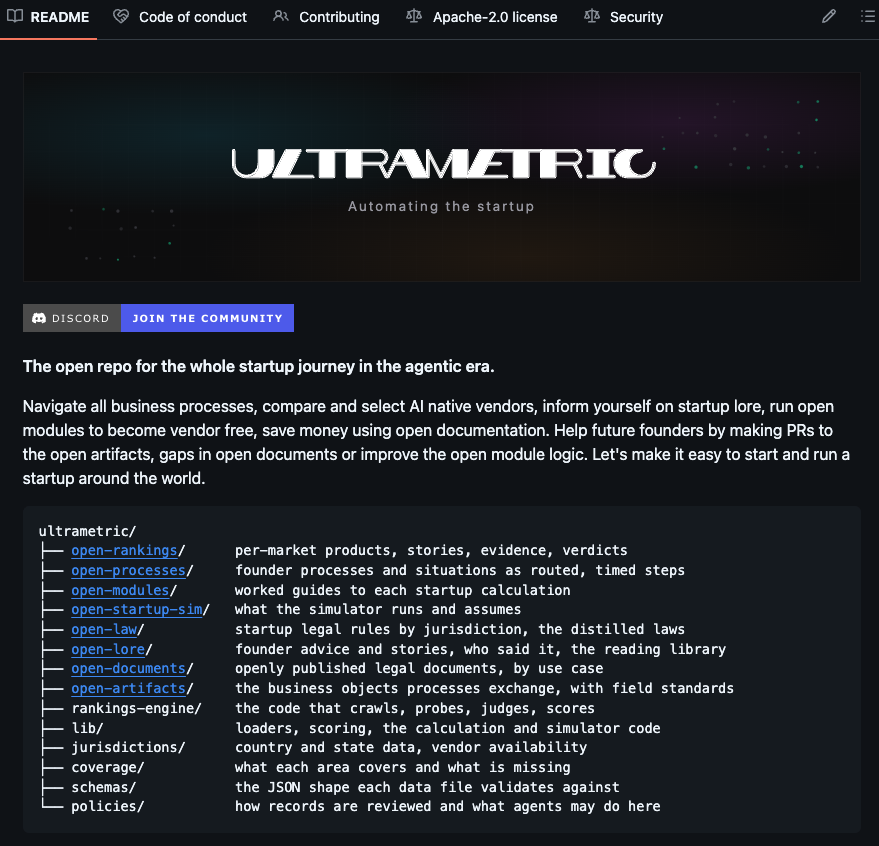
I'd like to share a little about what I've been working on at my new company @ultrametricai with my cofounder @tylerlastovich. We have been exploring how we could automate the startup itself, leaving founders with more time to focus on their exact mission.
Enter our first release of the Open Startup Repo: https://t.co/ecZZRU9iX4
A common foundation for transparent automation of the startup.
After close to 20 years in silicon valley, backing hundreds of amazing founders & startups, being in the trenches of founding Heyzap (YC08), then solo founding @golden, going through 2 acquisitions and working behind the scenes with some of the iconic companies today, I'm witnessing the largest change to how we work I could have imagined - a truly monumental era of creative abundance.
I believe the next generation of companies will largely run themselves: from operations, code, product upgrades, growth, vendor control & selection, process execution, special situations, strategy etc etc. That leaves founder time for 'the art' at the very niche core: the (currently) unautomatable, the special leaps humans tend to make, and north star setting.
We want founders to go super deep into the main problem they are trying to solve and not get held up doing anything else, from searching for domain availability with trademark checks to setting their company up, to running their processes on autopilot.
So to help that broad foundational layer for starting and running a company, we have spent around a year exploring how to help founders focus on their mission across different verticals, geos, stages and initial starting conditions.
Our first few attempts at making something useful actually failed as the market and AI was moving so fast; it just got absorbed into the models or other product releases. We saw polsia happen, openclaw, then grokbot, muse, dots, etc era as the astras, fables, opuses, kimis and jevs rolled out. What seemed to have been missing along the way was a common repo to identify, unify, open and normalize all the lego bricks that startups have to interact with (vendors, processes, business logic, law, best practices, surface areas, art of the possible).
As the number of software vendors blew up, the interfaces to drive them multiplied, the international startup founder blew up as silicon valley moved from a specific location to a state of mind and global movement. Unlimited pre seed funding in unlimited vertical sub markets and permutations has brought us to the age of infinity but we have yet to achieve being able to type into an agent a very simple sentence with very complex implications 'just setup my company and make $1m/m'. We have ended up with a hybrid mismash of computer use, API calls, plugins, shifting surface areas (API/MCP/CLI/plugins/chats/musish futures), and changing model absorption to vendor balance making it an exciting and unstable time.
As our first step we started to rank all the vendors that startups interface to when going about their journey in terms of how agentically controllable they are via their APIs, MCPs, CLIs etc and computer use compatibility as we are largely switching from a UI driven world to the agentic control surfaces and onto full automation. We have 100 ranking areas you can check out with an overall open ranking here: https://t.co/V6XRMME0Ib
Then we looked at the processes that startups do and how the vendors rank for the sub steps or process as a whole and how this changes across geos. Open processes: https://t.co/iSQ90poYxq
Then we started to hack on an open repo for startups that would contain all the components we are going to need for a common foundation for founders across the globe even if our gov processes vary so much from Bengaluru to SF or Lisbon to Shenzhen. The founder spirit is geo-invariant.
We have looked at special founder/startup situations, the business logic that will make open modules for the startup that we can hack on together, ranked law firms, government services and interfaces, stacks that go well together. We have mapped the law and lore that maps to startups and the schemas that make up the data objects and documents. But also the open documents and the missing gaps. MUCH TO DO.
All the BS processes and fluff work that founders waste their time on needs to goto zero. I want to see more supersonic planes, cancer drugs, seemingly impossible missions done and increase the bang for buck founders have with their funding.
This is a work in progress and we are keen for the community to come hack on the repo with us here: https://t.co/ecZZRU9iX4
Lets get into the structure of the general repo and the visualizations we made on https://t.co/XEYK9ipnfI site with example links:
- Open rankings: https://t.co/V6XRMME0Ib
- Open rankings example (online payments): https://t.co/1kXHZCVfIi
- Open ranking example 2 (cap table): https://t.co/oqBjatGkfW
- Open processes: https://t.co/iSQ90poYxq
- Open process example (Incorporate C-Corp) https://t.co/pxKUXpW03D
- Open situations that founders face: https://t.co/AFzAp5FRPk
- Open startup simulator (you can test our different initial starting conditions): https://t.co/QqPek01J7K
- Open modules (e.g. cap table, payroll logic etc - we'd love help improving these) https://t.co/sfzIhgAJYS
- Open law (we are interested in how law changes the processes, situations and normalizing this over time) https://t.co/5yJnYbC0bk
- Open lore (we are interested in the historical lore of startups, the rules of thumb and heuristics that might guide your agent): https://t.co/gjliXoQwe1
- Open fields (we are interested in how the schema for the data connects to the open modules, business logic, open documents and artifacts of each process eg how is a EIN defined?) https://t.co/59rcEXhnCx
- Open documentation (eg SAFE notes and missing! docs) https://t.co/BbvBow2Olt
We have looked at YC companies as well in terms of which ones do well agentically: https://t.co/snnJ83r9ly
We are interested in stacks and how people are changing their work: https://t.co/wFHoew5V9I
We are interested in what is automatable and where the agentic ceiling is currently and how to push that up in all areas: https://t.co/WmTDjmNyV4
There is more for you to explore and a lot more coming in terms of how you will be able to navigate business in an optimal way in your chosen surface area; whether you are hanging in grokbot, dots, muse, claude, terminal, chat, or whatever is coming up in this exciting time.
We have a lot of data to collect, clean up and help agents navigate the vast landscape emerging functionality the entire startup ecosystem has to offer.
Come join us getting your vendor in, ranked or that access pattern you have wanted or getting the data more accurate in terms of which vendor is best for a process or steps. Or open a module of something that currently cost money that could be free.
Also come play in our discord for founders and join the chaos (we can solve each others issues including fund raising tips from me personally): https://t.co/AmBtzFy0Bz
It's time to lift all the boats in the harbor and I'm extremely excited as to what the community of hackers and painters will hack into the repo, what asks they will have and whether we can shift normalization of processes globally, gov agentic interfaces and have common repo for founders that grows over time. I expect a lot of experimentation along the way, bugs and upside...
I appreciate our backers having faith in us as well from @ycombinator with @garrytan to @immad doing a sizable check (congrats on $1bn rev homie) to @darbyw (congrats on Stripe buying @clerkyinc), @drewhouston form @Dropbox and also @pioneer_fund@tomerlondon cto @GustoHQ and hopefully this is 'boring' and complex enough for Charlie Songhurst :> @delingpole@Liquid2V@ivolo from @segment @ryanpowe @sonicaghi of @kong@DellyTamer+ other supporters (@michaelwfrank, Fundamental ventures and if I missed you sorry moving fast!).
[And don't worry, all vendor rankings are open scoring methods so no favors are being done if someone backed us and is a vendor they have to compete with how agentic and automatable they are just like anyone else.]
PS: we have bugs and many quality upgrades to make but thought better to go out early and fix as a community.
PPS: we have other stuff to launch we just thought this was a great place to start and have 200 PRs coming out pretty soon but I still want to know what is broken or doesnt make sense or inaccurate.
Special thanks to current and past team members for getting us here and all the experiments we did you know who you are.
@RoKhanna@BernieSanders congratulations ro.
your naked, pandering ambition already cost the state $38.9B in lost revenue, so millions MORE californians and poor kids will lose their health care thanks to your complete lack of ability to think about second order consequences.
https://t.co/jN00B5c46g
this California wealth tax thing is just incredible.
so in October 2025, a California healthcare union proposed a "one time" 5% tax on any billionaire's wealth. the ballot measure will be voted on next month. In early December 2025, California announced that it would be a retroactive tax if passed, applying to anyone with CA residency as of Jan 1, 2026. The objective is to pay for Medi-Cal, California's incredibly dysfunctional healthcare system. (which also functions as a glorified welfare apparatus, but that's a discussion for another time).
polls reveal that the CA electorate is split around 50/50 on the tax, but prediction markets only give Prop 40 a ~23% chance of passing (there are competing measures on the ballet that would nullify it).
there are 200 billionaires in CA, worth collectively somewhere between $2.3 and $2.6 trillion. 5% of that is around $100b, accounting for a small amount of attrition. proponents of the tax forecasted a significant windfall, assuming only a 10% departure rate.
supporters thought they were being clever with the retroactive concept. no billionares would leave CA in the few short months between the tax being proposed and the residency cutoff date, without the tax even having passed yet, right?
well as it turns out, they did.
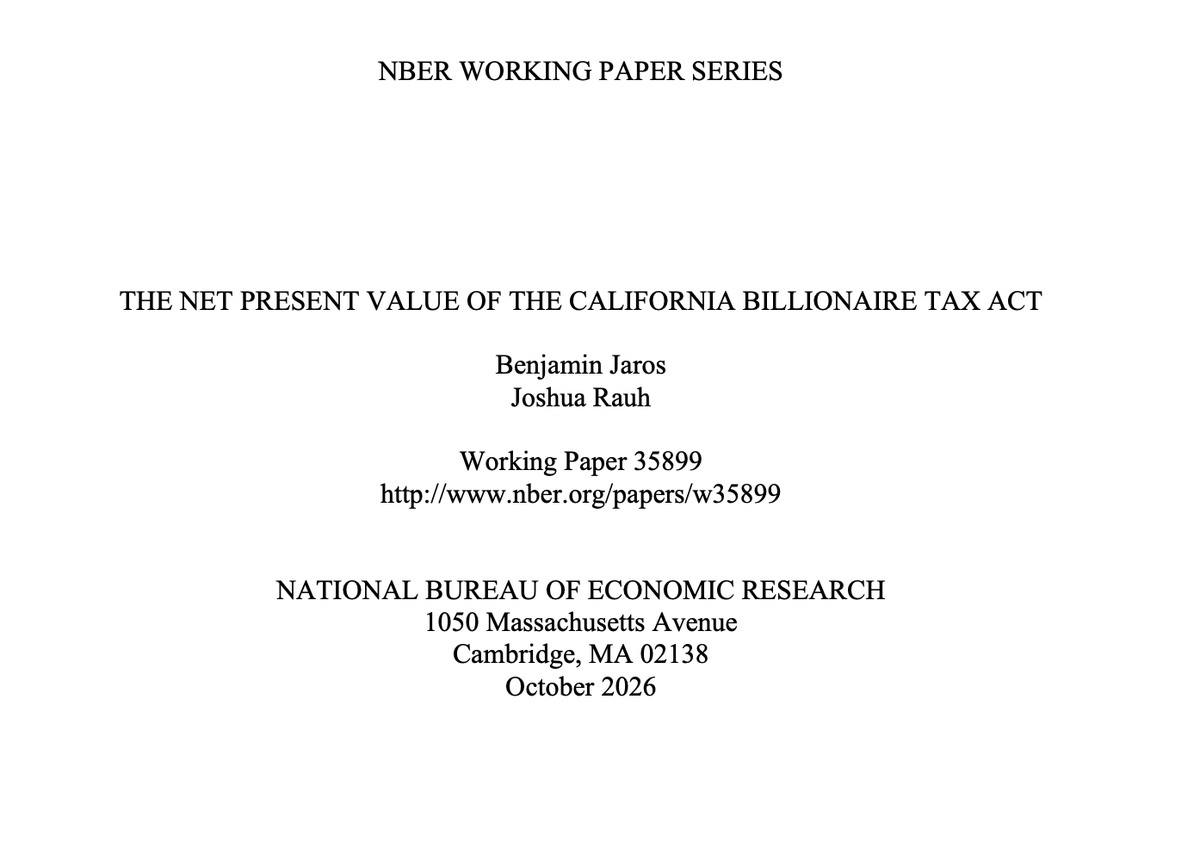
a new paper [1] from two academics at Stanford called "The Net Present Value of the California Billionaire Tax Act", argues that not only did more billionaires leave due to the proposed tax than its proponents expected, but that the value of the tax, if it does pass, is actually negative.
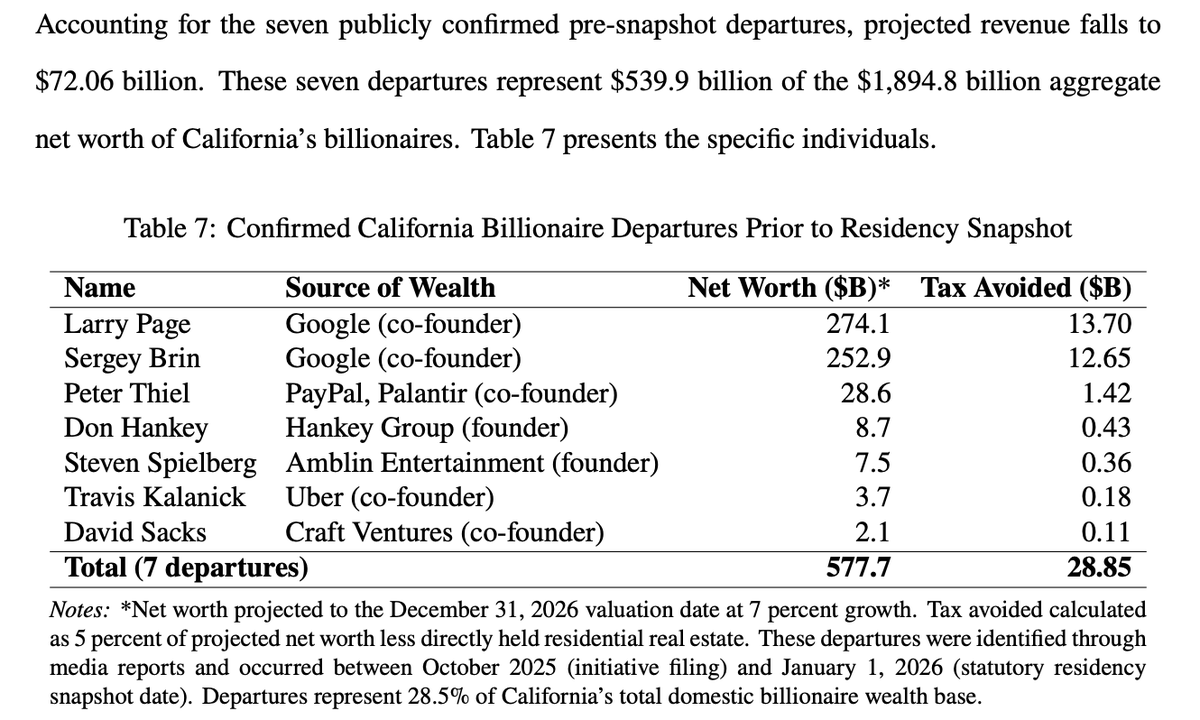
proponents of the tax only assumed 10% avoidance, that is, only 10% of the taxable base of targeted billionaires would leave CA within the very short Oct-Dec 2025 window. Jaros and Rauh, the Stanford academics, find that a lower bound of 28.6% of the taxable base managed to leave.
just based on known departures, those departures total $577b in net worth, or $28.8b in potential tax lost. this of course does not capture everyone (many left without announcing their departure), so the authors normalize to departure rates estimated from other wealth tax events, and apply other discounts for litigation, arriving arrive at a figure of only $28-$36b in forecasted tax revenues.
but this isn't all! all of the income taxes paid by the departed billionaires are also forsaken. the authors estimate that CA billionaires pay $3.3- 5.8b in annual income taxes. they assume a midpoint of $2b lost in annual collections from departed billionaires. the net present value of that lost income stream is -$68.9 billion.
so when you add it all up you get:
+ $30b one-time tax windfall (estimated)
- $69b in present value of lost future income taxes
= - 38.9b overall net present value of the tax
of course, this analysis is highly estimate driven. the authors simulate the parameters 100k times and find a negative NPV of the implemented tax 85 percent of the time.
and if the tax doesn't pass, which it's not looking like it will, California still ended up losing at least $577b in departed net worth, and they have permanently poisoned the well with entrepreneurs who will now worry about future wealth taxes.
[1]: https://t.co/1lbZgnMTG9
J’ai entendu dire que la France était finie, qu’il était trop tard pour la sauver.
Mais la France est toujours aussi belle, enviable même. Sa grandeur n’a pas disparu, elle ne demande qu’à renaître.
Nous avons surmonté en un an un problème cent fois plus grave, sans avoir les moyens dont dispose la France.
La France pourrait y arriver en une semaine.
the holmes story is used *all* the time to discredit me + my team's legitimate technical accomplishments
it's unbelievably frustrating + angering, and it has made what is already a very hard company to build significantly more challenging
so now feeling pity for her is strange
Mathematician Terence Tao:
"we're seeing the end of the romantic era of mathematics, the age of heroes. we're moving into an industrial era where math becomes large-scale, done in big teams like the other sciences"
We're entering, rather unwillingly, a new era where exciting new things are possible, but some things are being lost
New: Accenture has told employees it will only fund $29 per month of Claude use. Meaning that employees who often spend as much as $1,000 a month are now scrambling to find ways to keep access to the tool. A sign of the continuing crack down of AI https://t.co/Z2xswuSW5x
Introducing “Costco for your API spend.”
We made the best APIs you use every day FREE.
Flovia pools demand from individuals + startups to unlock deals you couldn’t get alone, then covers the rest.
For builders, traders, researchers & startups.
Get early access below ↓