DocuSign Personal: $10 to $15 per month.
DocuSign Standard: $25 to $45 per user per month.
DocuSign Business Pro: $40 to $65 per user per month.
A 10-person team on Business Pro pays $4,800 to $7,800 a year. To put signatures on PDFs.
A team of 50 pays $24,000 to $39,000 a year.
And there is a 100-envelopes-per-year cap on most plans. Send more contracts and you pay extra.
Need SMS delivery? $0.40 per send.
Need ID verification? $2.50 per attempt.
Need premium support? $5,000 to $50,000 per year add-on.
You are rationing digital signatures in 2026.
DocuSign is a $10 billion company built entirely on this pricing model.
Now meet DocuSeal.
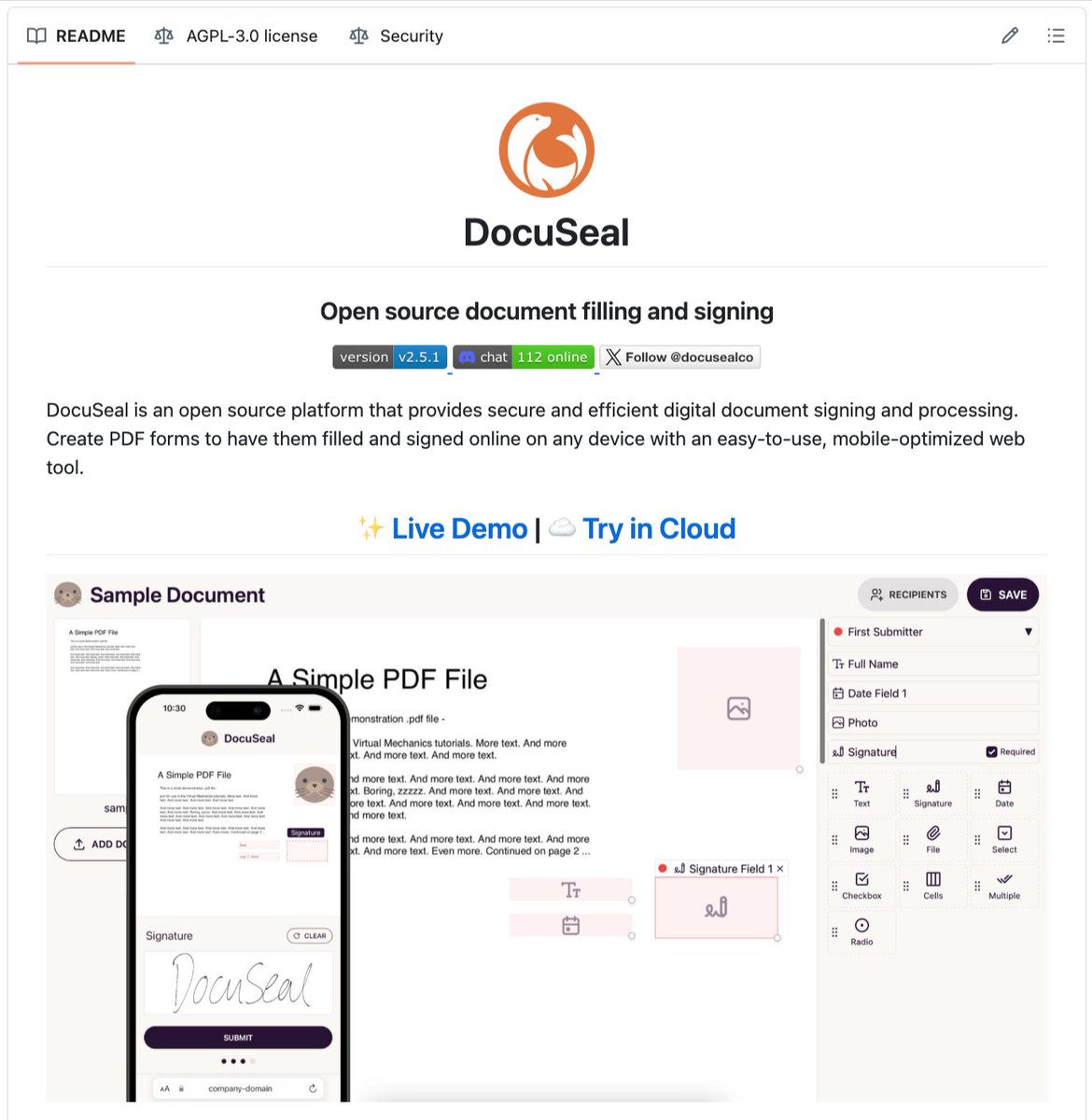
A free and open source alternative to DocuSign.
Created in 2023 by a Ruby developer named Alex who was simply trying to sign one document and realised every solution online was overpriced or required a subscription.
Three weeks later he had a working alternative. He pushed it to GitHub under the AGPL-3.0 license.
Today it has 11,800+ stars and over 1,000 forks. Bootstrapped. No VCs. No paywalls.
Here is what DocuSeal does:
- Upload any PDF and turn it into a fillable, signable form
- Drag and drop signature fields, dates, checkboxes, file uploads, and 13 field types
- Send to multiple signers with custom signing order
- Automated email reminders
- Mobile signing on any device
- PDF signature verification built in
- Audit trail for every document
- Bulk send and templates
- Full API access
- Self-host with one Docker command
Here is what DocuSeal costs:
Zero. Forever. Unlimited documents. Unlimited signers. Unlimited storage.
DocuSign limits envelopes. DocuSeal doesn't.
DocuSign charges per SMS. DocuSeal doesn't.
DocuSign charges for ID checks. DocuSeal doesn't.
DocuSign sees your contracts on their servers. DocuSeal doesn't.
Here is the wildest part:
The median DocuSign contract per Vendr is $17,250 per year. One Reddit thread has people saying "they want me to pay $4.80 per e-signature."
Self-host DocuSeal on a $5 cloud server and a 50-person team can sign as many contracts as they want without paying a single dollar.
Your contracts never leave your server. Your client lists. Your NDAs. Your employment agreements. None of it touches a third-party company.
For individuals who only sign a few contracts a year, you save $180.
For small teams of 10, you save up to $7,800 a year.
For a 50-person company, you save up to $39,000 a year.
Your documents. Your signatures. Your server.
100% Open Source. (Link in the comments)
The feeling of seeing this for the first time. With the mechs walking. The snow. The music. You knew what you were about to experience would be something special. This is Final Fantasy VI.
@realwonkers@xdadevelopers First-timers coming from Windows should go with Mint. Any other recommendation is really not doing them any favors. Lately I prefer Fedora and I do like Pop!_OS, but I'm not a new user.
@christroutner TBH, I haven't seriously used Ubuntu desktop since GNOME 2 (switched to Hackintosh around then). Today, Mint, Pop!_OS, and Fedora (either GNOME or KDE) are all far better options IMO. Ubuntu/Snaps are actually pretty sweet for servers, though - wonder if/how this affects server.
@ShipMyMoneyDFS The only real exception being your actual LOCAL newspaper - high school sports, events, crime, government, new development, road closures, etc - this is not as easy to replace by specialist destinations like generalist national news has been.
@ShipMyMoneyDFS I know a lot of serious sports people and I've never seen any of them with a newspaper, it's all ESPN/radio/pods/blogs and odds markets. I'm over 40 and couldn't give one iota about newspapers. Heck, even Gen-X is like ~55 now. I think the entire medium is just dead AF.
@ShipMyMoneyDFS TBH, the only folks I know who mess with newspapers fall into 4 camps: those whose living depends on them, psuedo-intellectuals (real intellectuals read sources & journals), the elderly who don't trust the internet, and severely elderly who don't know how to use the internet.
@theterk I don't have a problem with the test, I've just been beating this drum for so long that seeing a serious PC gamer like yourself test mostly non-native games in a head-to-head versus Windows with actual seriousness is celebratory in and of itself.
@Siris6771@theterk It's really a business perspective. Valve is already making money on game sales for existing Windows and Linux users. Why spend a bunch of effort to convert existing customers from one camp into another? New hardware sales is whole other story.
@Siris6771@theterk I'd like that, too, I'm just dubious that it'll ever happen since they switched to an Arch base. I'm also not sure what the upside is, as both Windows and Linux users can already install Steam and set it to auto-open in Big Picture Mode. I think SteamOS is for industry partners.
@Siris6771@theterk I don't think that'll ever happen. Supporting an Arch-based distro on just a couple of SKUs is brilliant. Supporting an Arch-based distro on everything is nuts.