The point of a first draft is to:
- Align the team around the direction and scope
- Flush out the implicit/unsaid expectations
- Break out of "white page syndrome"
High fidelity doesn't help with these goals. Often, it only distracts, and so these things are never established.
Both renewables and nuclear are a solution to decarbonize our grid.
As new nuclear power plants are highly capital intensive, you want them to run a maximum (high capex, low opex). Unfortunately, renewables would take an increasing number of hours, reducing the number of hours that nuclear will run (just look at the modulation in France already now).
Solar in particular, with batteries added, will take a large share.
I am all in for new clean tech, including renewables and nuclear, but let's be realistic, if new nuclear is already very expensive when it is planned to run baseload, who will finance the same nuclear for running less hours?
The hidden mechanism behind AI regulations:
1. Claim that AI can do everything .
2. Raise tons of money from investors.
3. Tell governments that AI is very dangerous and that open source AI should be regulated out of existence.
....
4. Profits!
Hybrids let’s not fall for this worst of both worlds technology.
Traditional car companies like Toyota and GM make the bulk of their profits not from car sales, but from financing, selling parts, and servicing. Transitioning to purely battery-powered electric vehicles (BEVs) would benefit consumers, but it would hurt these companies' business models. EVs have significantly fewer moving parts than traditional internal combustion engine (ICE) vehicles, which reduces the need for expensive servicing and replacement parts.
These companies are going hard to convince consumers that hybrids are the answer only to maintain their revenue streams from parts and servicing but hybrids will soon become obsolete, much like DVD-VHS combo players. Consumers should be wary of purchasing vehicles that combine the disadvantages of ICE powertrains into an electric vehicle.
While hybrids are an improvement over pure ICE vehicles in many driving scenarios, BEVs are superior in terms of efficiency and maintenance. Although there are valid concerns about towing and current energy infrastructure limitations, these issues are be addressed rapidly and will not be a concern in the coming years.
In addition to the reduced number of moving parts, electric vehicles are far more efficient in energy use compared to their ICE counterparts. An ICE vehicle typically converts only about 25% of the energy stored in its fuel into motion, with the rest being lost to heat and noise. In contrast, electric vehicles can use up to 90% of the energy stored in their batteries for propulsion. This increased efficiency not only makes EVs more environmentally friendly but also means that the energy you pay for actually goes toward moving you from point A to point B, rather than being wasted as heat and noise.
Furthermore, electric vehicles produce significantly less noise than ICE vehicles, contributing to a quieter and more peaceful driving experience. This is not only a matter of comfort but also has implications for noise pollution in urban environments.
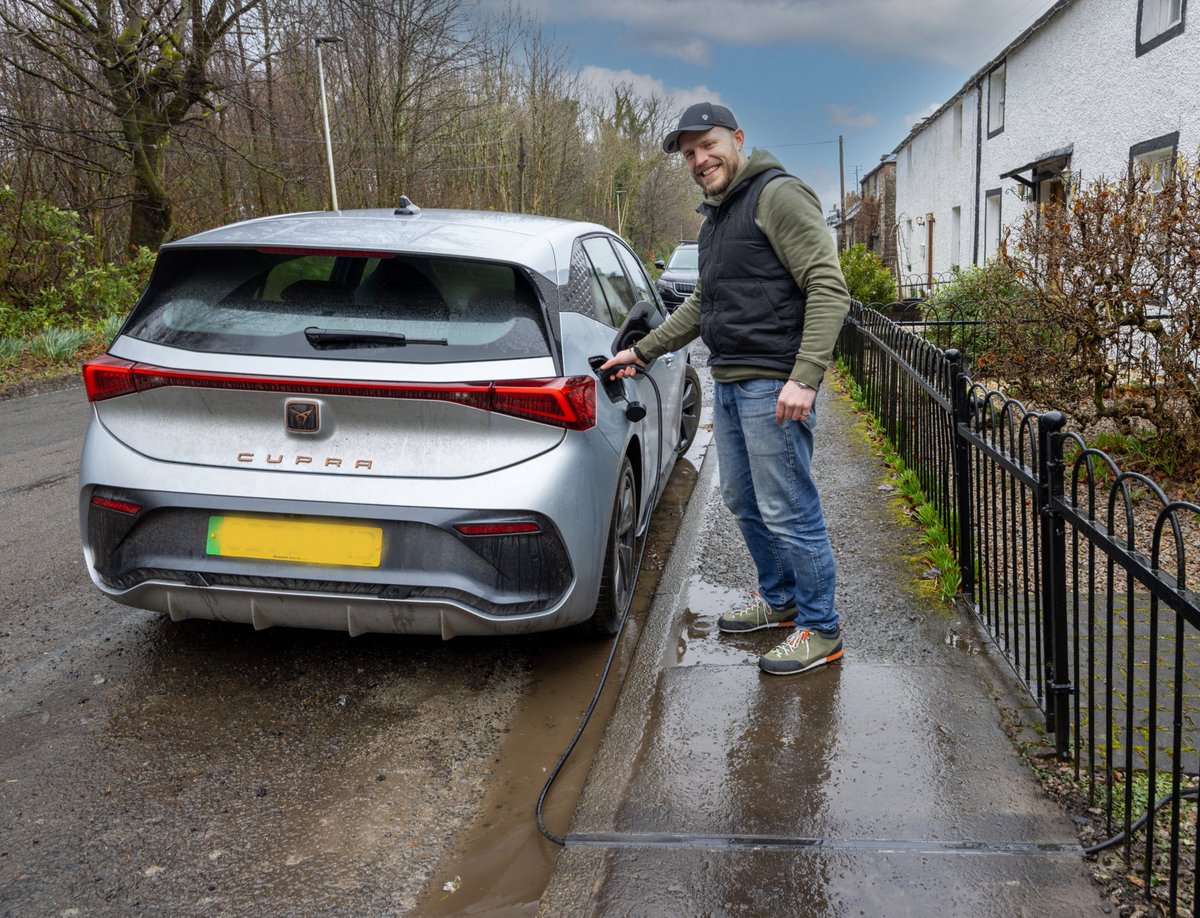
Kerbo Charge is live in Scotland! 🙌 🏴
Our through-pavement #EV charging channel becomes the first on-street solution of its kind to support residents in Stirling.
We're delighted to make home charging possible for Scottish residents like Steve pictured below - our installation gave him the confidence to sell his petrol car and move to electric! ⚡️
If you live in #scotland, tag your council in this post and let us know how a Kerbo Charge install would help you.
#electricvehicles #homecharging #chargechannel #chargegully @DeborahMeaden
NEWS: Brightest day for Australian solar manufacturing.
@SmartEnergyCncl strongly welcomes @AlboMP@Bowenchris announcement of $1 billion for manufacturing of solar panels & equipment.
Today Australians are right to sing the Government’s praises from their solar rooftops.
To address the cost-of-living crisis, we need a People Power Plan that lowers bills with rooftop solar, batteries, and better home appliances - not to waste billions on the most expensive energy source, nuclear.
@SmartEnergyCncl@RewiringAus
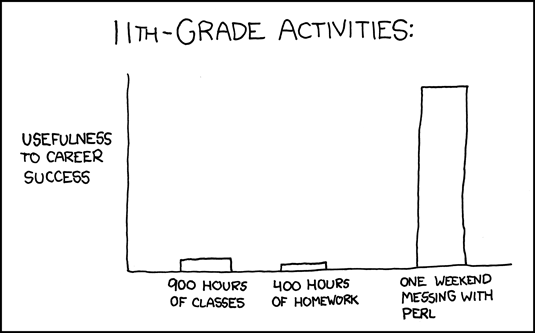
"The best designers and the best programmers aren’t the ones with the best skills, or the nimblest fingers, or the ones who can rock and roll with photoshop or vim, they are the ones that can determine what just doesn’t matter. That’s where the real gains are made."
Good founder, bad founder.
(With apologies to Ben Horowitz)
Good founders fall in love with a problem. Bad founders fall in love with the solution. Or with beating competitors. Or getting rich. Bad founders forget that the path to all these things runs only through solving a real problem in a way that is delightful. Bad founders are always thinking about the exit. Good founders are so focused on building that an exit seems beside the point.
Bad founders love to be the smartest person in the room, and hire people who carry out their orders. Good founders hope to be outshone by every hire they make, and relish being challenged and surprised by the people on their team. Bad founders are comfortable with mediocrity. Good founders care only about learning, and love nothing better than being wrong.
Good founders pursue and protect a lofty dream with steely-eyed pragmatic execution. Bad founders cannot correctly blend the two: they either refuse to confront reality, or else allow their pragmatism to corrupt and destroy their dream.
Bad founders are careless about their people. They hire easily and thoughtlessly, allow good performers to leave and bad performers to stay. Good founders care about every role in the company being filled by the precise right person. It obsesses them. Their drive for the startup to succeed overrides their empathy for any individual.
Good founders focus on their customers, clearly communicate their vision and plans to investors, and take investment from others who believe in them. Bad founders will adjust their plans to please investors, placing their needs above those of customers.
Good founders know that soft skills are hard, and that good communication is a core part of their job. Bad founders think that communicating with their team is a waste of time. Bad founders want to be in every room to make the right decisions. Good founders create a culture where the right decisions are made even when they aren’t in the room.
Bad founders change their mind every time they hear a new opinion, or never change their mind at all. Good founders listen carefully to the views of others, but always form their own conclusions.
Bad founders run their startup the same way when it is 100 people as when it was 3, and expect their team to somehow make it work. Good founders understand that their role fundamentally changes when their team grows, and that it is up to them to change and make it work. They understand that they have to earn their place in their role as much as everybody else in the team. More, in fact.
Good founders and bad founders both care about keeping their startup alive; but only good founders remember that it needs to have something worth living for.
@matt_vanswol This is why Tesla wins everything. They're competing with themselves for better everything while the rest of the world is maximizing profit for profit's sake. Tesla's competitors are the laws of thermodynamics.
My feeling is that AI will strongly increase the demand for APIs from services that right now are just apps. Without APIs, smart agents can't interact with the physical world. However I image that many service vendors will try to resist, not wanting to reduce user screen time.
AI is not exploited enough at product level. WhatsApp, the most used IM app in the world: where are summarization of chats? Local audio transcription? Urgent chat detection? Automatic translation? And the list could continue.
Becoming a manager is *giving up* a starring role, not attaining one.
Your job now is the advancement, flourishing, and promotion of your team, not yourself.
One thing programming teaches you is to look for reasons why you're wrong, instead of looking for reasons why you're right
If the computer is not doing what you expected, it's almost always because your mental model is incorrect, not because the computer is incorrect
@JsonBasedman In Australia, Oil & Coal companies are on the other side because they know Nuclear could buy a decade of inaction plus another of distraction.