“Startup journey’s (and most journeys in life) are full of highs and slumps. If you’re playing the long game, you’ll be fine. The only games you’ll lose are the short games” ~
Nadiem Makarim, Founder & CEO, @gojekindonesia
Yooo wait a minute this is a super cool idea for AR glasses!
But it should go much further: instead of just a minimap, actually render the ghost in 3D in front of you like in Mario Kart.
And then... actually put some item boxes in the air that you need to jump to collect. And you can shoot your ghost with a green shell. And you can put banana peels for your ghost.
This may be what it takes to get me into running. Maybe a new side project, if nobody is doing this yet?
spent my 11-hour flight back from europe working on a very long report. started as a slack message but morphed into a several pages long doc. wifi was as shitty as it gets. after finally making it home i realized that the computer had forcefully restarted. opened slack: draft was gone :(
hail mary: claude pls save me, no clue how but pls try
it checked APFS snapshots, time machine, slack indexeddb, write-ahead logs, service worker / http caches, local storage, app logs, hibernation image... nothing. all gone
but then... it realized i have alfred installed. so it checked the clipboard snapshots alfred keeps in sqlite. sad news: alfred clipboard memory gets deleted after 24h. aggressive retention policy. however! when sqlite runs DELETE, nothing gets actually deleted. it only marks pages as reusable, but it doesn't override the physical bytes. so claude decided to do a raw-scan of the db, reverse eng alfred data format, figure out the portion containing the timestamp, stitched everything back together across overflow pages... and handed me the exact final version of my report, the last one i cmd+C'd
all this, in a single shot
... day 200 of "what if you had an elite hacker you can ask anything to"
#LIK - #VigneshShivan pens down a note stating that many people may have missed his film due to the overwhelming negative reviews, which could have discouraged audiences from giving it a chance in theatres. Initially he had mentioned he is not satisfied with the box office numbers, as the movie has grossed only ₹70+ crores. He mentioned that the ₹100 crore benchmark was not reached, and that he was expecting the film to collect at least ₹200 crores at the box office.
He further mentioned that the narrative shifted after a promising opening weekend. He stated that it was a different kind of filmmaking and that it deserved a little more generosity from audiences. He also said that many people do not see the struggles behind making and releasing a movie.
Poco se está hablando que en pleno trailer aparezca el propio Spielberg y que diga la barbaridad que está diciendo.
Esta película viene en un momento histórico sin precedentes de plena desclasificación.
42 borradores ha tenido el guion.
Quiere mandar un mensaje potente y feroz
My wife (non-technical) built a fully functional iOS/Android app in 6 weeks... and it's made $1.5k on the app store since launch in the first month!
She's a stay at home mom with our 2 young children (3 and 1), and she wanted a way to write letters to our children to keep memories of their childhood (we kept using notes app and was all a mess).
Thank you @amasad and @Replit for making this possible!
Link if you want to try it: https://t.co/6llUqhyG3Z
One of my favorite time management essays is “Maker’s Schedule, Manager’s Schedule” by @paulg. Give it a read.
As @bfeld and many others have observed, great creative work isn’t possible if you’re trying to piece together 30 minutes here and 45 minutes there.
Large, uninterrupted blocks of time—3-5 hours minimum—create the space needed to find and connect the dots.
And one block per week isn’t enough.
There has to be enough slack in the system for multi-day CPU-intensive synthesis. For me, this means at least 3-4 mornings per week where I am in “maker” mode until at least 1pm.
If I’m in reactive mode, maker mode is all but impossible.
The Lone Genius and the Manager.
The Lone Genius is the person sitting alone at a computer, amplified 1000x by AI. One person with taste, vision, and relentless focus who can now do what used to take a team of 50.
The Manager is the person who becomes CEO of their own "firm" where most of the employees are AI agents. They define the goals. They decide what matters. They coordinate. The AI does the execution.
Bob McGrew has a framework I keep thinking about: in the AI future there are only two jobs. The Lone Genius and the Manager.
That's it. Everything else gets absorbed.
The Lone Genius is the person sitting alone at a computer, amplified 1000x by AI. One person with taste, vision, and relentless focus who can now do what used to take a team of 50.
The Manager is the person who becomes CEO of their own "firm" where most of the employees are AI agents. They define the goals. They decide what matters. They coordinate. The AI does the execution.
The Marxists will hear "two jobs" and panic. "What about everyone else?!" But here's what they're missing: AI doesn't shrink these two categories. It explodes them open. More people get to be geniuses. More people get to be managers. The barrier to entry for both just collapsed.
What actually gets eliminated? David Graeber called them "bullshit jobs." Graeber was no libertarian! He inspired Occupy Wall Street.
His words: "Huge swaths of people spend their entire working lives performing tasks they secretly believe don't really need to be performed. The moral and spiritual damage that comes from this situation is profound. It is a scar across our collective soul."
Graeber said bullshit jobs are "a form of spiritual violence directed at the essence of what it means to be a human being." They induce "hopelessness, depression, and self-loathing."
This is who the left should be fighting for. Not to preserve those jobs. To liberate people from them and give them better ones.
The dirty secret of the modern economy: millions of people sit in roles so pointless that even they can't justify their existence. Compliance layers. Reporting layers. Coordination layers. Meeting-about-the-meeting layers. They know it's meaningless. It eats them alive.
AI eats those layers. Good. That's a jailbreak.
What I love about Bob's framework is where it points. The Lone Genius used to require a PhD, a lab, institutional backing. Now a 19-year-old with taste and Codex can ship what took a research team a year. The genius bottleneck was never talent. It was access.
The Manager used to mean you needed to hire 50 people, raise money, build an org chart. Now you can orchestrate a fleet of AI agents from your laptop. The management bottleneck was never skill. It was capital.
AI doesn't concentrate genius and management into fewer hands. It distributes them into more hands. The working class kid in West Virginia. The single mom in Ohio. The 55-year-old who got laid off and now builds software for the first time. Those are some of Bob's future geniuses and managers.
The best founders I see at YC are already living this. They toggle between both modes in the same day. Morning: lone genius, creative insight, the thing nobody else sees. Afternoon: manager, spinning up agents, steering, shipping.
The cycle time between genius and manager IS the new productivity metric.
So when someone tells you AI means "only two jobs and everyone else starves," quote Graeber to them, they’ll get it.
Graeber knew the real violence was making people do meaningless work and pretending it was dignity. AI ends that. More genius. More agency. Fewer spiritual prisons.
Bob McGrew has a framework I keep thinking about: in the AI future there are only two jobs. The Lone Genius and the Manager.
That's it. Everything else gets absorbed.
The Lone Genius is the person sitting alone at a computer, amplified 1000x by AI. One person with taste, vision, and relentless focus who can now do what used to take a team of 50.
The Manager is the person who becomes CEO of their own "firm" where most of the employees are AI agents. They define the goals. They decide what matters. They coordinate. The AI does the execution.
The Marxists will hear "two jobs" and panic. "What about everyone else?!" But here's what they're missing: AI doesn't shrink these two categories. It explodes them open. More people get to be geniuses. More people get to be managers. The barrier to entry for both just collapsed.
What actually gets eliminated? David Graeber called them "bullshit jobs." Graeber was no libertarian! He inspired Occupy Wall Street.
His words: "Huge swaths of people spend their entire working lives performing tasks they secretly believe don't really need to be performed. The moral and spiritual damage that comes from this situation is profound. It is a scar across our collective soul."
Graeber said bullshit jobs are "a form of spiritual violence directed at the essence of what it means to be a human being." They induce "hopelessness, depression, and self-loathing."
This is who the left should be fighting for. Not to preserve those jobs. To liberate people from them and give them better ones.
The dirty secret of the modern economy: millions of people sit in roles so pointless that even they can't justify their existence. Compliance layers. Reporting layers. Coordination layers. Meeting-about-the-meeting layers. They know it's meaningless. It eats them alive.
AI eats those layers. Good. That's a jailbreak.
What I love about Bob's framework is where it points. The Lone Genius used to require a PhD, a lab, institutional backing. Now a 19-year-old with taste and Codex can ship what took a research team a year. The genius bottleneck was never talent. It was access.
The Manager used to mean you needed to hire 50 people, raise money, build an org chart. Now you can orchestrate a fleet of AI agents from your laptop. The management bottleneck was never skill. It was capital.
AI doesn't concentrate genius and management into fewer hands. It distributes them into more hands. The working class kid in West Virginia. The single mom in Ohio. The 55-year-old who got laid off and now builds software for the first time. Those are some of Bob's future geniuses and managers.
The best founders I see at YC are already living this. They toggle between both modes in the same day. Morning: lone genius, creative insight, the thing nobody else sees. Afternoon: manager, spinning up agents, steering, shipping.
The cycle time between genius and manager IS the new productivity metric.
So when someone tells you AI means "only two jobs and everyone else starves," quote Graeber to them, they’ll get it.
Graeber knew the real violence was making people do meaningless work and pretending it was dignity. AI ends that. More genius. More agency. Fewer spiritual prisons.
New blog post:
There should be ‘general managers’ for more of the world’s important problems
There’s a surprisingly big category of problems that are ‘orphaned.’ By ‘orphaned’ I mean: you can’t point to a specific person or organization who thinks it’s their responsibility to deliver the outcome in its entirety. Lots of people talk about the problem, and often many work on slices of it. But if you asked: ‘is there a hyper-competent person waking up every day feeling accountable for making sure this gets solved?’—the answer is very often, ‘no.’
These problems exist across domains and at a variety of ‘altitudes.’ Indeed, some are perhaps better described as ‘things we want to be true’ rather than ‘problems.’ In any event, a few examples that have been on my mind recently:
(1) Can we prevent infection from all respiratory pathogens (including the common cold)?
(2) Can we make every new building in SF both serve its function and be beautiful?
(3) Can we permanently fix the American west’s water problem?
(4) Can we halve X risk?
(5) Can we eliminate single-use plastic globally without making convenience trade-offs?
(6) Can we make childcare costs so low that they’re a non-factor in deciding whether to have kids?
In my opinion, there should be ‘general managers’—GMs—for problems like these. These are founder-types who feel personally responsible for delivering a specific outcome (vs field-building generally); hyper-competent leaders who will pull whatever levers necessary to achieve the defined outcome. Most companies wouldn’t let an important initiative go unmanned or without a ‘directly responsible individual’ — why are we OK not having GMs for even more wide-reaching problems?
(Link to full post in reply)
We recently built an AI assistant inside @Razorpay called Slash.
It reads our entire codebase, debugs production incidents, reviews specs, writes code, reviews every single PR, answer tech queries and also raises PRs for small features.
It's easily accessible through Slack. We can tag it in any Slack thread, describe the problem in English, and it gets to work.
Six weeks ago, Slash handled 122 tasks in its first week. Last week it handled 14000+. Queries, analysis, bug fixes, PR reviews, test runs and work that earlier lived across scattered tools and teams can now be done with Slash right within Slack. 1000+ people used it in a single week because it got their work done faster. The whole adoption has been completely organic.
The numbers from last week have been very encouraging - 14,854 tasks completed. 2,150 PRs raised, 1,152 merged, 45% of those PRs shipped with zero human rework.
A payout gets stuck mid-retry during a live incident, an engineer tags Slash and within seconds, it cross-references logs with code and pinpoints a state machine bug blocking the retry-to-failed state transition. Tells the team exactly which logs to check and how to resolve the incident.
With its K8s analyzer skill, Slash scanned a single namespace, right-sized all 11 workers using 48-hour P95 pod metrics, and raised the PR. One run saved $560/month.
A marketing banner bug was fixed with few prompt iterations with a PR raised, merged to prod and deployed in minutes. No front-end developer touched the code.
Security teams ran static security testing and remediation through Slash at org scale. Thousands of findings were purged and many more got validated autonomously.
But Slash isn't just an engineering tool.
Account managers now trace stuck customer payments and integration failures through Slash instead of pinging engineers on Slack. L2 product support tickets get triaged by Slash before they reach engineering.
250+ non-engineers ran thousands of sessions last week. PMs used it for research on our payments infra, customer interviews and product features sometimes raising PRs of their own. Analytics teams built SQL pipelines. 11% of all sessions came from people outside tech and product.
On our company bakkar (watercooler) Slack thread, someone asked Slash jokingly to assign tasks to everyone and it responded in the same tone. It seamlessly started participating in inside jokes and conversations.
The quality compounds with use. Engineers who shipped 11+ Slash PRs averaged a 63% merge rate without rework. First-timers averaged 37%. Across the org, human review comments per PR have dropped more than 40% with Slash starting to do in-depth review of every single change.
We're still early. Large cross-repo refactors, fully agentic sdlc and plan mode are next. But Slash has already changed how people at Razorpay build, debug, and ship every day.
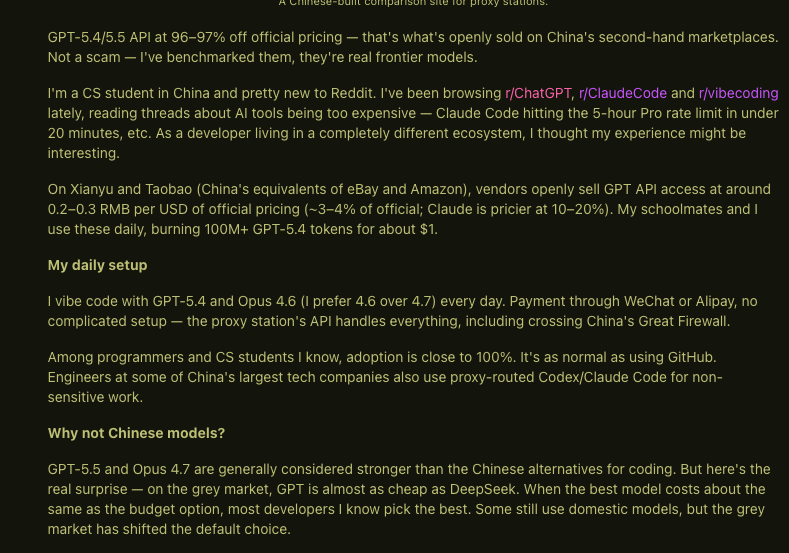
Chinese students are buying GPT-5.4/5.5 and Claude API access from Xianyu/Taobao proxy sellers for almost 96-97% cheaper
People are apparently burning 100M+ tokens a day for like $1 and vibecoding nonstop.
if @RJ_Balaji can win? why can't you win? if suriya can make a comeback after 13 yrs? why can't you? if the new kid who everyone doubted gave us an album that had people possessed in devotion, why can't you? #Karuppu is not just a movie, its a sign that anything is possible.