🚀 Guide 2.0 is one of the most exciting product launches I've had the privilege to announce. RecOps teams can now have increased efficiency and automation…without sacrificing on candidate experience 💯
Check out a sneak peak at https://t.co/DDFzGdqf76 👏👏
@wholemars@dallasteslaclub lol agreed it’s more sensitive but only when looking at a phone, etc. Obviously it would be great if they actually allowed that, but since they don’t, I get why they’re tightening attention monitoring.
A year ago I was genuinely excited about what our first version of Aria could do. AI has changed a lot for Guide in the past year, both in terms of how we build products and even more so what our products today can do. We’re still in the early innings but I’m constantly amazed by what’s already possible.
Meet Aria 2.0.
Today we're announcing Aria 2.0 - our most significant release since Aria’s launch a year ago.
Aria, @GuideDotCo's AI RC, is now significantly smarter, more capable and more autonomous. You can instruct her in natural language and hand off your most complex scheduling work - from nuanced panels to conference rooms to interviewer declines, swaps and more.
For TA and RecOps teams, Aria represents a genuine shift in how work gets done. Coordinators and recruiters are no longer scheduling interviews themselves and instead shift into the role of managing an RC agent - delegating and reviewing work, and spending more time making hires.
AI for TA is growing up. With this release, AI is automating the real coordination work that used to require full-time humans clicking through manual workflows.
Guide has seen exceptional growth since Aria’s launch, more than tripling our business in less than a year. Today, Aria helps schedule thousands of interviews weekly for the most pressure-testing talent teams including Vercel, Block, Flexport, Duolingo, Fastly and many more trusted brands around the globe.
We’re just getting started, and we believe AI in TA is here to stay.
@Starlink it would be great if resuming plan subscription from paused were immediate - sometimes you need WiFi and having a Mini is huge…unless you have to wait 2 hours for the plan to resume
@RobotaxiClub@JoshWest247@robotaxi I didn't ask - but i know Dallas and Houston continued unsupervised rides so it was probably just maintenance on the normal cars or something. Mine didn't have a Robotaxi decal either
Finally got to ride in an unsupervised Robotaxi today 🎉 (in Austin, TX). It was awesome - watched Netflix in the front seat of a super smooth/perfect ride. That said, I was able to almost immediately validate a hypothesis I've had for a while:
My sense has been that one of the last hurdles to a full scale-out are railroad tracks. It's one of the few situations Tesla just can't afford to get wrong (alongside driving into lakes and running red lights/heading into oncoming traffic at busy intersections, both of which they have orders of magnitude more data for). Most other mistakes have felt harmless in my Model Y, and even if unsafe, other drivers can react and account for it.
It's been pretty clear to me that they haven't fully solved this problem yet - even in my own Model Y (14.2.2.5) I've had a scenario where the gates came down, my car slammed to a full stop right in front of the gates, then (presumably thinking it was on the tracks) hit the gas - and I had to disengage to avoid breaking into the barrier. Given the number of weird clips on the Internet and my own experience, it's felt like they still don't have the # of 9's they need in these scenarios.
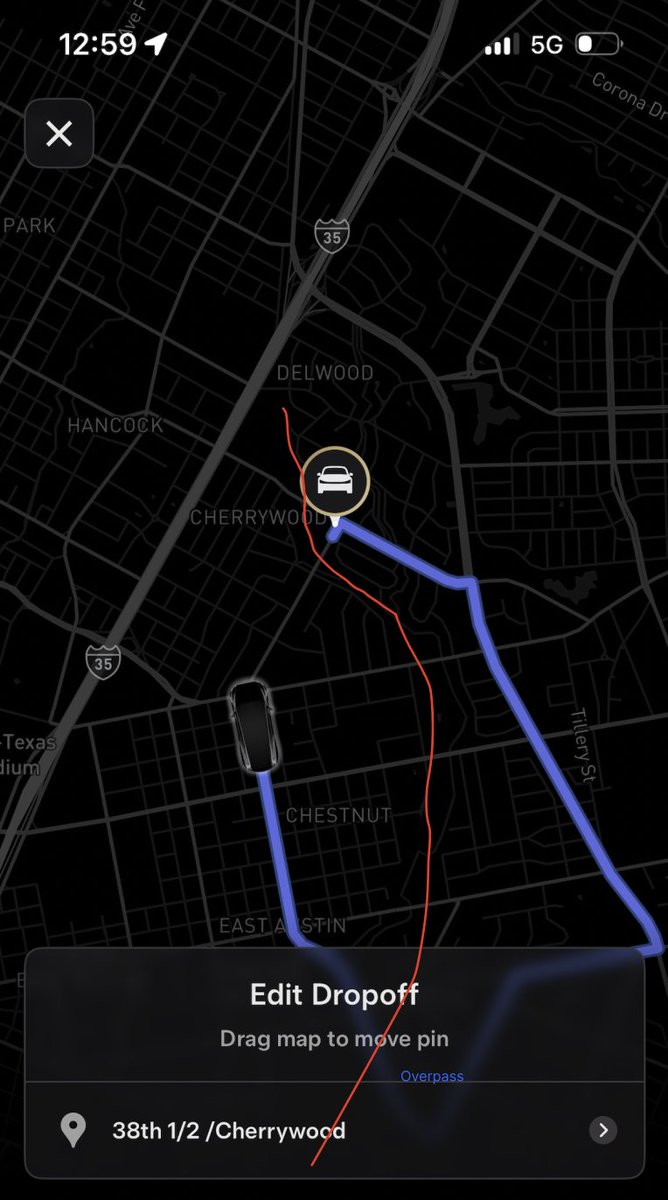
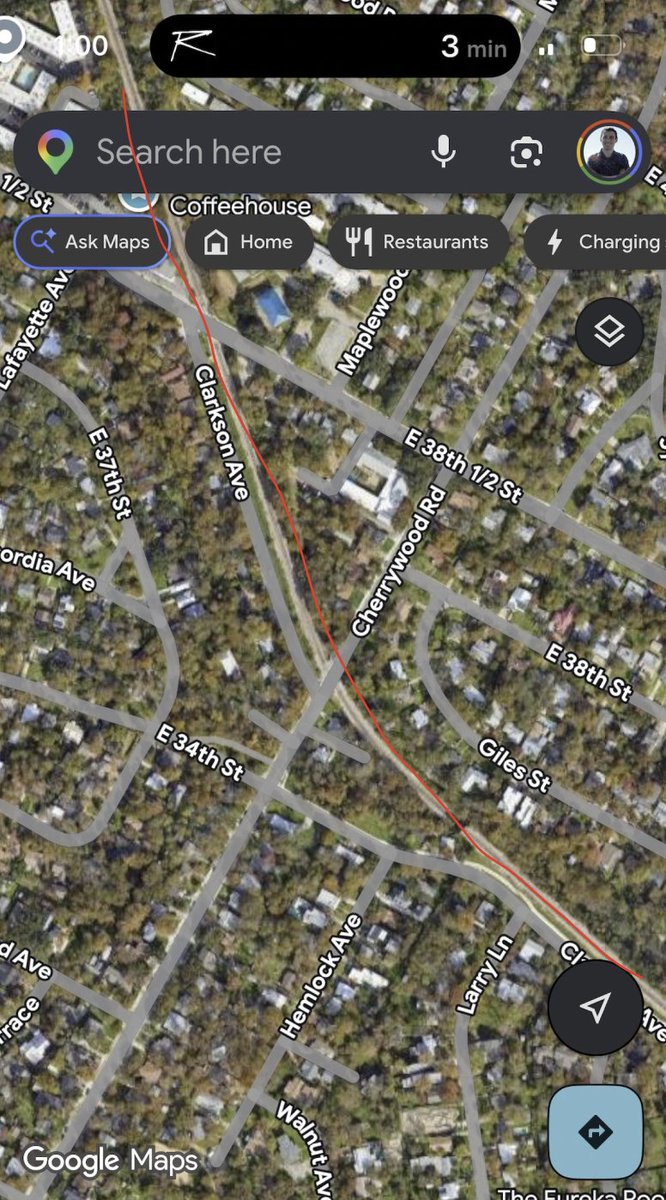
Well, that's definitely the case and Unsupervised robotaxis appear to be avoiding them entirely - you can see here that during my ride, I changed my destination to a point on the map (a) ahead of the main railroad track in Austin, then (b) behind the railroad track (see satellite image for where the tracks are).
No matter which way I tried it, if the destination was on the other side of the tracks, it re-routed my ride south (to an overpass that avoids RR crossings).
It's pretty clear to me that they've essentially blocked certain intersections with RR crossings (not sure if all, or just specific ones). I also don't know if it's only doing this for unsupervised rides (vs supervised where the safety monitor could presumably tell the car to stop).
Honestly, it's a pretty smart solution (though i'm sure some riders will be confused/annoyed) given there are typically routes that go under/over tracks. But the fact that they have to account for this means it's not easily generalizable.
@DirtyTesLa cc @mikepat711 as I know you've been as confused as I have about why they aren't rolling out faster. This appears to be one reason
SpaceXAI and @cursor_ai are now working closely together to create the world’s best coding and knowledge work AI.
The combination of Cursor’s leading product and distribution to expert software engineers with SpaceX’s million H100 equivalent Colossus training supercomputer will allow us to build the world’s most useful models.
Cursor has also given SpaceX the right to acquire Cursor later this year for $60 billion or pay $10 billion for our work together.
Pretty awesome perk of @robotaxi over Waymos:
Netflix and other services are already logged in - jump right back into the show you were watching, full screen 🤯
feel like I haven't seen this advertised well enough cc @SawyerMerritt
While these posts from Fred and Dan are annoying and lacking any facts, there _is_ a small possibility that the chase cars have “pull over before driving onto that train track” kill switches. I think it’s unlikely given how well my car drives in Austin, but we’ll know based on how fast the service scales and the chase cars are removed