In >1 year as a PM @ Facebook I've created zero tickets/tasks. We don't do sprints either.
PMs here focus on vision, strategy & partnerships. Less on project management & tasks.
Engineers carry most of the project management responsibility & create their own tasks.
It's great.
Stripe's technical interview for PM candidates is 60 minutes with an engineer (not a PM).
Part 1 of the interview is about a past system you worked on. Part 2 is about designing a system for a product they choose (e.g. Docusign). This post is about Part 1.
They'll ask you to whiteboard the architecture of a system you've personally worked on, then probe every component. Why this database? Why this API structure? What were the scaling challenges? etc...
Most PM candidates prep by studying system design courses and memorizing architecture patterns. More useful for Part 2, but not where Part 1 focuses.
The candidates we spoke to who did well in Part 1 all did something simpler. They called their old engineering or tech lead. The person they worked with on the system they planned to discuss.
They had them walk through the entire architecture from scratch. Not a high-level chat. A real walkthrough where the engineer explained the rationale behind every decision.
Then they asked three things.
↳ "Why did we make this choice?" for each major component
↳ "What's missing from my diagram?" for completeness
↳ "What was the hardest trade-off?" for anticipating curveballs
These are exactly the types of follow-up questions the Stripe eng interviewer will ask the PMs.
When you get to the actual interview, my advice is to start with a blank canvas (although you should definitely have the filled out diagram printed on your desk for reference).
During the interview itself, build the diagram one component at a time, walking the interviewer through the rationale in every step. Client layer, APIs, backend services, data stores. Explain each connection and trade-off as you draw.
Don't share your screen with a pre-built 10-box diagram pulled up (people actually do that and it's a bad idea trust me). The interviewer wants to follow your thinking as you build the system, not orient themselves to a finished artifact.
P.S. This is just one slice from the Insider Loops Stripe guide. We captured the complete Stripe PM interview playbook at https://t.co/T6YUC9sTYg
PSA: This week only, get 25% off all the @MavenHQ Lenny's List courses (and hundreds of other courses)
A few in particular to check out right now:
+ How to Become a Supermanager with AI w/ @yourgirlhils https://t.co/r4xwYdAkPG
+ AI Evals For Engineers & PMs w/ @HamelHusain@sh_reya https://t.co/SvmkaLvnXv
+ PM Interview Bootcamp w/ @ViableBen https://t.co/84f10N4B4L
+ Building Agentic AI Applications w/ Aishwarya & Kiriti https://t.co/965qDm6iEr
+ Executive Playbook for AI in Engineering, Product, and Design w/ @clairevo@zackdavis https://t.co/wGcXfHFTk7
+ World-class Product Sense in Practice w/ @shreyas https://t.co/68Sh8L6Aqv
Here's the full list: https://t.co/7leJ5EEYoQ
Top 100 Maven courses: https://t.co/0PZ9RKOTX2
There’s no better time to invest in yourself.
You can work 5 days a week and succeed as a startup.
Mercury has done that from day 0 and we are valued @ $5.2bn 7 years after launch.
I have been an entrepreneur for 20 years and raised 3 kids while doing it.
The point of success is to have a great life not just a startup 😊
I'm sure Anthropic has reasons for disallowing AI tool usage during engineering interviews but it's a bit odd to me.
I learn so much about someone by watching them use AI to get something done: which tool they reach for, how they set up the context, how they frame the prompt, how they steer the AI by iterating in a session by inserting judgement/taste, etc.
I can see why you'd want to disallow AI usage in *some* interviews - there are plenty of other dimensions to evaluate in addition to AI fluency.
But banning AI usage in *all?* interviews means the company now has to evaluate this competency in different ways like take-homes (which most companies are very bad at extracting signal from in the AI era IMO).
Will be interesting to see how this plays out but when the dust settles, I have a feeling many interview loops will include at least one live AI session by default.
Ben Erez and his co-founder Marc are building Insider Loops. They haven't even read Incorruptible yet. Just hearing about the argument on Lenny's podcast was enough.
Now they're writing the mission directly into their operating agreement, with both partners required to unanimously agree before it can change. They also launched a scholarship for laid-off PMs as their first proof of life.
From Ben's post: "The best time to make a company incorruptible is when there's not much to corrupt. So we're starting now."
The book is officially out today. The blueprint is already in use.
Ben Erez and his co-founder Marc are building Insider Loops. They haven't even read Incorruptible yet. Just hearing about the argument on Lenny's podcast was enough.
Now they're writing the mission directly into their operating agreement, with both partners required to unanimously agree before it can change. They also launched a scholarship for laid-off PMs as their first proof of life.
From Ben's post: "The best time to make a company incorruptible is when there's not much to corrupt. So we're starting now."
The book is officially out today. The blueprint is already in use.
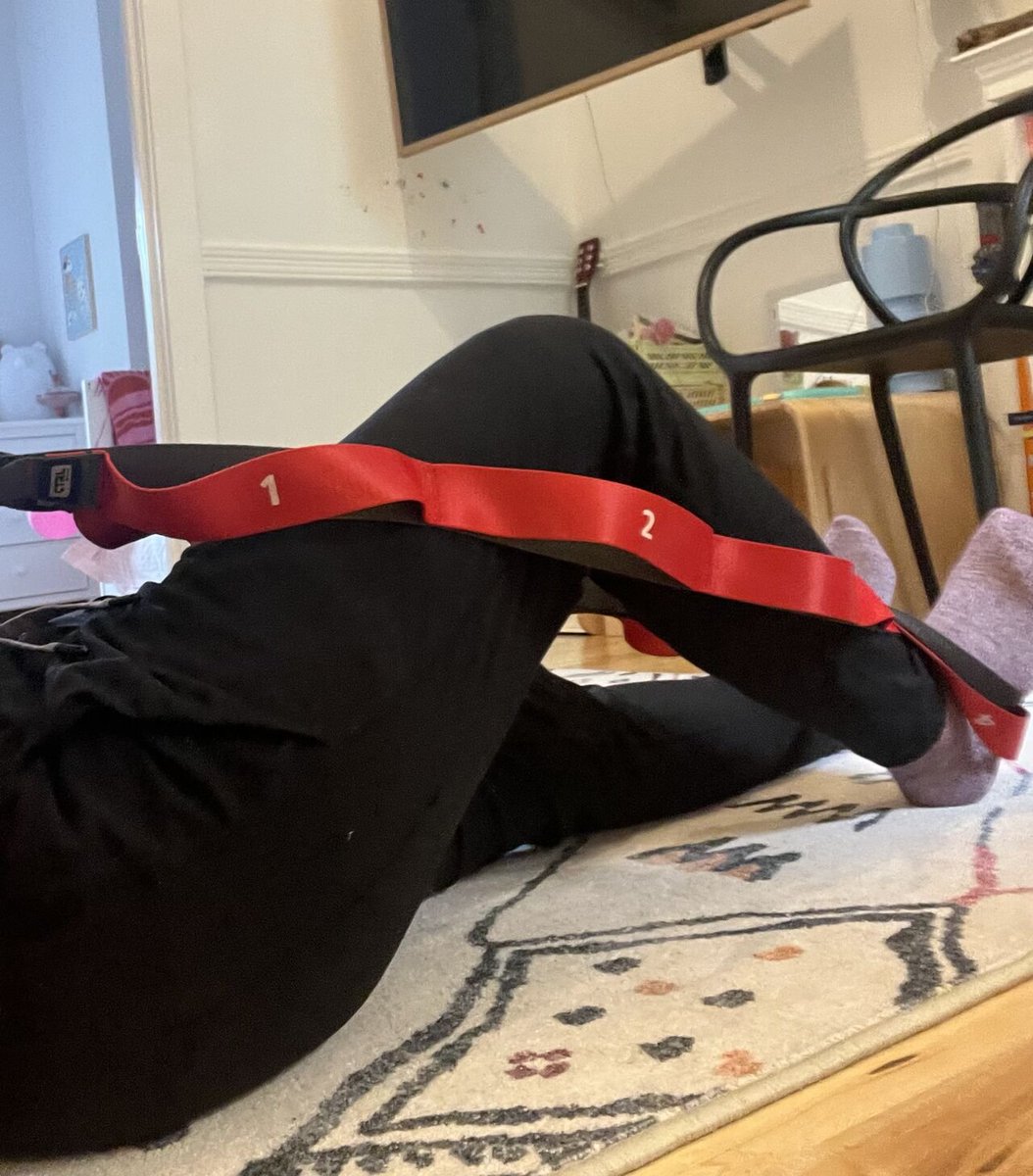
One of my 3 goals for post-ACL rehab is to restore range of motion (i.e. bending).
This means I’m laying down on the floor multiple times every day, trying to get my heel to come closer to my butt by squeezing a stretching band.
This picture is as far as I can go right now. But it’s 2x as far as I went just a few days ago.
Gotta celebrate the little wins. 1% better every day for the next 6-9 months and I’ll be good as new.
And in case you’re curious about the other two physical therapy goals for rehab: reduce swelling and strengthen quads.
Once all three are in good shape, I’ll be able to walk again with a normal gait.
Hoping to get there in the next 2-3 weeks. Trusting the process and putting in the work 💪
This is fundamentally why we run a profitable business. Because as long as we're profitable, we can sustain. And when you sustain, you have more opportunities for these magic moments. I've found no better way to bump into more magic than to simply be available for it. There's nothing better than that moment of insight, of catching a glint, of seeing a meh transform into an oh wow, we're on to something.
I’ve had a front row seat to rounds of layoffs at four companies, having been both the employee being laid off, and also the employee who “survived” a layoff.
Many people recently experienced a layoff or might in the near future (hopefully not) so I wanted to offer some thoughts about the topic with the goal of normalizing the layoff experience and reminding people that it’s not the end of the world.
I've been laid off three times and survived two rounds of layoffs across four companies, including: Life360, Breeze, Abstract, Continuum. Each of these experiences taught me something I couldn't have learned any other way.
At Life360, I was already frustrated that I couldn't break into a PM role. Getting laid off with 20% of the company when we hit a growth plateau forced my hand — and I landed my first PM job shortly after at Breeze.
At Breeze, I survived two rounds of layoffs as we downsized from 85 to 25 before being acquired by Ford. This chapter taught me about the simultaneous "survivor guilt" and the real increase in velocity and cohesion that can happen with a smaller team.
At Abstract, I watched Figma eat the market and was laid off with 30% of the company the same day our CEO was replaced. This freed me to go find my next opportunity, which turned out to be Facebook.
At Continuum, we struggled to grow our fractional exec marketplace, leading to a 30% RIF and the CEO stepping into the product function. That pushed me to explore solopreneurship 2.5 years ago, which has been incredible for me.
A few things I've learned from these layoffs:
1) Layoffs aren't personal.
Companies are just people and people get scared and make hard calls to survive. The decision to let you go was never a reflection of your value. It was just business.
2) Surviving isn't always the win it looks like.
Morale craters after a round of layoffs. I've seen it up close. Sometimes being let go is what liberates you from a sinking ship and gets you to somewhere better, faster.
3) Being laid off can accelerate your career.
Both of my layoffs pushed me into roles I might not have had the courage to pursue on my own timeline. The pressure created momentum.
4) Have your story ready.
Interviewers will ask. Know why the layoff happened, what you'd do differently, and what you learned. Own the narrative - don't let it own you.
5) Life genuinely goes on.
In the moment layoffs feels enormous. They're just moments. I've watched so many people land somewhere great within weeks or months.
If you're "in it" right now, my advice is to put yourself out there, build a pipeline, and trust the process. You'll emerge stronger on the other side.
People always do. You got this 💪
@MarcBaselga and I are making Insider Loops incorruptible.
Our inspiration comes directly from what @ericries shared on his recent episode of @lennysan's podcast.
Eric's new book, Incorruptible, dives into the core idea that most "mission-driven" companies are just mission-hopeful and the mission only survives when you build governance around it (before being forced to choose between the mission and the money).
Insider Loops is small today and we're still early. We have every excuse to wait on this stuff.
But Eric's point is that the best time to make a company incorruptible is when there's not much to corrupt.
So we're starting now.
We're writing a mission statement directly into our operating agreement, with both partners required to unanimously agree before it can change. The core commitments:
1️⃣ When a candidate's interests conflict with a recruiter's or hiring company's, we side with the candidate
2️⃣ We only recommend products, services, and approaches we'd actually use ourselves
3️⃣ We won't sell or share candidate data in ways the candidate wouldn't be comfortable with
4️⃣ We won't take money to promote things we don't believe in
Yesterday we took our first action to live up to these new commitments, launching our scholarship program for PMs impacted by layoffs (offering 50% off our interview guides).
The response has been very encouraging, with 50+ applications in the first 24 hours including ex-PMs from Meta, Walmart, AWS, Google, Visa, Mastercard.
A lot of these folks are on visas with 60-day clocks. Some have newborns on the way. Some have been job hunting for 8+ months.
Marc and I are reviewing every single application together, manually.
This is just the first action to make this company incorruptible and more are coming because we want Insider Loops to be the kind of company we're still proud and excited to run in 10 years.
If you're building something you want to last, go listen to Lenny's latest episode with Eric Ries. It literally inspired us to think in more positive-sum ways.
And if you've been impacted by a layoff and want to apply for the Insider Loops scholarship, our form is here: https://t.co/MOUIxqR4st
Meta is cutting ~8,000 jobs today, which is roughly 10% of the company. Many of those impacted will be PMs and we want to help them land somewhere great.
@MarcBaselga and I just launched our scholarship program for Insider Loops, which offers PMs impacted by layoffs 50% off our interview guides.
Impacted PMs can apply here: https://t.co/tg05ReKA5J
This program doesn't just help PMs impacted by the Meta layoff; all PMs impacted by layoffs are eligible. Meta's RIF was just a catalyst for something we've wanted to do since we launched Insider Loops, and we finally shipped it.
PMs who were shipping great work two quarters ago are now being told they’re not needed and unfortunately I think we’re going to see a lot more of this in the coming year. I'm glad to be building something that can actually help.
Landing a role at top companies like OpenAI, DoorDash, Stripe, Anthropic, Figma, Uber, and Google can literally change the trajectory of someone’s life. The comp packages, elite rolodex, brand name, etc are all meaningful. Insider Loops helps land those roles.
We’ve been wanting to give back for a while now. And we’re starting now. The program will run as long as people find it helpful.
We read every application ourselves.
P.S. If you’ve worked at one of the companies we cover (Meta, OpenAI, DoorDash, Stripe, Anthropic, Figma, Uber, Google) in the last 12 months, we’re happy to offer you one guide for free in exchange for substantive feedback that helps make our guide about your past company better. Just mention it on the form 👇
I have zero desire to raise money for Insider Loops right now (Marc feels the same).
That would have sounded strange to me a few years ago.
We recorded our first in-person Supra Insider episode this month, and the part I've been thinking about since is how much I value being able to design the environment I work in.
That's probably the biggest reason raising money doesn't feel attractive to me right now.
VC can be exactly the right move. You get breathing room, can hire faster, buy yourself time, and take bigger swings. For the right kind of company, that trade-off makes a ton of sense.
My hesitation is that once you raise, the operating environment changes. You add investors, board expectations, a fundraising narrative, and pressure to make the company look like it can become massive. Again, maybe that's exactly what the company needs. But it also means more voices in the room.
The part I love about Insider Loops right now is how direct the whole thing feels.
If Marc and I don't like how we're working, we can change it.
If a customer sends us feedback in the morning and we realize there's truth in it, even if the tone is annoying or we don't agree with every claim, we can fix the actual issue immediately.
That's basically how we ended up moving the guides out of Gamma and into our own codebase. One difficult customer interaction made us look at the delivery experience and admit it wasn't good enough. A week later, we had the OpenAI guide built natively, then the other guides moved over too.
And the question changed from "how do we make a better Gamma guide?" to "what should the experience of a guide actually be if we control the whole thing?"
That is super fun to me. Not glamorous fun, but the good kind. The kind where the machine gets better because the feedback loop is tight and nobody needs to approve the obvious next move.
This is the part I think people discount when they talk about starting something.
The outside version is all labels: founder, VC-backed, bootstrapped, consultant, solo builder. The lived version is mostly about who gets to shape your day, your standards, your customer experience, and your definition of success.
Right now, the thing I don't want to give up is agency over the operating environment.
Marc and I work hard, but we get to fit the work into our lives. We get to decide that a plan from Monday is wrong by Wednesday. We get to build a business around reputation, trust, craft, and long-term usefulness instead of needing every decision to ladder up to the next round of funding.
Maybe we change our minds someday. I don't want to turn bootstrapping into a religion.
But today, raising money would simultaneously give us more resources and less control. And we value control because it's a proxy for agency. And agency is everything.
To hear more about how @MarcBaselga and I are building Insider Loops, check out our latest episode: https://t.co/zLJlf7HrN9
I don't understand people who trivialize the value of having fun at work.
Fun is not frivolous.
Fun signals to me that I'm doing something right.
Fun tells me I'm in flow, doing what I should be doing.
When I'm having fun, I'm where I'm meant to be.
The idea that you shouldn't try to have fun at work is nonsense. Life is too short to eat glass all day every day.
But I don't think you can create fun work out of the box. I think you need to create the right conditions for it to emerge.
And if you've ever tried to find work that feels fun, you likely know it's hard.
But I'm telling you - it's worth it.
I know it because building Insider Loops w/ @MarcBaselga generates a sense of fun consistently. I attribute it to a few factors:
→ Impact: work we're proud of and care about
→ Trust: Partners who have each other's backs
→ Agency: Full autonomy over how we operate
→ Results: Tight feedback loops from the market
→ Asset: Every activity makes our asset more valuable
When we put these together, the result in us having fun. It probably helps we've been running a podcast together for over two years. Fun has been the lifeblood of the podcast.
My point is that life is too short to spend on something that drains you and I want to see more people having fun with their work.
If you've found work that feels like play, amazing! Keep it going.
If you haven't yet, it might be time to start asking yourself some questions.
🎙 Marc and I got into this (and a lot more) in our first in-person episode recorded a few weeks ago in NYC. Dropping tomorrow on Supra Insider.
Shame on your @NYCMayor. This is political propaganda masquerading as compassion.
Mamdani erases the fact that the Arab world rejected the UN's partition plan which would have created a Palestinian state and instead launched a war to destroy the newborn Jewish state in 1948.
He ignores that roughly 850,000 Jews were expelled or forced to flee Arab countries in the years that followed.
And he presents “Nakba Day” as though it is about grief, when in reality it is a movement that rejects Israel's existence (and along with it millions of Jews).
In a city where Jews are already facing rampant harassment and violence, this kind of one-sided historical revisionism fuels hostility toward Jews.