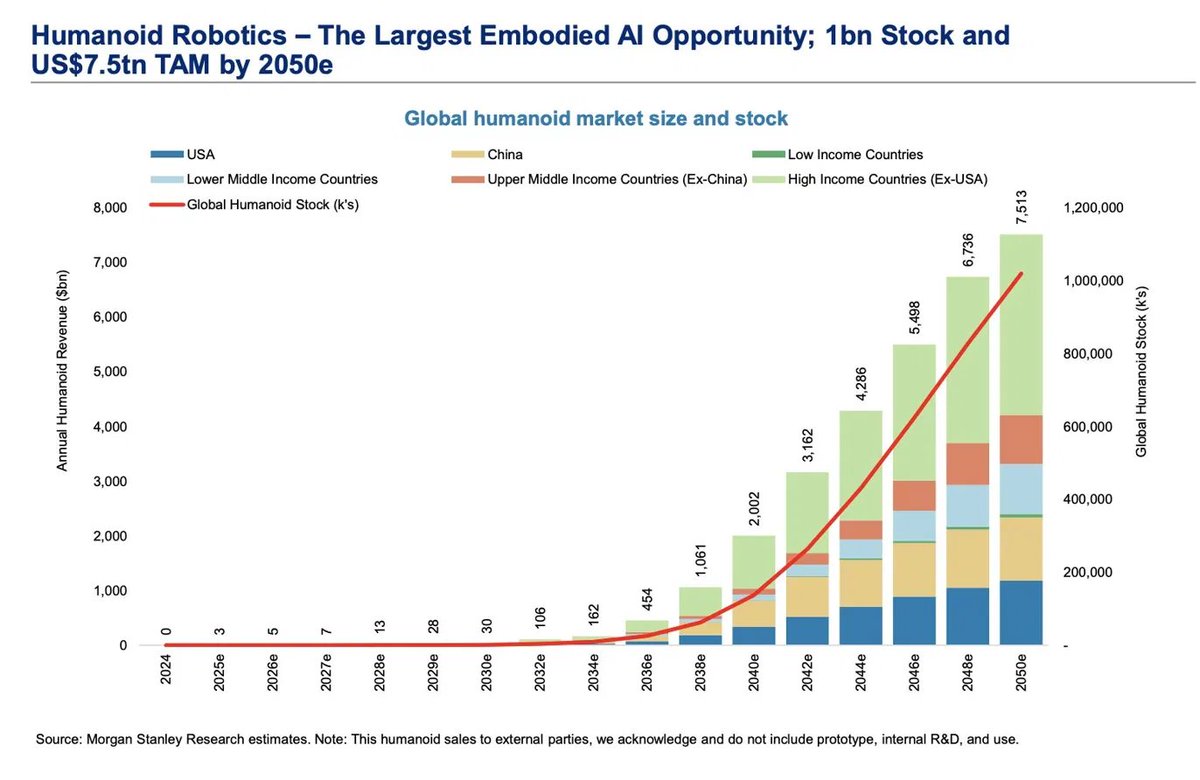
🔥 Morgan Stanley le puso número al negocio de los robots humanoides: US$7.5 trillones de facturación al año para 2050, cerca del doble del tamaño de toda la industria automotriz mundial de hoy
Su Global Humanoid Model traza la curva completa y hoy estamos en el pie de la montaña: las empresas del sector facturan apenas millones de dólares
Lo que el banco proyecta es un crecimiento exponencial: años casi planos y de golpe un despegue vertical
Los hitos del modelo:
- 2030: US$30 billones de facturación anual
- 2040: US$2 trillones
- 2050: US$7.5 trillones al año, o 7.5 millones de millones de dólares, con un parque de 1000 millones de robots funcionando en el mundo
La curva roja del gráfico es ese parque instalado creciendo de casi nada a mil millones de unidades, la mayoría destinadas a fábricas y depósitos, no a los hogares
El otro día te mostré la supply chain que fabrica estos robots y los vehículos para invertir en el tema. Este gráfico es el porqué de todo eso: el tamaño de la ola que explica que cada banco, automotriz y gigante tech se esté acomodando ahora para la foto
Ahora, lo honesto, porque con proyecciones a 2050 es obligatorio
Esta es una de las estimaciones más agresivas de Wall Street y mira a 25 años, una eternidad para cualquier pronóstico. El propio Morgan Stanley advierte que en el corto plazo hay hype, riesgo de shakeout (depuración: muchas de las startups de hoy van a morir en el camino) y una brecha enorme entre el capital que entra y las aplicaciones reales probadas a escala, que casi no existen todavía
Para dimensionar la incertidumbre: Goldman Sachs, para una fecha más cercana como 2035, proyecta US$38 billones. Que dos bancos top tengan números tan distintos te dice lo temprano e incierto que es todo esto
A mi parecer, los US$7.5 trillones no son una promesa, son el techo de un escenario optimista a dos décadas y media, útil para entender por qué se mueve el capital y no como garantía de nada
La tesis de fondo es sólida (poblaciones que envejecen y costo laboral en alza que empujan a automatizar), pero entre esa tesis y los 7.5 trillones hay un océano de ejecución que recién se está cruzando
My favorite 800V Power Semiconductor stocks ranked:
1. $WOLF (Wolfspeed) $2.7B market cap — The most asymmetric setup in the entire space. Wolfspeed controls the SiC substrate bottleneck, the foundational material every other SiC device maker needs. If the fab reaches target utilization, revenue could 3-5x from the current ~$713M run rate, and gross margins would inflect from negative to 40%+. At $2.7B, the market is pricing in heavy skepticism. A successful execution would make this a $10B+ company.
2. $NVTS (Navitas Semiconductor) $6B market cap — If Navitas captures even 2-3% of the AI data center power conversion TAM over the next three years, that’s a $500M+ revenue business on a fabless cost structure with 40%+ gross margins. The GaN IC technology is proven, the GeneSiC SiC portfolio adds a second vector, and the 59% revenue concentration in one AI-infrastructure distributor tells you where the growth is coming from. From a 3-year view, the revenue base could be 10x larger than today.
3. $AEHR (Aehr Test Systems) $1.5B market cap — The purest picks-and-shovels play on SiC scaling. Every SiC wafer that Wolfspeed, onsemi, STM, Infineon, or Rohm produces needs burn-in testing, and Aehr’s FOX-XP platform is the standard tool. Revenue is ~$100M and growing rapidly, but SiC production volumes are projected to 5-10x over the next five years. Aehr’s revenue is directly levered to that ramp with high incremental margins. A $100M revenue equipment company serving a market that’s about to quintuple has obvious math.
4. $VICR (Vicor Corporation) $5B market cap — Vicor’s factorized power architecture and power-on-package modules solve a physics problem that gets worse with every GPU generation: delivering 1,000+ amps at sub-1V to a processor die without unacceptable voltage droop and heat. If this architecture becomes standard in AI accelerator designs, Vicor’s content per server could be $500-1,000+. Revenue is ~$400M today. In a bull case where 2-3 major AI chip platforms adopt Vicor’s approach, this is a $2B+ revenue company at 50%+ gross margins, a $25B+ market cap.
5. $AOSL (Alpha & Omega Semiconductor) $1.5B market cap — The most overlooked name in power semi. AOSL makes power MOSFETs and PMICs for computing, server, and industrial applications. At $1.5B market cap and ~$650M revenue, it trades at ~2.3x sales, a fraction of MPWR’s 37x. The company is modestly profitable, has real products shipping into server power applications, and would benefit enormously from any broadening of AI power demand beyond the top-tier suppliers. This is the deep value pick: if the AI power theme lifts all boats, AOSL re-rates from 2x to 5x sales and the stock doubles without heroic assumptions.
Honorable mentions:
$DIOD $XFAB $ON $POWI $MPWR
Did you remember my $AXTI InP substrate bottleneck call last year anon?
IntelliEPI CEO (Q1 2026 ER):
"The InP substrate shortage is a bottleneck for the entire AI infrastructure"
Digitimes: "Taiwan's IntelliEPI warns of severe indium phosphide supply shortage"
I said as photonics ramps: There was going to be a major InP bottleneck as all the next-gen AI architectures go optical.
This was most goated call with AXT as the upstream chokepoint.
I'm usually a few months ahead of time, but they play out directionally.
While I'm sitting in existing bottlenecks up 1800%+, I'm long CPO as the next major supercycle.