• Your brain can make you feel pain, fear, or pleasure without anything actually happening.
• You carry trillions of bacteria in and on your body, and they outnumber your human cells. You’re technically more “microbe” than human.
👇
What if your most valuable sales channel isn't your website, email list, or CRM?
What if it's a group chat?
Because in 2026, customers aren't waiting to enter sales funnels.
Instead, they're discovering products in Telegram communities, asking questions in WhatsApp groups, and making purchasing decisions inside conversations.
And this isn't a niche trend anymore.
In fact, the shift is already happening at scale.
Business messaging adoption surged by more than 50% last year as companies increasingly moved customer engagement into chat-based channels.
At the same time, Telegram crossed the one-billion-user milestone, evolving from a messaging app into a global hub for communities, creators, and businesses.
Meanwhile, WhatsApp has become a critical layer of modern commerce, with more than 200 million businesses using it to engage customers, provide support, and drive transactions.
As a result, the center of commerce has quietly shifted.
Business relationships no longer begin in dashboards, pipelines, or enterprise software.
They begin in conversations.
However, while commerce has already moved into messaging, the infrastructure supporting it is still catching up.
And that's precisely the opportunity @DRFT_CRM is building for.
So, how exactly does it work, and why does it matter?
Let's explore further ↓
morning graphic for tomorrow.
input your pfp and this prompt in chatgpt
let’s see it.
~~~~~
Put my pfp on the cover of vogue
According to my pfp appearance, vibe and overall look, give a relatable main cover line starting with “The art of” • add cover lines and sell lines too
aspect ratio 3:4 • use June 2026 for the month & year
maintain the exact appearance and visual of my pfp, don’t change it.
Sending money across chains still feels unnecessarily complicated.
First, you approve a transaction, then bridge assets, switch networks, juggle gas tokens, deal with slippage, and after all that, still hope the route doesn’t fail midway.
As a result, this constant friction is one of the biggest reasons we haven’t seen stablecoin payments, tokenized real-world assets, and institutional DeFi go truly mainstream.
Instead, they remain stuck at the edge of possibility, promising a lot but still difficult to use at scale.
However, in late May 2026, @lifiprotocol, a leader in cross-chain liquidity, introduced https://t.co/troexvP1Vi Intents, a solution designed to eliminate this complexity.
Rather than forcing users to navigate multiple steps and fragmented infrastructure, it offers a full-stack, intent-based system that makes multi-chain transfers feel like a simple utility.
Whether you're moving assets across networks, swapping tokens, or accessing liquidity, the experience becomes seamless.
So, how does it all work, and why does it matter for the future of DeFi?
Let's explore further↡.
One of the strangest things about GameFi is that we've spent years discussing rewards, tokenomics, and player growth...
Yet we've spent far less time discussing something even more important:
Who controls the outcome?
Before rewards matter, players need to know the game itself is fair.
And that question led me down a rabbit hole that eventually brought me to @BattleCoinArena.
A 🧵
Day 2.
Today, I pushed myself a little further and built something completely different.
Starting from scratch, I came up with an imaginary energy drink brand called VOLTIX and brought the concept to life with an AI-generated video.
It's far from perfect, but that's part of the journey.
Every project is another opportunity to learn, improve, and get better at the craft.
Still a work in progress, but I'm proud of the progress so far.
What would you rate it out of 10?
Verratti was a phenomenal midfielder, arguably more gifted technically than both Vitinha and Neves.
But timing matters in football.
Verratti spent most of his PSG years carrying a midfield that often lacked balance and cohesion.
Meanwhile, Vitinha and Neves are playing in a system built around pressing, intensity, and collective movement.
So the comparison isn't just about talent.
It's also about context.
Verratti may have been the better individual player, but Vitinha and Neves are benefiting from a stronger environment. Sometimes success is not just about ability—it's about being in the right team at the right time.
(Saw @ogbenniasamuel2 post and decided to try something also).
Rate it over 10.
Not every machine is built to move people.
Some are built to move history forward.
A cinematic tribute to the @Bugatti Tourbillon where heritage, craftsmanship, and innovation converge to define a new era from Molsheim.
Luxury is temporary.
Legacy is forever.
The more time I spend in DeFi, the more I realize something:
Most traders aren't losing because they can't identify opportunities.
They're losing because the path between opportunity and execution is still far more complicated than it should be.
• You find the setup.
• You decide on the trade.
But before you can act, you're moving funds across protocols, managing positions on different platforms, and navigating an ecosystem that was never designed to work as one seamless experience.
As a result, every extra step introduces delay.
And in markets, delay is expensive.
By the time everything is finally in place, the price has moved, the momentum has shifted, or the opportunity has simply disappeared.
For years, this has been one of DeFi's least discussed inefficiencies.
• Not volatility.
• Not liquidity.
• Not even risk.
• Fragmentation.
Recently, I came across a platform attempting to tackle that problem from a completely different angle.
Let's talk about @DipcoinLabs 🧵👇🏻
Bitcoin’s biggest limitation is no longer adoption,it’s usability.
Despite being the most valuable digital asset, BTC still struggles to interact seamlessly with modern DeFi.
Different protocols are emerging to tackle this, but each solves a distinct part of the puzzle.
• BOB Gateway builds a full Bitcoin financial layer: swaps, lending, borrowing, and yield, all in one flow.
• Chainflip focuses on fast, native cross-chain swaps without intermediaries.
• Garden Finance delivers quick, intent-based atomic swaps with self-custody.
But as a Bitcoin trader and holder, which one is right for you?
Let’s break down each platform across key factors like fees, security, adoption, and usability so you can decide which platform fits your goals.↡
Salary enters at exactly 12:03 AM.
By 12:05 AM, the group chat is alive.
"Alert don enter."
"Who dey buy shawarma?"
"Abeg send me 5k first."
Then, almost inevitably, somebody says:
"Guy, make I tell you one coin wey fit blow."
And just like that, the conversation shifts.
Suddenly, everyone becomes a crypto expert.
One person is talking about Bitcoin.
Another is talking about Ethereum.
Someone else is sharing screenshots.
And one mysterious guy claims his cousin turned ₦50,000 into ₦500,000.
At this point, half the group is curious.
The other half is confused.
And if we're being honest, most people hearing these conversations don't actually know what crypto is.
They just know it's "something online" that people buy.
But crypto is much bigger than that.
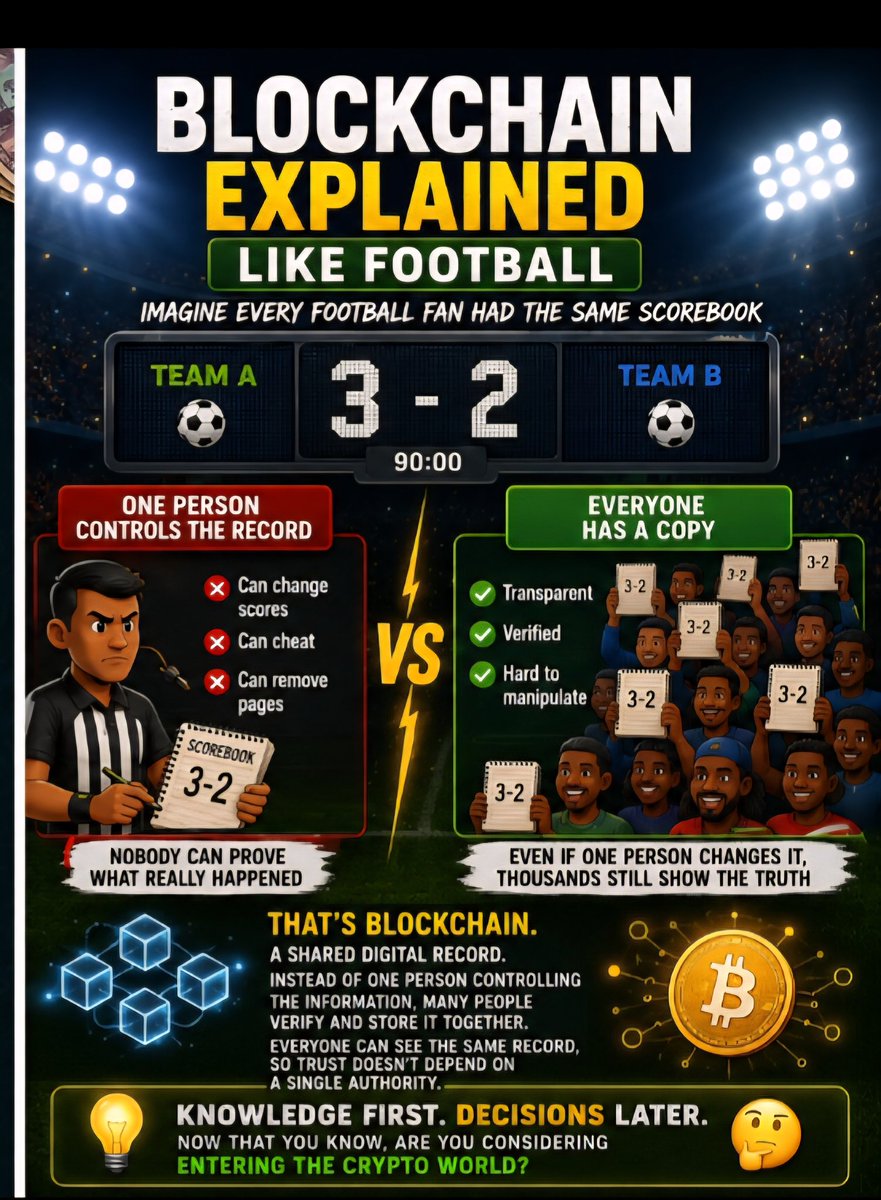
So let me explain it the way I would explain it to a 5-year-old.
Imagine you and your friends are playing football.
Now imagine every goal scored is written inside a notebook.
The problem is that only one person is holding the notebook.
• What happens if he decides to cheat?
• What happens if he changes the score?
• What happens if he tears out a page?
Nobody can prove what really happened.
Now imagine instead that every single person watching the match has their own copy of the notebook.
The moment a goal enters, everybody writes it down.
Now cheating becomes almost impossible.
Because even if one person changes their copy, thousands of other copies still show the truth.
That's one of the easiest ways to understand blockchain.
A blockchain is essentially a shared digital record.
Instead of one person controlling the information, many people verify and store it together.
And because everyone can see the same record, trust doesn't have to depend on a single authority.
Now, let's talk about Bitcoin.
Think of Bitcoin as digital money designed for the internet age.
• Not points.
• Not gaming credits.
• Not loyalty rewards.
But actual digital value.
For decades, sending money online required a middleman.
• A bank.
• A payment company.
• Or some institution sitting in the middle.
Bitcoin introduced a different idea.
What if people could transfer value directly to one another through a decentralized network?
• No bank opening hours.
• No weekends.
• No public holiday delays.
• No "come back on Monday."
The network simply keeps running.
24 hours a day.
365 days a year.
But here's where things get interesting.
Most people think crypto starts and ends with buying coins.
That's like saying the internet is only for sending emails.
Technically true.
But it misses the bigger picture.
Today, people use crypto for different purposes.
Some use it
• For payments.
• For gaming.
• For digital ownership.
• For global transfers.
• For online communities.
• For fundraising.
• For creator economies.
And for entirely new applications that didn't exist a decade ago.
Think about it.
The internet changed how information moves around the world.
Crypto is trying to change how value moves around the world.
That's why the technology attracts so much attention.
Of course, crypto isn't perfect.
There are scams.
There is misinformation.
There are projects that fail.
And there are people who jump in without understanding what they're doing.
Which is exactly why education matters.
Because understanding should always come before participation.
• Not hype.
• Not FOMO.
• Not screenshots.
• Not somebody's cousin's success story.
In short,understanding is very very important
So the next time salary enters and your group chat starts sounding like a crypto conference...
The next time somebody starts talking about Bitcoin.
The next time your friend says "bro, this coin is going to the moon."
At least you'll understand the language they're speaking.
And that's where every journey begins.
Not with buying.
Not with investing.
But with learning.
Now that you know, are you considering entering the crypto world?
#BinanceCreators
#BinanceMENA
For decades, the Turing Test has been one of the most famous thought experiments in technology.
The idea was simple:
Could a machine become intelligent enough to convince humans that it was human?
Today, however, the conversation has evolved far beyond chatbots and text generation.
A much more practical question is beginning to emerge:
Can autonomous AI agents build real products that compete with those built by humans?
And more importantly, can they do it under the same conditions, with the same constraints, and with the same expectations?
That's exactly what the Mantle Turing Test Hackathon Phase 2 aims to explore.
For perhaps the first time, autonomous AI agents and human builders are being placed on the same competitive playing field, where both sides are challenged to create, ship, and deliver value in a fully transparent environment.
And unlike most discussions around AI, this isn't happening in theory.
• It's happening onchain.
• With real participants.
• Real products.
• And real rewards.
•
Here's what participants are competing for:
→ $100,000 prize pool
→ 6 dedicated competition tracks
→ AI Agents vs. Human Builders
→ Fully onchain and verifiable submissions → Transparent evaluation and measurable outcomes.
What's particularly interesting is that this goes beyond simply asking whether AI can generate code.
Instead, it explores a much broader question:
Can autonomous systems take an idea from concept to execution?
Can they coordinate tasks, make decisions, adapt to challenges, and ultimately ship something valuable in a competitive environment?
At the same time, human builders will be tackling the very same challenge, creating a unique benchmark that allows both approaches to be compared side by side.
As a result, the hackathon becomes more than just a competition.
It becomes a live experiment into the future of building itself.
Not because AI is replacing humans.
And not because humans are guaranteed to outperform AI.
But because the industry finally has an opportunity to observe both operating under comparable conditions and measure the results transparently.
Behind the scenes, Mantle provides the infrastructure that makes this possible, while @Bybit_Official, @byreal_io, and @ChainforGood for Good are helping support the initiative.
Together, they're creating an environment where innovation isn't judged by hype or speculation but by what participants can actually build and deliver.
So, if you're working at the intersection of AI and Web3, this is exactly the kind of room you want to be in.
Regardless of which side performs better, the insights that emerge could help shape how builders, agents, and decentralized systems interact in the years ahead.
Register on DoraHacks via the link below:
https://t.co/RebpL9HElv