Father. Cloud and GenAi builder at AWS. Technical advisor for business execs across many industries.
All opinions expressed here are mine and mine alone.
@Arjunjain For a CEO of an AI company you'd hope you know better than to get into a useless argument on technology with Elon..... But sure! You must be right! Look back at what you wrote and see howuch is based on analogy with what everyone else does and how much on first principles
@monk_stuff@niccruzpatane@Tesla Try again... You are ignoring things conveniently and you are now upgrading the BMW to EV in order to try to get close to the model 3.... Interesting isn't it?
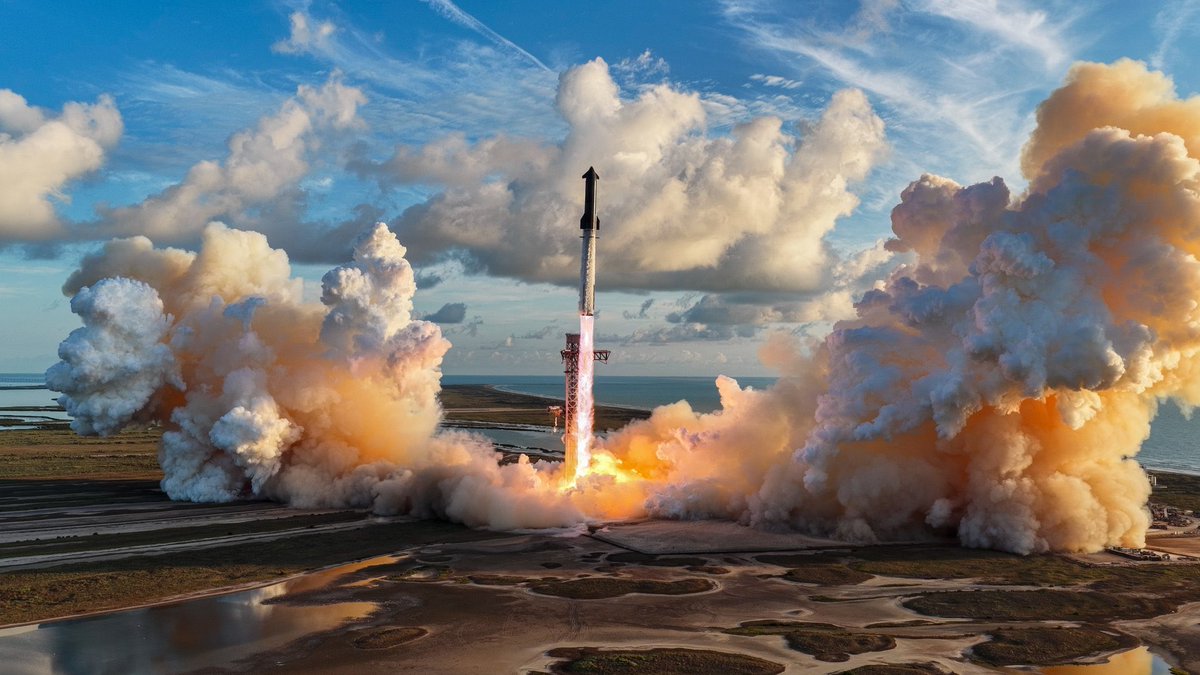
I find it funny that some people got hung up on Starship not having gone orbital before Flight 14 when in the grand scheme of things it was completely arbitrary in terms of performance. The 19ish second burn only added about 91 m/s of velocity (a 1.2% increase in velocity)
This capability has been physically capable since Flight 6 which demonstrated a single Raptor relight in space. Heck, Flight 13’s burn was about 14 seconds, but intentionally oriented to primarily do a plane change instead of a prograde insertion burn for continued safety.
Any of the relights COULD have done the orbital insertion burn, the duration was not of any special technical capability. The reason Starship didn’t go orbital until Flight 14 is probably what we should applaud them for the most… SAFETY.
Their methodical approach to getting good data and going one step at a time while hucking the single most massive object ever put into space proves they weren’t just doing things haphazardly, despite the occasional narrative from the outside.
While it’s easy to compare Starship to vehicles like SLS or Vulcan or New Glenn, the reality is the focus hasn’t been on orbit, it’s been all on the “downhill” side of that. Safe and targeted de-orbit, clean reentry, targeted and soft splashdown. That’s the part that has (almost) never been done before.
And here I do have to add a little Space Shuttle admiration for figuring out a lot of these things on its first flight in 1981 (although it came a bit close to not being successful). Pretty amazing there was a vehicle of similar scale capable of such precise deorbit and reentry that it landed on a runway with no go-around capabilities. Crazy.
But Starship is well on a path to absolutely leap-frog the Space Shuttle in terms of performance (already over double and someday 6 fold) and hopefully in terms of full and rapid reuse. I hope we see the latter part speed up even more now that orbit has been demonstrated.
Exciting times ahead!!! Keep going @spacex@elonmusk
1/7
SSE might be the most overloaded acronym in IT. 🧵
Tell a CPU engineer, a web dev, a security architect and a data scientist "we're working on SSE" and you'll get four different movies.
Here's one acronym living 8 lives, in order 👇
2/7
1805 📉 Sum of Squared Errors
Legendre's least squares. Still the number your regression model sweats over.
1999 ⚡ Streaming SIMD Extensions
Intel, Pentium III. Originally "Katmai New Instructions". Its descendants still ship in every x86-64 CPU.
3/7
2000 🔐 Searchable Symmetric Encryption
Song, Wagner & Perrig: search data you can't read. Crypto got there before the cloud.
2005 🔄 Simple Sharing Extensions
Microsoft's Ray Ozzie made RSS two-way. Later renamed FeedSync. Extinct, but ambitious.
4/7
2006 📡 Server-Sent Events
Opera ships it as an experiment; it's now part of the HTML standard (EventSource).
Today it's the plumbing behind streaming AI chat replies, token by token. Glow-up: complete.
5/7
2011 🪣 Server-Side Encryption
AWS S3 launches it as opt-in. Since January 2023, every new object gets it by default.
It even has sub-flavors: SSE-S3, SSE-KMS, SSE-C. Acronyms inside the acronym.
6/7
2021 🛡️ Security Service Edge
Gartner split the security half off SASE (Secure Access Service Edge, 2019) and gave it its own category. An acronym spin-off, and vendors rushed to the spin-off.
7/7
Always 👔 Senior Software Engineer
Lurking in job titles (also: Software Support Engineer). Recruiters love an overload.
Moral: in IT, acronyms don't die, they get reused. Always ask "which SSE?" first.
Your most-met SSE? 👇 #TechHistory
@Tooth_Chipper If it can do that, it will be able to do more maneuvers, smoother or even not need to make them if the planing is different. You can't judge the future strictly to the present. Imagine saying the same about the first plane...
@Rainmaker1973 Hubble was supposed to last 15 years but lasted 36; in space, where there is radiation and all kind of "deadly" things for technology. Same story with rovers on Mars. And yet, people, scientists even, keep saying that we can't make things that survive in space or on Mars...