30 min book reading every day (15 yrs)
45 min workout every day (12 yrs)
30 min meditation every day (7 yrs)
60 min tennis every day (6 yrs)
1 IG reel every day (4 yrs)
1 youtube shorts every day (4 yrs)
2 youtube long form videos every week (6 yrs)
1 newsletter every week (6 yrs)
1 course every week (6 yrs)
1 lunch date with ruchi every week (6 yrs)
1 team offsite every qtr (6 yrs)
1 book every year ( 6 yrs)
100+ days of travel every year (5 yrs)
consistency >>>>
FY26 was a special year for Meesho. It was our first year as a public company.
When we started Meesho, the ambition was never just to build another e-commerce platform. We wanted to make it possible for more Indians to participate in e-commerce, not only as consumers, but as entrepreneurs.
That still drives how we think today.
For a small business owner, participating in e-commerce shouldn't require significant upfront investment or deep technical expertise. A logistics entrepreneur shouldn't need end-to-end capabilities to benefit from the growth of e-commerce. And a creator should have the opportunity to turn their creativity and influence into a source of income.
Over the years, we've built Meesho around removing these barriers.
Our zero-commission model allows sellers to participate without paying commissions to Meesho. Technology is making it simpler for them to catalogue, advertise and understand demand. Valmo is opening the logistics ecosystem to more entrepreneurs, while content commerce is creating new ways for creators to monetise their influence.
FY26 showed how quickly that ecosystem is expanding:
Our active seller base grew 87% to 961,000 sellers
Annual Transacting Users grew 33% to 264 million
Marketplace NMV grew 38.6% to ₹41,560 crore
Revenue from Operations grew 34% to ₹12,626 crore
63,000+ active content creators generated more than 1.4 million pieces of order-generating content
We've come a long way, but millions of entrepreneurs have still never sold online, and a great deal of logistics capacity and creative talent still sits outside the digital economy.
For me, that's what makes the opportunity ahead so exciting. Every barrier we remove gives someone new the ability to participate, build and grow.
Thank you to everyone who has placed their trust in us and continues to be part of this journey.
Read our FY26 Annual Report here: https://t.co/AC55coF0gg
A couple days ago a founder sat thinking silently for a minute and fifteen seconds before answering a question I asked. (This is an estimate, because I only started timing him after about thirty seconds.) One of the smartest founders I've met too.
Studied 900 people who'd call themselves successful. All of them earned their dopamine the same five ways.
1. Working hard at something real.
2. Getting stronger through boring, repeated routines.
3. Learning something that actually challenges them.
4. A conversation that changes how they think.
5. Sitting with a problem long enough.
None of that gives you a hit immediately. That's exactly why it works.
Elon Musk was asked by an interviewer what he does when he makes a wrong decision.
He said he doesn't make decisions based on being right. He makes decisions based on expected value. Which means he expects to be wrong frequently. He said if you're not wrong at least 30% of the time you're not making enough decisions.
He described SpaceX's approach to rocket design. Instead of spending years perfecting a design on paper and then building it, they build it fast, launch it, watch it explode, and use the explosion as data for the next version. The explosions aren't failures. They're the fastest way to generate the information needed for success.
He said most companies fail not because they make bad decisions but because they make too few decisions. They spend so long trying to be right that the opportunity passes. A wrong decision made quickly generates data. A delayed decision generates nothing.
Then he said the part that made the interviewer go quiet. He said the biggest mistakes of his career weren't the times he was wrong. They were the times he was right but too slow. The times he knew the answer and waited for more confirmation before acting. The delay cost more than any wrong answer ever did.
The world sees Elon as a risk taker. He sees himself as someone who moves fast enough that the cost of being wrong is always lower than the cost of being slow. That's not the same thing as courage. It's math.
Your mind becomes sharper when your life has fewer unresolved loops. Unanswered messages, half-finished tasks, vague plans, and delayed conversations running in the background drain you. Clarity comes from mental peace.
The most interesting person in any crypto conversation is the one whose business depends on adoption and still gets asked to defend it publicly. That's a real stress test, not a talking point. If India really is the largest crypto market by users, the accountability structure hasn't caught up to the volume yet. Being early on users while being late on protection is exactly how bubbles get remembered as bad luck instead of bad design.
one common trait I find in high achieving individuals is urgency. it looks almost like impatience until you understand it is closer to reverence, a deep refusal to waste the one thing they can’t buy more of. the alarm goes and they rise. the message is answered while it is still warm. the small task is done before it can find a shelf to hide on. they commit and move in a single motion. an idea sparks and they chase it that day, before the world talks them out of it. they run at their own lives like something is at stake, because they have decided something is.
While there are many behaviors needed to guarantee high output, there is one single behavior guaranteed to prevent all output: trying to please everyone.
Today's read:
design for your most demanding customer, and everyone less demanding follows along. It's a useful gut-check before your next campaign brief.
Narrowing the target on paper is often what makes the real audience bigger.
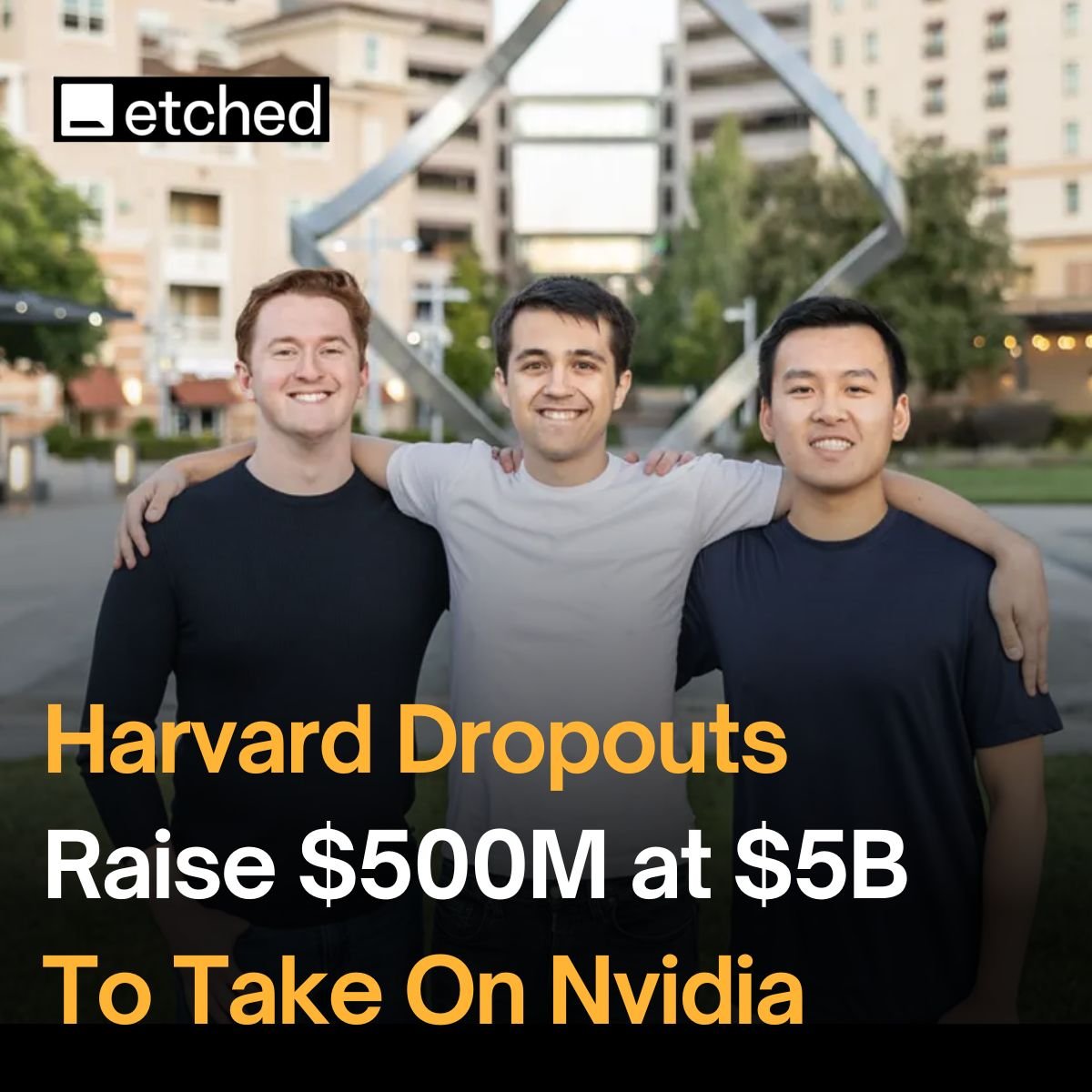
The Etched story is incredible, as shared by Elana Gold of Two Roads 👉
In 2023, three Harvard dropouts were pitching a 30-page memo arguing that AI would eventually need specialized chips, not just GPUs.
Most investors passed.
The company was running month-to-month.
Close to out of cash.
Today, Etched just came out of stealth with $800 million raised, $1 billion in customer contracts, and a $5 billion valuation.
It started at Harvard in 2022.
Gavin Uberti was on a gap year, writing compilers at OctoML. He kept running into the same problem: the chips weren't built for the workloads that mattered. He started Zoom calling Chris Zhu, who was still on campus studying math and computer science. Robert W., who had been running a nonprofit baking birthday cakes for underprivileged kids while launching startups, joined them.
What began as a dorm room project became a conviction.
Transformers would dominate AI. Whoever built chips specifically for transformers would win.
By spring 2023, all three dropped out, became Thiel Fellows, and moved to the Bay Area.
They raised a $5 million seed round. Then hit a wall.
Most VCs didn't buy the thesis. Specialized chips for one architecture? Too risky. They were burning through runway with no clear path to the next round.
Then inference became the bottleneck.
Training happens once. Inference happens every time a model runs. As AI shifted from chatbots to agents running 24/7, inference costs started eating companies alive.
Suddenly the thesis made sense.
The investor list now reads like a who's who: Peter Thiel. Geoffrey Hinton. Andrej Karpathy. Fei-Fei Li. Stanley Druckenmiller. Jane Street. Two Sigma.
They brought in Mark Ross, former CTO of Cypress Semiconductor. Built a team of 400+ engineers from NVIDIA, Google TPU, Broadcom, and SK Hynix. Partnered with TSMC on 4nm manufacturing. Set up a San Jose data center with a path to gigawatt-scale production by 2027.
Their chip is called Sohu. It hard-codes transformer architecture directly into silicon.
The performance claim: a single 8-chip Sohu server can process over 500,000 tokens per second on Llama 70B. A comparable 8-GPU H100 setup runs around 23,000.
That's not incremental. That's 20x.
The catch: Sohu only runs transformers. If AI moves on, the chips are worthless.
Two years ago, they couldn't close a round.
Today: $800 million raised, $1 billion in contracts, and their just getting started.