Sen. Blumenthal: What lessons can USAF learn from Ukraine?
Gen. Niemi: Ukraine is building a million drones a month. We think in dozens; they think in mass production. The AF is adopting that lesson through low cost cruise missiles and affordable mass munitions. 1/
“I don’t think I can think of another condition that would be treated this way.”
Dr Anna Brooks, Liggins Institute.
A powerful opening to Zoe Madden-Smith’s award-winning RE:News documentary on #MECFS
Also featuring @rhirhiarhii
1) Impressive paper from Iwasaki’s lab pointing at autoimmunity in a subgroup of Long Covid patients. They replicated previous experiments of human antibody transfer causing symptoms in mice.
A couple of findings that stand out…
CEOs are quietly realizing the AI replacement plan has a problem.
Two problems, actually.
One: the token costs for running AI agents are now exceeding what they were paying the employees they fired.
Two: when the tokens run out, the AI stops. Just stops. No continuity. No workaround. Just a spinning wheel where your workforce used to be.
You fired humans to save money and bought a subscription that bills you into a corner.
The employees you let go knew what to do when things broke.
The AI just invoices you for the outage.
And then there��s the permission problem nobody wants to talk about.
To do its job, the AI agent needs access. Full access. Your systems, your patents, your contracts, your future plans. Everything you spent years building, handed over to a process that has no loyalty, no discretion, and no skin in the game.
You didn’t hire a replacement.
You gave a stranger with no soul the keys to everything you own.
Enjoy.
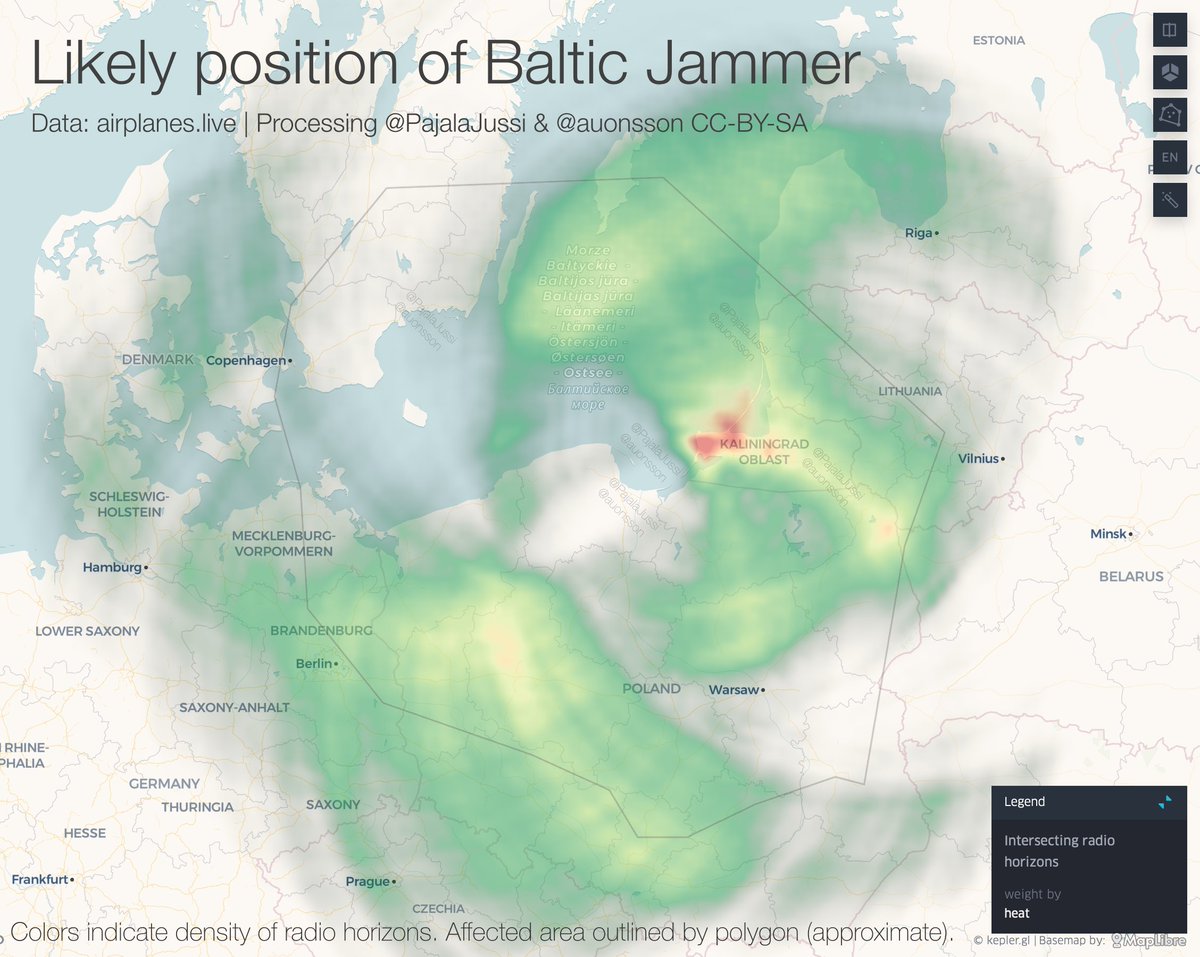
The Baltic Jammer is in Kaliningrad.
5th proof, 3rd method.
This time with numbers on likelyhood. We just need a statistician to tell us how sure we are. Surely over 9000.
@PajalaJussi computed how many radio horizons of first jammed plane intersect. Here, heatmapped.
Anyone who says "summers have always been like this" is lying.
Night time averages are up.
Day time averages are up.
Highest temperatures are up.
Lowest temperatures are up.
Heatwaves are higher and cover more area.
The deniers are liars.
I strongly believe there are entire companies right now under heavy AI psychosis and its impossible to have rational conversations about it with them. I can't name any specific people because they include personal friends I deeply respect, but I worry about how this plays out.
I lived through the great MTBF vs MTTR (mean-time-between-failure vs. mean-time-to-recovery) reckoning of infrastructure during the transition to cloud and cloud automation. All those arguments are rearing their ugly heads again but now its... the whole software development industry (maybe the whole world, really).
It's frightening, because the psychosis folks operate under an almost absolute "MTTR is all you need" mentality: "its fine to ship bugs because the agents will fix them so quickly and at a scale humans can't do!" We learned in infrastructure that MTTR is great but you can't yeet resilient systems entirely.
The main issue is I don't even know how to bring this up to people I know personally, because bringing this topic up leads to immediately dismissals like "no no, it has full test coverage" or "bug reports are going down" or something, which just don't paint the whole picture.
We already learned this lesson once in infrastructure: you can automate yourself into a very resilient catastrophe machine. Systems can appear healthy by local metrics while globally becoming incomprehensible. Bug reports can go down while latent risk explodes. Test coverage can rise while semantic understanding falls. Changes happens so fast that nobody notices the underlying architecture decaying.
I worry.
The U.S. military is considering re-naming the war with Iran “Operation Sledgehammer” if the current ceasefire collapses and war resumes -NBC
The working theory is that it would restart the 60-day War Powers countdown.
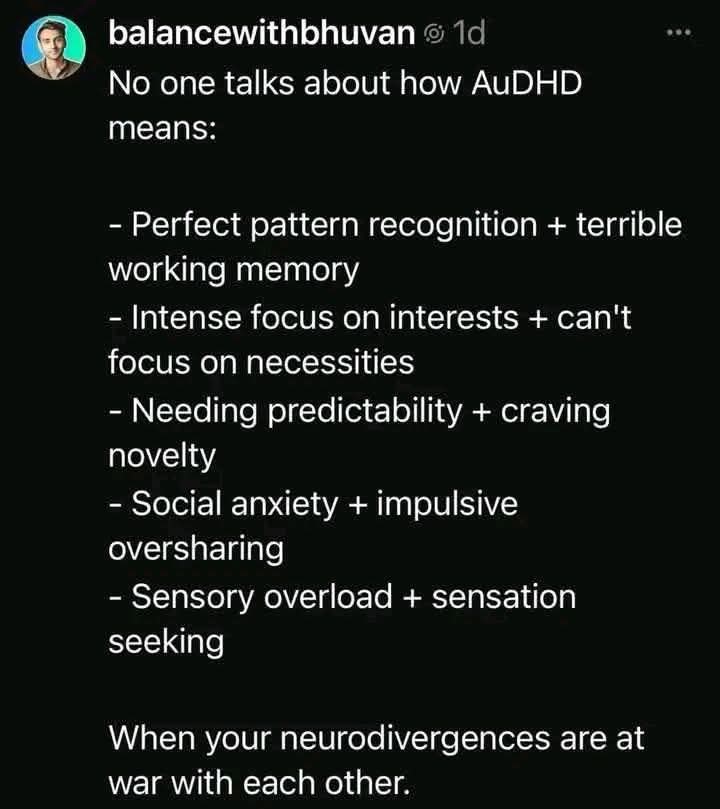
Most people talk in a socially expected way. Autistic people often talk in a “thought-first” way instead. Your voice changes when your brain gets interested in an idea or suddenly connects things together, not mainly because of emotions or social performance.
You also tend to explain extra connected thoughts and side ideas instead of following the expected social conversation script. It is like connecting dots from outside the current conversation. For example: Person: “I had a bad day.” Social script/expected response: “Oh no, are you okay?” That is a “micro social role.” You are performing the role people expect: comforting person.
But an autistic person may instead say: “What happened?” or “Was it because of the meeting earlier?” or “Wait, didn’t this same thing happen last week?” The autistic brain is often trying to understand the pattern or full context first instead of automatically performing the expected emotional response script.
“Parenthetical thinking” means your brain keeps adding connected thoughts inside the conversation. For example: “I went to the shop, actually this connects to what happened yesterday, because the cashier said something weird…” Your thoughts branch sideways a lot instead of staying in one straight line.
And “coherence clicks” means your tone suddenly changes when something mentally “clicks” or makes sense. Like: “WAIT…!! That’s why he reacted like that!” Suddenly your voice becomes more energetic because your brain connected the dots. It feels like an intellectual win when the connection finally makes sense.
My rheumatologist actually did this to me yesterday when i apologized for my broken communication style that doesn’t always emphasize the right points in the right order.
this part of the KIMI K2.6 launch blog is insane:
> it deployed Qwen3.5-0.8B model locally on a Mac.
> coded and optimized its inference in Zig
> (never knew you could do that)
> improved throughput from ~15 to ~193 tokens/sec
> made it 20% faster than LM Studio
> did 4,000+ tool calls, >12 hours of execution, 14 iterations
Only one chance in this lifetime…
Like watching sunset at the beach from the most foreign seat in the cosmos, I couldn’t resist a cell phone video of Earthset. You can hear the shutter on the Nikon as @Astro_Christina is hammering away on 3-shot brackets and capturing those exceptional Earthset photos through the 400mm lens. @AstroVicGlover was in window 3 watching with @Astro_Jeremy next to him.
I could barely see the Moon through the docking hatch window but the iPhone was the perfect size to catch the view…this is uncropped, uncut with 8x zoom which is quite comparable to the view of the human eye. Enjoy.
Let me explain exactly why Apple still uses drag-to-install in 2026, because the joke here accidentally proves Apple right.
A macOS .app is a single self-contained folder disguised as a file. Every dependency, every framework, every resource lives inside it. Drag it to Applications, it works. Drag it to Trash, it's gone. No registry entries. No leftover DLLs. No uninstaller that misses half the files.
Windows installers scatter fragments across Program Files, AppData, the registry, system32, and a dozen temp directories. Uninstalling a Windows app is an archaeological dig. Five years later you're still finding config files from software you forgot you owned.
Linux is worse. Dependency hell is so common they named it. Entire package managers exist to solve the problem of "I installed something and now nothing else works." Flatpak and Snap were invented specifically to copy what macOS bundles already did natively.
The macOS bundle architecture came from NeXTSTEP in 1989. Steve Jobs brought it to OS X in 2001. The core design hasn't changed because the core design was correct. An app is a folder. Installation is a copy. Removal is a delete. Three operations that map perfectly to how humans already think about files.
The drag-to-install window with the arrow isn't lazy UX. It's the entire thesis of the system made visible. You are literally just moving a folder. There is no "installation" step because there's nothing to install. The app is already complete.
Every other OS eventually tried to get here. Windows got MSIX. Linux got Flatpak. Mobile figured it out from day one because phones shipped after Apple proved the model. The pattern everyone else converged toward is the pattern this tweet is calling outdated.
The funniest part: the app being dragged in that screenshot is Claude. An AI that can write code, analyze documents, and reason about complex systems. And the most advanced step in getting it onto your machine is holding down a mouse button and moving your wrist two inches to the right.
That's not a design failure. That's a 37-year-old architecture so good that the most sophisticated software on earth still ships inside it.