@srisiv1 You are a seasoned investor to fall to such data. Risk pricing in loans is such an important element of any loan life cycle. It just signifies poor understanding of risk cycles. Besides, PSU managers have little to lose by extending aggressive loans. Fut cost of ths decisions ?
@DivaJain2 Crude prices fall, prices stay unchanged. Crude prices rise - underrecoveries!! need to raise prices. Cant have it both ways. Need transparency in crude pricing. For nearly a year, lower crude prices did not result in lower pump prices.
@SandeepParekh@ananthng It matters if MFs are buying stock from FPIs who in turn repatriate that money back to home country. In which case its a drain from the domestic banking sector.
Two economists just published a mathematical proof that AI will destroy the economy.
Not might. Not could. Will — if nothing changes.
The paper is called "The AI Layoff Trap." Published March 2, 2026. Wharton School, University of Pennsylvania. Boston University. Peer reviewed. Mathematically modeled.
The conclusion is one sentence.
"At the limit, firms automate their way to boundless productivity and zero demand."
An economy that produces everything. And sells it to nobody.
Here is how you get there.
A company fires 500 workers and replaces them with AI. A competitor fires 700 to keep up. Another fires 1,000. Every company is behaving rationally. Every company is following the incentives correctly. And every company is building a trap for itself.
Because the workers who were fired were also customers.
When they lose their jobs faster than the economy can absorb them, they stop spending. Consumer demand falls. Companies respond by cutting costs — which means automating more workers — which means less spending — which means more falling demand — which means more automation.
The loop has no natural exit.
The researchers tested every proposed solution. Universal basic income. Capital income taxes. Worker equity participation. Upskilling programs. Corporate coordination agreements.
Every single one failed in the model.
The only intervention that worked: a Pigouvian automation tax — a per-task levy charged every time a company replaces a human with AI, forcing them to price in the demand they are destroying before they pull the trigger.
No government has implemented this. No major economy is seriously discussing it.
Meanwhile the numbers are already tracking the curve. 100,000 tech workers laid off in 2025. 92,000 more in the first months of 2026. Jack Dorsey fired half of Block's workforce and said publicly: "Within the next year, the majority of companies will reach the same conclusion."
Nobody is doing anything wrong. Companies are following their incentives perfectly. That is exactly the problem.
Rational behavior. At scale. Simultaneously. With no mechanism to stop it.
Two economists built the math. The math leads to one place.
Source: Falk & Tsoukalas · Wharton School + Boston University ·
What a disastrous policy
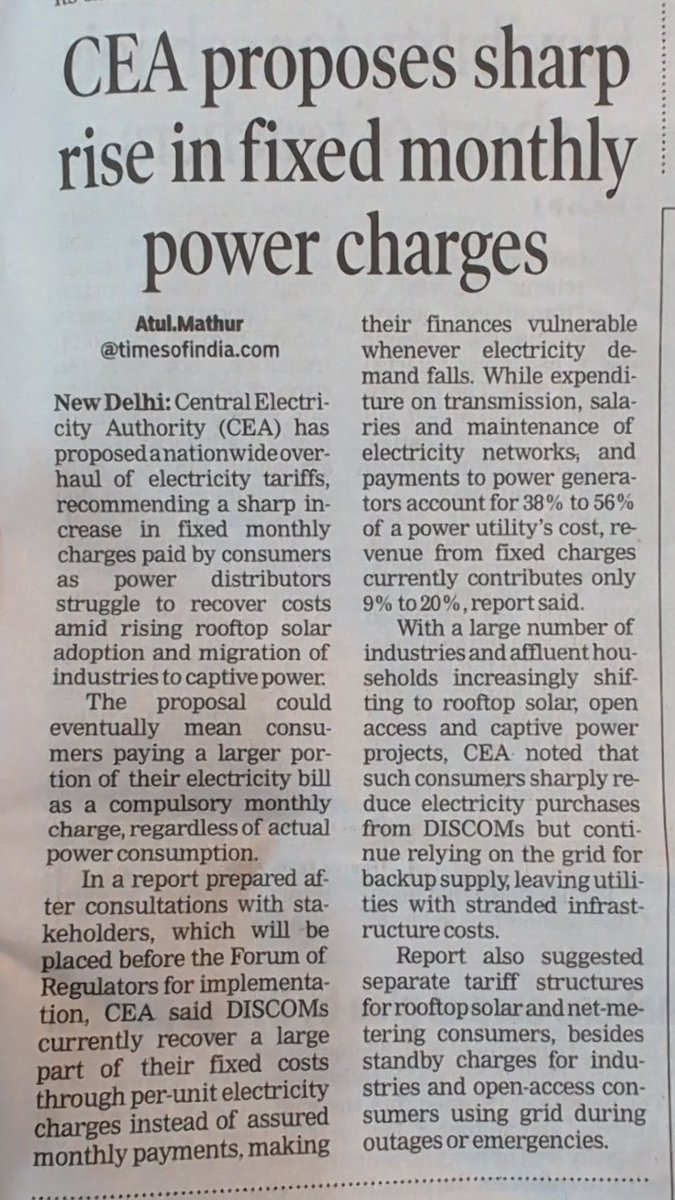
Consumers will be penalized for installing Solar Panels is what this implies
As it is consumers are getting no benefit of the huge Solar Capacity expansion with tariffs rising every year instead of falling
Solar Panel companies are reporting huge profits via PLI plus import tariff protection
@PMOIndia@narendramodi@mlkhattar please scuttled the CEA policy at the bud.
@DivaJain2 If rates are not raised, heavy lifting of financing the CAD has to be picked up by the exchange rate almost entirely. Thats why you got to raise rates.
@Nithin0dha Sorry the math doesn't add up. NRIs can invest in a UST at 4.4%, while in India they are at best looking at 3% return (7% yield - 4% INR depreciation). Unless you compensate them for the risk appropriately, its futile to think that they will flood in with capital.
@harshmadhusudan Real inflation in India is quite understated as compared to headline CPI. Rates in India are too low. The result is financial repression and individuals buying Gold as a way to export savings abroad for better returns. Fix rates, end fin repression, fix CAD and Rupee
@CMOMaharashtra Power shutdown in Vashi Navi Mumbai from 9am to 2pm in peak summer, ostensibly for maintenance. Every quarter there is a shutdown taken for maintenance and yet every day there is power outage. Are we going back to old days of power shutdown every day?
@Noahpinion A 50th percentile Indian is smarter than a 50th percentile American or European. A race doesn't survive a few thousand years without being smart and flexible.
@OnTheNewsBeat Sorry, but our bureaucracy does not really understand the factors that will drive talent back to India. Even if they do, trying to fix the issues will make themselves redundant. And therin lies the problem. Who would want to do things that reduce your own position and power?
Sorry, unacceptable explanation. This station should not have been open to the public if work was not complete. Just imagine the trust you have lost in the entire underground transit system.
Ashwini Bhide, managing director of Mumbai Metro Rail corporation explains here why Mumbai Metro 3 Acharya Atre Chowk station witnessed flooding following Mumbai rains of May 26,2025