I’ve resigned from my role leading the Audio team at Stability AI, because I don’t agree with the company’s opinion that training generative AI models on copyrighted works is ‘fair use’.
First off, I want to say that there are lots of people at Stability who are deeply thoughtful about these issues. I’m proud that we were able to launch a state-of-the-art AI music generation product trained on licensed training data, sharing the revenue from the model with rights-holders. I’m grateful to my many colleagues who worked on this with me and who supported our team, and particularly to Emad for giving us the opportunity to build and ship it. I’m thankful for my time at Stability, and in many ways I think they take a more nuanced view on this topic than some of their competitors.
But, despite this, I wasn’t able to change the prevailing opinion on fair use at the company.
This was made clear when the US Copyright Office recently invited public comments on generative AI and copyright, and Stability was one of many AI companies to respond. Stability’s 23-page submission included this on its opening page:
“We believe that Al development is an acceptable, transformative, and socially-beneficial use of existing content that is protected by fair use”.
For those unfamiliar with ‘fair use’, this claims that training an AI model on copyrighted works doesn’t infringe the copyright in those works, so it can be done without permission, and without payment. This is a position that is fairly standard across many of the large generative AI companies, and other big tech companies building these models — it’s far from a view that is unique to Stability. But it’s a position I disagree with.
I disagree because one of the factors affecting whether the act of copying is fair use, according to Congress, is “the effect of the use upon the potential market for or value of the copyrighted work”. Today’s generative AI models can clearly be used to create works that compete with the copyrighted works they are trained on. So I don’t see how using copyrighted works to train generative AI models of this nature can be considered fair use.
But setting aside the fair use argument for a moment — since ‘fair use’ wasn’t designed with generative AI in mind — training generative AI models in this way is, to me, wrong. Companies worth billions of dollars are, without permission, training generative AI models on creators’ works, which are then being used to create new content that in many cases can compete with the original works. I don’t see how this can be acceptable in a society that has set up the economics of the creative arts such that creators rely on copyright.
To be clear, I’m a supporter of generative AI. It will have many benefits — that’s why I’ve worked on it for 13 years. But I can only support generative AI that doesn’t exploit creators by training models — which may replace them — on their work without permission.
I’m sure I’m not the only person inside these generative AI companies who doesn’t think the claim of ‘fair use’ is fair to creators. I hope others will speak up, either internally or in public, so that companies realise that exploiting creators can’t be the long-term solution in generative AI.
Thankfully, it's pretty rare to see hatefully bad websites among large companies nowadays. But yesterday I tried booking tickets with @Finnair, and boy was that experience a complete trash fire. Random errors preventing debit card payments, infinite loading times. Shame!
@rawrafox@CelGenStudios Regarding tech advances: audio is an area where sometimes we do regress. Eg when Apple changed how their headphone jacks work, so that instead of properly regulating volume they just reduced the digital signal without adding dither, thus causing garbling in low volume scenarios
I worked at Moog for ten years, in production, sales, and lastly tech support. Any warmth that the public felt towards the brand and their instruments existed in spite of ownership. Or, they took the marketing at face value and believed that employees owned the company.
@Qw4z1 Training to be able to pick up children and grandchildren and groceries when I’m 85 is my focus! Bonus if it makes me look good nekkid at some point! 🙂
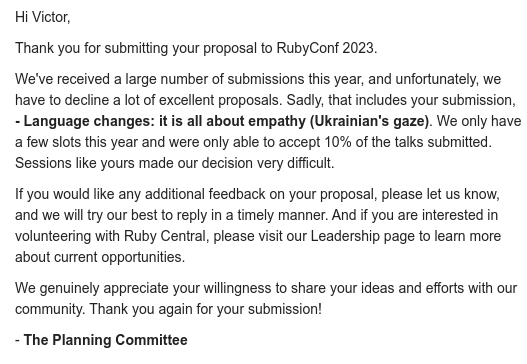
Oh well. Let's not spoil the #RubyConf party with dark material, I guess 🤷♀️(Obviously, I asked to present online. And, well— call me entitled, but I do believe the case deserved at least a personalized rejection, not a standard "there are too many of you" one)
Just published a long and personal article: about how my 2022 went, why I still found some time to work on Ruby programming language, and why it matters to me.
https://t.co/JyYzsQjjMK
1987. The Met Police are waging an intimidation campaign against London's gay community.
Wearing rubber gloves to "protect from AIDS" they raid the Royal Vauxhall Tavern
"Well well," says Lily Savage (Paul O'Grady) on stage. "It looks like we’ve got help with the washing up" /1
@senyeezus Saw it in person, I really enjoyed it! Your rhythm and tempo were great, good balance between memes and serious content. I also appreciated how you didn't make up answers to audience questions you didn't know the answer for. A simple "I dunno" is refreshing.
@RustNationUK Looking forward to the conf! But is it possible to improve the schedule? I'd like to see who the speaker is, and some explanation about the topic of each track.