D2C jewellery brand GIVA has announced Bollywood actor and Hyphen cofounder @kritisanon as its newest brand ambassador and investor. While the specific investment amount remains undisclosed, Sanon is set to play a multi-faceted role beyond her financial contribution, actively participating in brand-building, collection design, and consumer engagement initiatives.👇
The startup, established in 2019 by Ishendra Agarwal, Nikita Prasad, and Sachin Shetty, initially focused on authentic 925 fine silver jewellery. Since its inception, the brand has significantly diversified its portfolio to include 14K and 18K gold, along with lab-grown diamond jewellery.
In addition to its core jewellery lines, GIVA has expanded into lifestyle accessories, offering watch charms, perfumes, and personalized jewellery. This strategic partnership with Sanon is expected to further strengthen the brand's presence in the competitive D2C fashion and fine jewellery market.
🔗 Read the full article here: https://t.co/aowWQEcC47
#Inc42 #news #KritiSanon #D2C #Jewellery
Just crossed 100k applications for the 100 introductory Temple devices.
To the 100 who get one: you're the founding cohort. We'll be grateful for what you teach us.
To the rest: we're building as fast as we can without compromising what @temple needs to be.
Follow @temple for updates.
Hello everyone, here are the highlights from Eternal's last quarter –
- Eternal’s Q4FY26 Consolidated Adjusted Revenue grew 64% YoY (like-for-like) to 17,680 crore
- B2C NOV grew 54% YoY (4% QoQ) to INR 26,880 crore
- Consolidated Adjusted EBITDA increased 160% YoY to INR 429 crore while increasing 18% QoQ (vs INR 364 crore in Q3FY26)
- Blinkit NOV growth remains strong at 95.4% YoY (8.2% QoQ)
- Food Delivery NOV growth at 18.8% YoY (-0.9% QoQ) - continues to improve for the third quarter in a row, inching closer to our long-term expectation of 20%+ YoY
- Going-out NOV grew 42% YoY for the full year FY26
- Hyperpure’s overall Adjusted EBITDA margin improving to 0.5% resulting in absolute Adjusted EBITDA profit of INR 5 crore
- 109 million Indians completed transactions worth over $10 billion through Blinkit, District, and Zomato in FY26
- Delivery Partner Welfare: ~₹200 crore in government benefits unlocked in FY26; expanding to 1 lakh gig & contract workers by FY27
- Greening India: 1M saplings distributed to 3,000 farmers across 6 states; 600K+ planted over ~5,000 acres (free of cost)
- EV Adoption: EV delivery partners grew from 52K (Mar 2025) to 100K+ (Mar 2026)
- Plastic Waste: 15,000 MT recycled in FY26; 60,000+ MT recycled since inception (100% plastic neutral initiative)
- Feeding India: 1.4 lakh+ children fed daily across 2,300+ centres in 150+ cities
That’s all for now. To our customers, delivery partners, business partners, policymakers, and team members: your support is what moves us forward.
If there’s anything we can do better, we are always listening. Please feel free to share any questions or feedback at [email protected]
Full report here – https://t.co/r88GCLeggt
Beyond insurance, we’ve added other forms of support where gaps are most visible. (5/5)
1. Period rest days of 2 days per month for women delivery partner
2. Support in filing income tax returns (95,000 delivery partners leveraged this)
3. Access to a gig-variant of National Pension Scheme (54,000 delivery partners enrolled in PRAN under NPS, enabling long-term retirement savings)
4. SOS Service for immediate support in case of emergencies, including accidents, vehicle breakdown, theft etc.
Gig workers GET welfare benefits AND long term support. (4/5)
In 2025, Zomato and Blinkit spent over ₹100 crore on insurance coverage for delivery partners. These premiums are borne entirely by us, and the benefits are administered with record speed without any fuss.
Coverage includes:
1. Accident insurance with coverage of up to INR 10 lakh:
2. Medical insurance with coverage of INR 1 lakh plus OPD coverage of INR 5,000
3. Loss of pay insurance of up to INR 50,000
4. Maternity insurance with coverage of up to INR 40,000
Quick commerce’s 10-minute promise DOES NOT put pressure on gig workers, and it DOESN’T lead to unsafe driving. Why? (3/5)
The most common concern is that faster delivery promises translate into pressure on delivery partners to drive unsafely. That isn’t how the system operates.
Firstly, delivery partners are not shown customer-facing time promises. There is no “10-minute timer” or countdown in the delivery app.
10 mins or faster deliveries are primarily due to our stores being closer to customers and not by higher speeds on the road.
In 2025, the average distance travelled per order on Blinkit was 2.03 km. Average driving time was ~8 minutes, which implies an average speed of ~16 km/h.
On Zomato, where delivery times are longer, average driving speeds in 2025 were ~21 km/h.
As you can see, average driving speeds are broadly similar across Zomato and Blinkit: 10 vs 30 min delivery time is not affected by driving speed.
Road safety, I agree, remains one of the hardest challenges in any logistics ecosystem. Which needs to be solved with shared responsibility across road builders, rule enforcers, customers and delivery partners alike, regardless of the platform they work with.
Delivery partners are not overworked on our platforms. (2/5)
In 2025, the average delivery partner on Zomato worked 38 days in the year and 7 hours per working day, reflecting true gig style participation rather than fixed schedules. Only 2.3% of partners worked more than 250 days in the year. Demanding full-time employee benefits like PF, or guaranteed salaries for gig roles doesn’t align with what the model is built for.
Delivery partners are not assigned shifts or geographies. They determine when to log in and log out, and their area of work in a specific city. Partners also have the freedom to add or remove a desired work area based on their preferences. Once a partner opts into a gig, the only expectation is availability for the duration of that gig; beyond this, there are no participation requirements.
This shows that gig work is a reliable source of secondary income for delivery partners which is available to them all 365 days of the year. It is used as a flexible, stop-gap earning option, not a long-term lock-in.
Flexibility isn't incidental to the gig model, it is the whole point.
Facts below (1/5):
In 2025, average earnings per hour (EPH), excluding tips, for a delivery partner on Zomato were ₹102.
In 2024, this number was ₹92. That’s a ~10.9% year-on-year increase. Over a longer horizon also, EPH has shown steady growth.
Most delivery partners work for a few hours and only a few days in a month. But if someone were to work for 10 hours/day, 26 days/month, this translates to ~₹26,500/month in gross earnings. After accounting for fuel and maintenance (~20%), the net earnings for the partner are ~₹21,000/month.
Note: Earnings per hour are calculated on total hours logged in, including the time when the partner might be waiting to receive an order. Earnings per “busy hour” will be higher but that’s not the right metric to look at.
On top of this - delivery partners earn 100% of tips given by customers. The average tip per hour in 2025 on Zomato was INR 2.6 and in 2024 was INR 2.4 per hour. Tips are transferred instantly, with zero deductions. We absorb the payment gateway processing cost ourselves. About 5% of the orders get tipped on Zomato; 2.5% on Blinkit.
Last one on this topic, and I have been holding this in myself for a while.
For centuries, class divides kept the labor of the poor invisible to the rich. Factory workers toiled behind walls, farmers in distant fields, domestic help in backrooms. The wealthy consumed the fruits of that labor without ever seeing the faces or the fatigue behind it. No direct encounter, no personal guilt.
The gig economy shattered that invisibility, at unprecedented scale.
Suddenly, the poor aren't hidden away. They're at your doorstep: the delivery partner handing over your ₹1000+ biryani, late-night groceries, or quick-commerce essentials. You see them in the rain, heat, traffic, often on borrowed bikes, working 8–10 hours for earnings that give them sustenance. You see their exhaustion, their polite smile masking frustration with life in general.
This is the first time in history at this scale that the working class and consuming class interact face-to-face, transaction after transaction. And that discomfort with our own selves is why we are uncomfortable about the gig economy. We want these people to look our part, so that the guilt we feel while taking orders from them feels less.
We aren't just debating economics. We are confronting guilt. That ₹800 order might equal their entire day's earnings after fuel, bike rent, and app cuts. We tip awkwardly, or avoid eye contact, because the inequality is no longer abstract. It's personal.
Pre-gig era, the rich could enjoy luxury without moral discomfort. Labor was out of sight. Now, every doorbell ring is a reminder of systemic inequality. That's why debates explode. It's not just policy. It's emotional reckoning. Some defend the system (“they choose it”), others demand change (“this isn't progress, its exploitation”).
And here’s the uncomfortable twist: the unsaid ask of clumsy ‘solutions’ isn’t dignity. It is about returning to invisibility.
Ban gig work and you don’t solve inequality. You remove livelihoods. These jobs don’t magically reappear as formal, protected employment the next day. They disappear, or they get pushed back into the informal economy where there are even fewer protections and even less accountability. Over-regulate it until the model breaks, and you achieve the same outcome through paperwork instead of slogans: the work evaporates, prices rise, demand collapses, and the people we claim to protect are the first to lose income.
And then what happens?
The rich get their old comfort back. Convenience returns without faces. Guilt dissolves. We go back to clean abstractions and moral posturing from a distance. The poor don’t become safer, they become invisible again: back in cash economies, back in backrooms, back in shadows where regulation rarely reaches and dignity isn’t even debated.
The gig economy just exposed the reality of inequality to the people who previously had the luxury of not seeing it. The doorbell is not the problem. The question is what we do after opening the door.
Visibility is the price of progress. We can either use this discomfort to build something better (which we keep doing continuously as delivery partners are our backbone), or we can ban and over-regulate our way back into ignorance. One of those choices improves lives. The other simply helps the consuming class feel virtuous in the dark.
I’m not sharing this as the CEO of Eternal, but as a fellow human, curious enough to follow a strange thread. A thread I can’t keep with myself any longer.
It’s open-source, backed by science, and shared with you as part of our common quest for scientific progress on human longevity.
Newton gave us a word for it. Einstein said it bends spacetime. I am saying gravity shortens lifespan.
Read on, and tell me what you think.
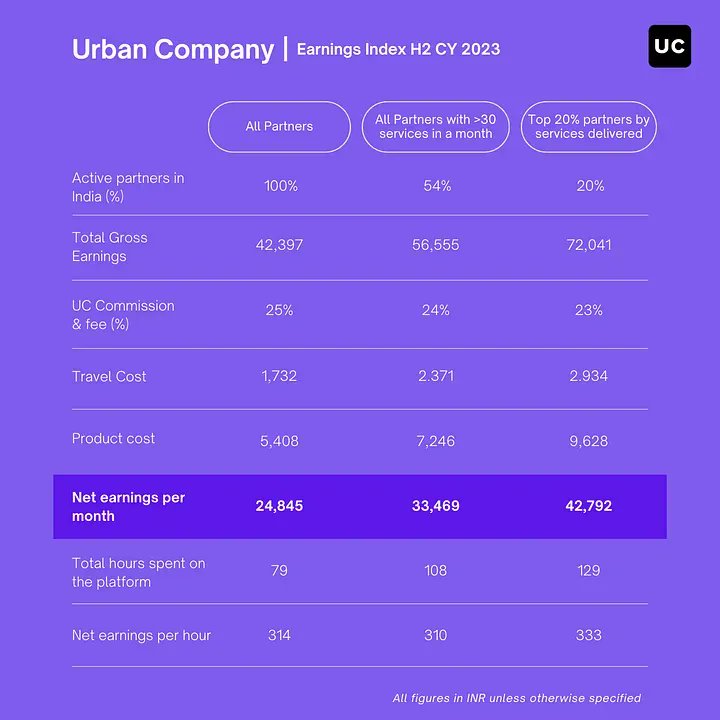
Below are audited earnings of @urbancompany_UC partners in H2 CY23, net of commissions, fees, transport and product costs. We publish this data half yearly, and have published 6 editions of the UC Earnings Index so far. More details can be accessed here -
https://t.co/dLtaO2GBEr
The Blast airdrop is launching June 26.
We know this is past our initial estimate of May and we’re sorry for the delay. The airdrop allocation will be increased to account for this.
There will be two final Dapp Gold distributions before the airdrop.