Research Scientist, Institute of Foundation Models. Working to make ML faster and easier to train.
Less data, more speed, less compute, you get the idea...
LLM training runs can look healthy for billions of tokens or more then suddenly diverge. We find that quantization error in the LM head drives these delayed time-bomb loss spikes. A simple optimizer change can prevent them. 🧵 1/n
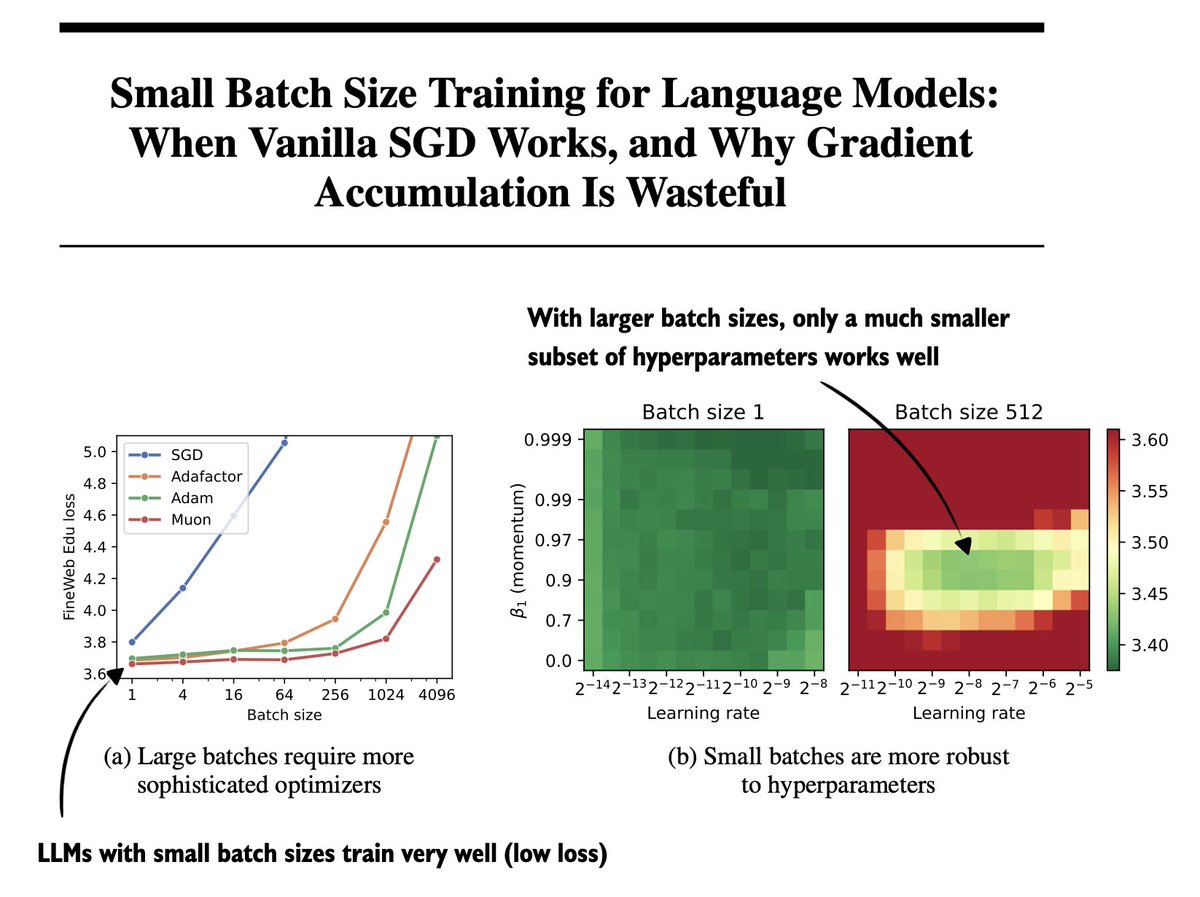
One of the underrated papers this year:
"Small Batch Size Training for Language Models:
When Vanilla SGD Works, and Why Gradient Accumulation Is Wasteful" (https://t.co/0O4XjGDLIP)
(I can confirm this holds for RLVR, too! I have some experiments to share soon.)
Getting small batch sizes to work in bfloat16 precision can be challenging. In our recent paper on batch size, we ran all experiments in float32, but memory-constrained settings demand lower precision. Here are two tricks that we used to enable bf16 training at small batch sizes:
Thrilled to announce I was able to independently replicate some of the results in https://t.co/Pk83A68r8e. Good news for local finetuning w/ MLX. The thread below covers the details - but in summary, Adafactor & Adam perform similarily for local fine-tuning at BS=1. More below:
Beautiful recommendations for slightly broke practitioners to train language models AND compete with the giants and their insane compute!
Huge shout out to my amazing co authors and mentors @mrtnm@LotfiSanae, @micahgoldblum, @andrewgwils!
🚨 Did you know that small-batch vanilla SGD without momentum (i.e. the first optimizer you learn about in intro ML) is virtually as fast as AdamW for LLM pretraining on a per-FLOP basis? 📜 1/n