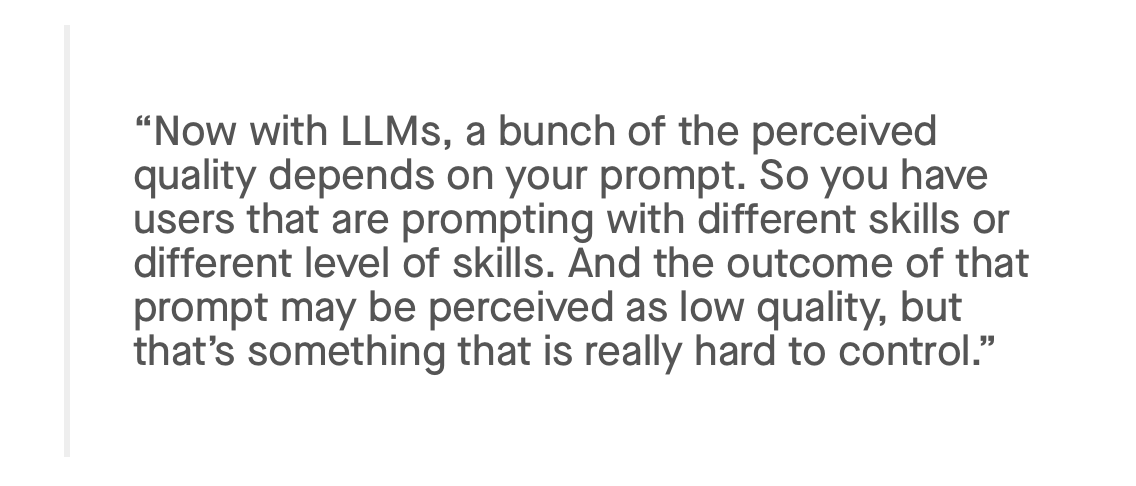
Loïc Houssier, VP Product at Superhuman, shared this perspective on a recent podcast. AI products differ from classic software in that the experience is in large part determined by the user.
Software has always had a learning curve; master Photoshop, for example, and you can apply Bezier curves consistently, just like any other skilled user.
AI products selling outcomes, operate differently. The ideal output isn’t an identical fixed output achievable by all skilled users.
Instead, it’s a collaboration where expert prompts can lead to a spectrum of valid results based on nuanced intent and context.
How can product teams manage this? They can rewrite the user prompt - many are - to expand on the user intent and steer a basic query into a more nuanced & ultimately successful answer.
Even then, anticipating how a user might want to steer the AI is hard.
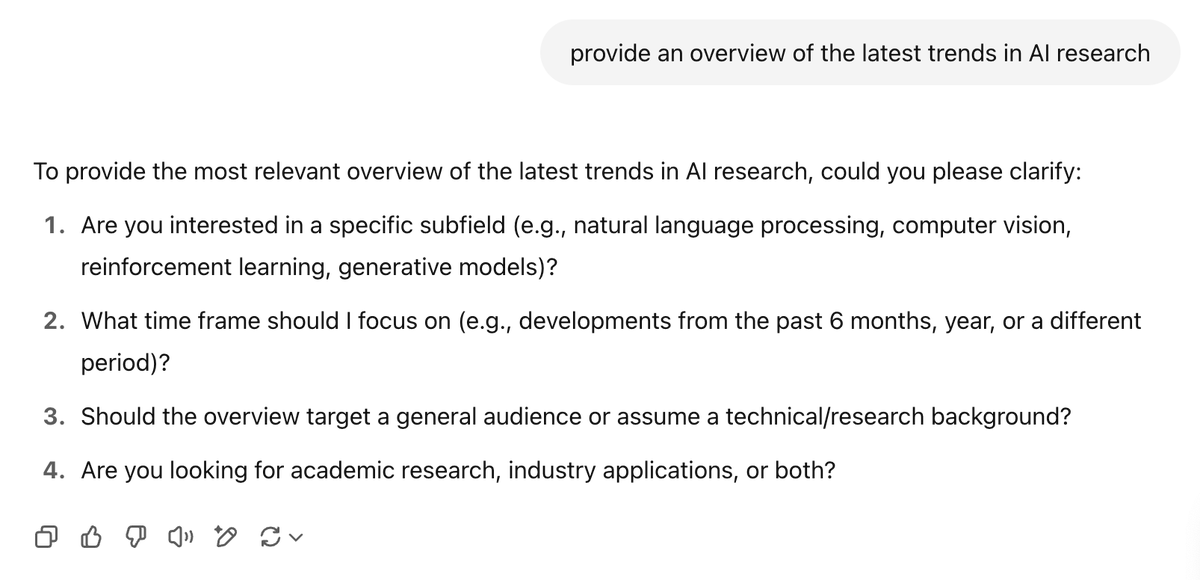
One product technique I’ve found very useful is a series of follow up questions. ChatGPT does this very well - like in this example above, asking for refinement on a broad query.
Just like a colleague asking for clarity, the AI seeks guidance. More than just asking for greater insight, the questions help me understand my request better.
https://t.co/1PGDxa6obw
More than any other role designers drive clarity from ambiguity. They do this through first-pass designs and subsequents.
PRDs help establish clarity. But they do not drive it forward.
When the written becomes visual, then and only then is clarity ratified, disputed, iterated.
great products pull out an internal experience and allow you to experience them outside of yourself.
cameras externalize seeing.
tweets externalize thinking.
reels externalize feeling.
icons externalize our ideal selves.
I've always found that talented introverts express their ambitions through quality work as their form of extraversion — and disappointedly watch as the squeakier wheels of extroverts get all the grease. This can lead to one of two behaviors: 1/ resentment and giving up for want of extrinsic motivation, or 2/ acceptance and continued curiosity fuelled by intrinsic motivation. Path 2 gets even better when they win the lottery by finding the right boss :-).
Probably a host of reasons:
- pm/teams make decisions based on a/b testing/data
- engineers and designers are not listened or contribute to the product direction
- teams are incentivized by “y metric go up” so vision arguments are not listened
- hiring those people who say “we launched x, y metric went up 2%” because quality or vision harder to interview
- multiple layers of management and hiring massive teams where any vision there might be gets diluted away
- product development process is framework driven/overly complex where mental pm energy goes to running it, meetings, not focusing on the product
- founders/execs focus on timelines and launch dates, not quality output
Essentially great work and quality is hard to measure so organizations give up on it.
What replaces is different kind of motions that supposedly do something towards greatness but whole organization mostly just a phoning in/acting product management instead of truly focusing on building great products.
At @linear basically trying to do the opposite of all these things :)
82% of what you pay for #Amul milk, reaches the primary stakeholder, the farmer; this model is the need of the hour; for vegetable farmers, for fruit farmers, for every dairy farmer, for pulses farmers, for oilseed farmers, for cereal farmers. This is the way ahead, the only way.
"thank you for that smile, thank you for the shoeys, thanks for i never left, thanks for that gorgeous nose of his" 😭😭😭 teddy kravitz made me sob again
@hrushb While reading this, I couldn’t help but reminisce about the long but so satisfying journey of shipping Tuxedo for Hotels. Lessons from those 9 months will last a lifetime.
As you become an adult, you realize that things around you weren't just always there; people made them happen. But only recently have I started to internalize how much tenacity *everything* requires. That hotel, that park, that railway. The world is a museum of passion projects.
One of your primary responsibilities as a leader is to create clarity.
Clarity on:
-context, strategy, vision, goals
-roles, careers, expectations
-culture, boundaries, what’s acceptable vs not,
-etc…
A lot of problems I see in orgs can boil down to a lack of clarity.
dude how tf did we take sand and make it into 3nm chips that can do numerical computations billions of times per second, and we use those chips to make machines "learn" !?!?!?
magic does not exist in the real world because this is what real magic is.
In software there are at least two types of interface design issues:
1) "There is a better approach but we can't do it for technical/cultural/whatever reasons."
2) "We thought about all the approaches, and they've all got problems. This is the one we settled on."