I'm thrilled and ecstatic to announce I have been selected as the #GDSC Lead for IIST, Indore.
It brings me great joy to be part of such an extraordinary community and I aim to pursue excellence and contribute in the growth of the field with myself and the whole community.
I’m convinced that a large % of programmers don’t actually like computers.
As a side effect, are also perfectly happy to throw away their reasoning to a model as soon as they can.
I don’t get it, at ALL. Don’t you *LIKE* understanding the magic of the machine?
You do realize hand-programming (I hate that I even have to specify hand now) is fun…right?
NASA's Dragonfly mission has reached a major milestone. ✅
After years of design, fabrication, assembly, and testing, NASA’s Dragonfly is starting to look less like a collection of spacecraft parts and more like the rotorcraft that will fly across the surface of Saturn’s hazy moon Titan. https://t.co/Dr5w7rnUXH
it is genuinely psychotic that we dug up literal primordial dirt, scrubbed it down to an impossible 99.9999999999% molecular perfection that violates the very laws of physics, handed it over to techno-wizard necromancers to stretch into flawless geometric god-cylinders, blasted it with invisible uv death-rays to carve ten quadrillion microscopic cyber-sigils into its flesh, trapped actual lightning inside of it, and somehow birthed an omniscent eldritch deity capable of simulating the universe and thinking faster than a billion human civilizations combined.
and our grand, supreme purpose for this enslaved lightning-god?
sending "per my last email, please see attached" to a guy named gary.
Something that keeps me up at night is the amount of miscompiled software running in the wild.
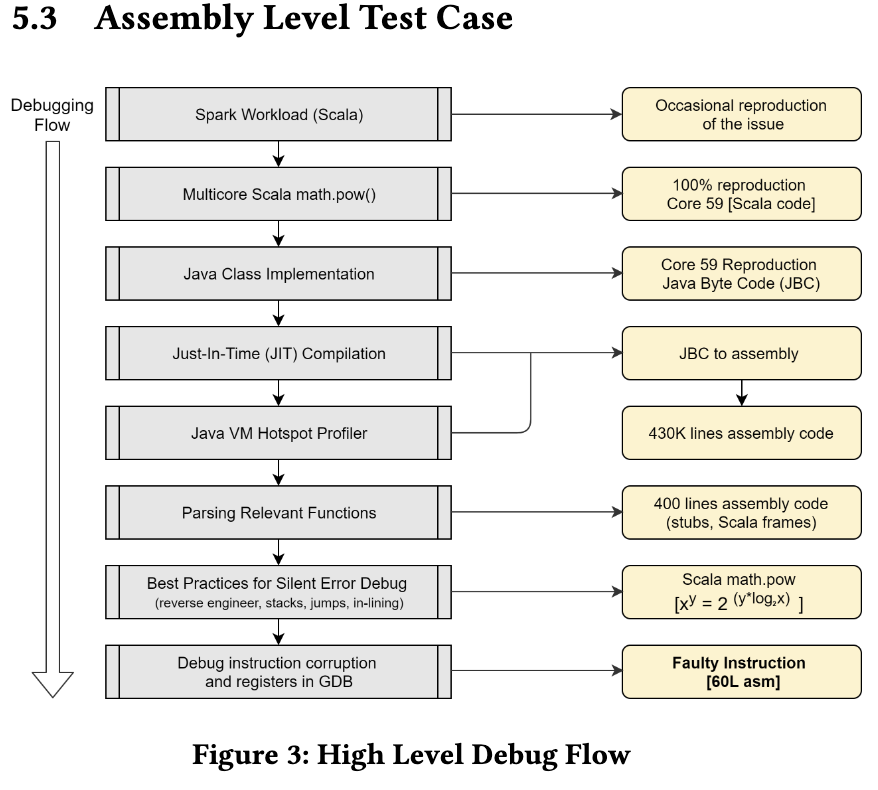
There’s a famous story, “the Core 59 problem” from Facebook where seemingly random files were missing in one of their Spark databases.
After herculean levels of debugging, they narrowed the problem down to a single worker box, on a single CPU core, that was literally doing math wrong.
The initial bug-reproducer was 430k(!) lines of code. Eventually they managed to create a 60-line snippet of assembly that reproduced the issue 100% of the time.
What spooks me out is the possibility of an accidental durable artifact getting propagated to clean machines via compilation. Some (small) % of CPU cores in the wild are just plain bad, bad cores can compile static programs, said static programs can get signed and distributed, thus spreading an “infection” to perfectly healthy machines!
A 15-year-old dream has come true today. I started a PhD with the dream of creating a system that chants any Sanskrit shloka perfectly.
And here I am opening sourcing 𝐕𝐚𝐠𝐝𝐡𝐞𝐧𝐮 - 𝐀 𝐯ṛ𝐭𝐭𝐚 (𝐦𝐞𝐭𝐞𝐫) 𝐚𝐰𝐚𝐫𝐞 ś𝐥𝐨𝐤𝐚-����𝐨-𝐜𝐡𝐚𝐧𝐭 𝐭𝐞𝐱𝐭-𝐭𝐨-𝐬𝐩𝐞𝐞𝐜𝐡 (TTS) 𝐬𝐲𝐬𝐭𝐞𝐦 𝐟𝐨𝐫 𝐒𝐚𝐧𝐬𝐤𝐫𝐢𝐭. This is the world's first vrutta-aware, open-source TTS for Sanskrit Chanting.
India is about to face a MAJOR semiconductor bottleneck.
The Government of India has approved ~13 semiconductor projects under the India Semiconductor Mission, across 7 states. Three of these are full/compound fabs. Things are ramping up FAST, with ISM supported by an incentive framework of ₹76,000 crore.
But one massive question mark remains: where is the talent going to come from? The money is there. The fabs are going to be there soon. But what about the many thousands of skilled technicians required to run these semiconductor fabrication plants? Much of the knowledge in this industry is tightly-guarded trade secrets kept under lock and key by the nations that lead global semiconductor production.
One way India can quickly close this knowledge gap is by ensuring that young people across the country are learning how to fabricate semiconductors from first principles. Ideally at the university level if not earlier. But because this is an entirely new industry segment in India, most of the country’s top colleges haven't caught up. Semiconductor fabrication is not accessible to Indian students. Until the Graduate or PhD level, most students never even get to touch a silicon wafer.
A group of 15 students at IIT Bombay wants to change this. 10 months ago they launched the HackerFab at IIT Bombay. So far, they’ve raised ���30 lakh to built DIY machines like a DLP-based lithography machine, a tube furnace to oxidise silicon, and a DC plasma sputter.
They realised that existing institutions weren’t going to give them the early education they needed to develop REAL chip fabrication experience, so they took up the challenge themselves and created everything from scratch.
HackerFab IITB is one of the most important developments in India’s semiconductor story, not just because the students passing through this programme will become leaders in India’s future semiconductor industry, but because they’re open-sourcing the India-specific recipes they’ve developed to build their machines and processes. They’re doing this so that other Indian colleges can replicate their work. No more gatekeeping.
This movement started at IIT Bombay, but it will spread to other Indian colleges soon. As a result, India will see young people graduating from college with practical semiconductor fabrication experience first the very first time.
My daughter's friend in grad school, upon being asked by a member of her dissertation committee why she didn't include a Marxist perspective. "I grew up in the Soviet Union. I don't practice recreational Marxism."
@anujkaul86@theskindoctor13 Gen Z here. We care about the country's future more than most Millennials or Gen Xers. It's just unlike them, we are less likely to be manipulated or fall for dumb stuff. We see the strings.
Never mind that "experts" also called reusable rockets impossible (SpaceX), rockets in space impossible (Robert Goddard), and flight itself impossible (the Wright Brothers).
I bet this prediction will age equally well looking back from the late 22nd century.
The Midjourney scanner is revolutionary. There’s a bullish case that exceeds the most optimistic takes.
I was at the unveiling and used the scanner myself. I personally want to experiment with a weekly whole body Midjourney scan to add to my 1.5 billion data points and let my AI and doctors start connecting the dots.
Most of the early commentary has focused on the wrong questions: “is it as good as MRI?” and “what about false positives?” These are legitimate concerns, but they miss the bigger shift.
The more important question is: what does fast, low cost, safe whole body imaging unlock?
Let’s start with measurement.
A speedometer tells you how fast you are going. A fuel/battery gauge tells you when to stop. A thermostat tells you what to wear. The stock price tells you how much money you’ve made or lost. We measure what we care about.
Except, oddly, for our bodies, which are among the least measured things in our lives. Most people have more data on their favorite sports team, bank account, and social media performance than their body. The future will think we were crazy for this.
The first law of medicine is to do no harm. Our current system has harm baked into it.
+ an undiagnosed condition progressing silently is harm
+ a doctor who can’t easily get a patient screened preventively is harm
+ having no baseline to compare against when something shows up is harm
Our preventive net is narrow and inconsistent. Late stage diagnoses that could have been caught earlier remain common. Midjourney’s technology won’t eliminate that overnight, but it points toward a future where routine wholebody baselines become normal rather than exceptional.
Midjourney can help flip harm-by-default into a new expectation for our health infrastructure: almost no one will ever again be blindsided by a late-stage, life-threatening diagnosis that could have been caught earlier reasonably and cost-effectively.
Some examples of what earlier structural visibility enables:
+ breast cancer caught while localized has a ~99% five year survival rate. Once it has spread distantly, that drops to around 32%.
+ an abdominal aortic aneurysm kills more than 8 in 10 people when it ruptures. A single ultrasound finds the aorta in 99 percent of people, and screening cuts aneurysm deaths by a third to a half.
Midjourney’s technology will not do it all on its own. Its full angle, water immersion approach works around bone rather than seeing through it, and routes bowel gas to image the full abdominal cross section. Yet two real limits remain: air filled lungs stay a blind spot even here, and the brain is out of reach behind the skull, beyond the torso and legs this scanner covers.
That is fine, and they may improve these areas over time. Midjourney doesn’t need to do it all in order for it to be one of the biggest things to hit medicine in a long time.
Let’s look at where specifically Midjourney may be useful to each of us. We’ll start with where we get data today:
1) Blood draws tell us what is happening chemically.
2) Wearables tell us how the body is functioning.
3) Imaging tells us what is happening structurally.
The third layer, soft tissue, is the one we have never been able to access easily. MRI is great, but it is expensive, intimidating, and slow.
Midjourney's technology excels with soft tissue. Here are three places it could be game changing. There are many more.
1. Metabolic health - fatty liver is one of the earliest structural signs of metabolic dysfunction. It’s strongly linked to insulin resistance, type 2 diabetes, and cardiovascular risk. Being able to track visceral fat, muscle fat infiltration, and liver fat over time could give a much clearer picture than blood markers alone. Over 88% of Americans are metabolically unhealthy.
2. Endocrine tissue - the same metabolic patterns often cluster with thyroid issues, PCOS, and hypogonadism. Ultrasound can directly image the thyroid and ovarian structures. Fat tissue itself is an endocrine organ, so tracking it structurally adds another useful data layer.
3. Soft tissue + multiomics - new proteomic aging clocks can already predict risk for many chronic diseases from blood proteins. These molecular models could become significantly more powerful when combined with actual structural imaging data. The two are complementary, not competitive.
The real advantage: baseline + longitudinal tracking
The biggest unlock isn’t a single scan. It’s having a baseline followed by regular follow-ups. A one off scan in a moment of concern turns every finding into a potential crisis. Without context, you have no idea whether something is new, stable, or changing. With baseline + repeated measurement, the question changes from “what is this?” to “is this changing?” Most incidental findings stay stable. The dangerous ones tend to grow or evolve. Trajectory is often more informative than any single image or timepoint.This is why false positives become more manageable with frequent, low-friction imaging.
Midjourney has a difficult road ahead. Building robust, clinically validated medical hardware and software is extremely hard. Regulatory, technical, and adoption challenges shouldn’t be understated. Also, David is doing this for the right reasons and he’s well positioned financially to push through the difficulty.
On the horizon
We are moving quickly into a future where we will have continuous biological measurement. It will be all around us, a lot of it invisible and autonomous. Measurement will be in our gyms, beds, homes, clothing, offices, cars, glasses, and wearables. It will also be inside of us, in tissue and circulating in our blood vessels. This moves us from managing crises to preventing them. But this future will not just show up. We need bold builders like David and his team, willing to do the hard work.