I've built WordPress sites for 14 years. Last week I moved my own site off it.
Not because WordPress is bad. I still ship WooCommerce stores every week and I'd recommend it to most businesses tomorrow.
But I looked at my portfolio honestly.
Five pages and a blog I update a few times a year.
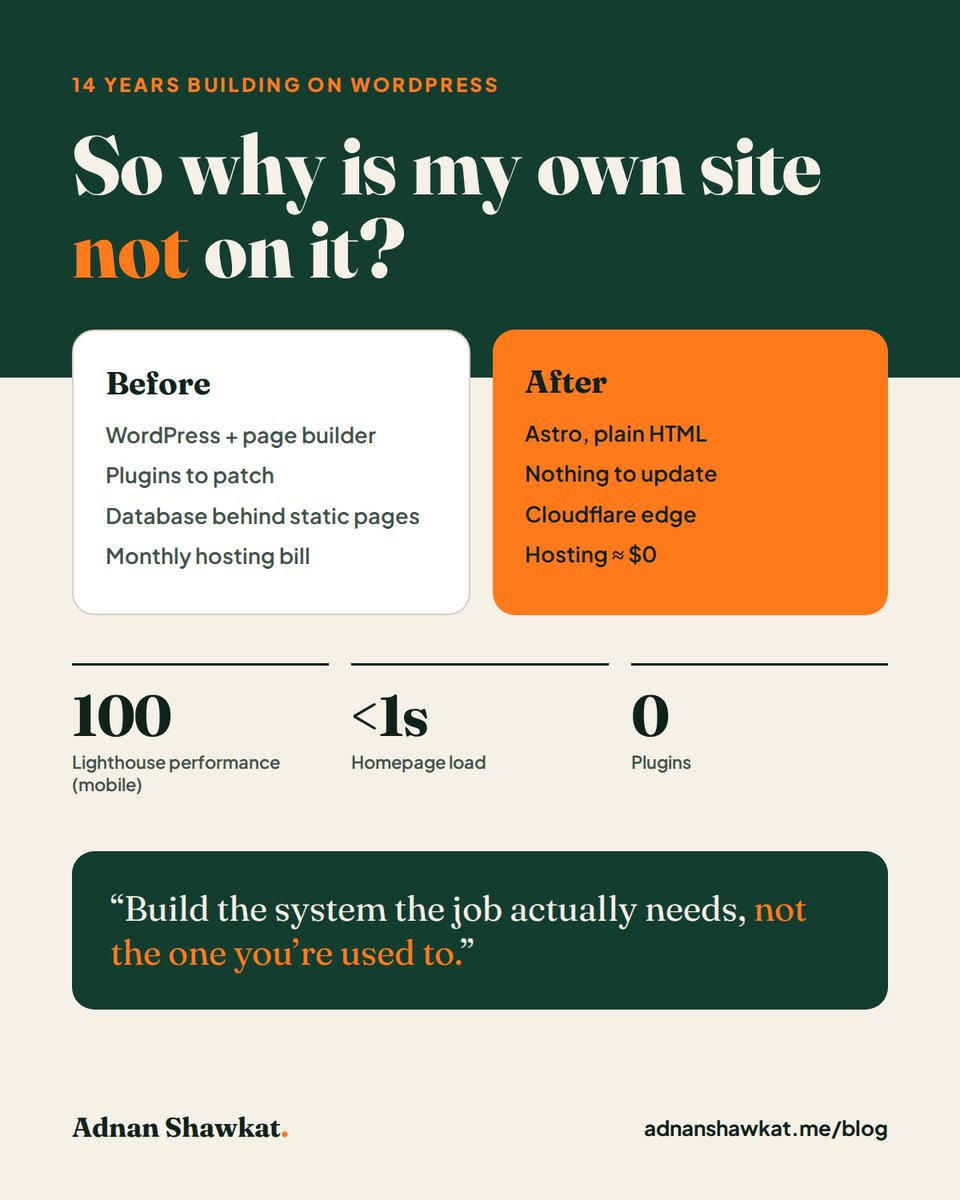
Plugins to patch for forms, SEO, caching and security.
A database and PHP running behind pages that never change.
That's a lot of machinery for a site that mostly sits still.
So I rebuilt it with Astro and put it on Cloudflare Pages.
Every page is plain HTML, built ahead of time. Nothing to hack, nothing to update at 2am.
Hosting went from a monthly bill to basically zero.
Lighthouse on mobile: 100 for performance. The homepage shows up in under a second.
The contact form is one small serverless function. No plugin.
I treated it like a client migration, too. Old URLs redirect, posts keep their original dates, and SEO is generated on every build.
Here's the part I'd tell a client, though.
If you run a store, publish with a team, or need editors who never touch code, stay on WordPress or Shopify. That's still the right tool.
The lesson isn't WordPress vs Astro. It's building the system the job actually needs, not the one you're used to.
What's one tool you kept using long after it stopped fitting the job?
#WordPress #WebDevelopment #Astro
🎉 Bundixo is live on https://t.co/0xHWk8cNn4!
Build product bundles with tiered quantity discounts, a Gutenberg block & a storefront widget — discounts apply as real WooCommerce coupons, so totals are always right.
Free & open source 👇
https://t.co/TOdR1JnUgy
#WordPress #WooCommerce
1/
New plugin just got approved on the https://t.co/0xHWk8cNn4 repo 🎉
EventRelay stops Sublium subscription renewals from being tracked as new Purchases in PixelYourSite, so your ad platforms stop counting the same customer twice.
https://t.co/NtKEDXJFM2
2/
What it does:
→ Blocks renewal Purchase events (browser + CAPI)
→ Unlocks PYS's greyed-out renewal checkboxes
→ Sends FirstTimeBuyer only on a real first order
→ Logs everything it sent or blocked
No fork. Uses PixelYourSite's own filters.
3/
Also open-sourced a companion: Cart Renewal Price for Sublium.
Keeps renewal totals matched to what the customer actually paid at checkout, not the raw variation price.
https://t.co/rj1Zij36iG
#WordPress #WooCommerce
I noticed something interesting while testing Command Code in two different ways.
I used it through the agentic chat/view and also directly from the command line through CMD.
What surprised me was the usage difference.
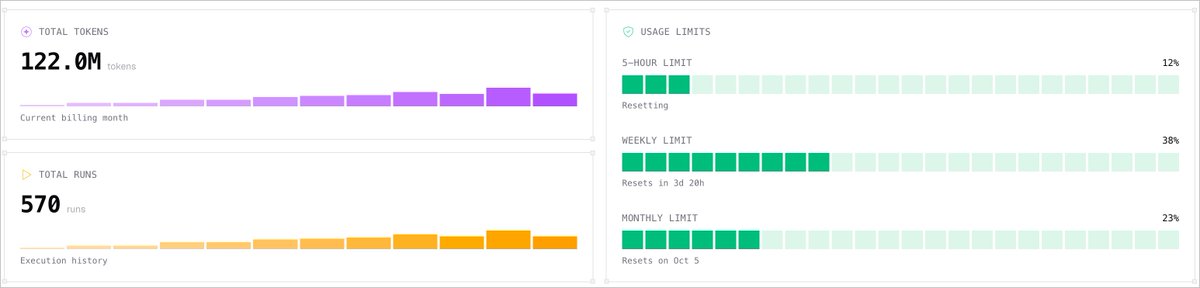
On the agentic view, I was on the $10 plan and managed to hit the usage limit after only a few fairly active chats.
But when working through the terminal, I was on the $1 plan. I actually felt like I was using more tokens and doing more coding work, yet I never hit the 5-hour usage limit.
That got me thinking.
Maybe using coding agents like Claude or ChatGPT directly from the terminal gives us more room for actual token usage, while the agentic UI consumes additional context/tokens behind the scenes for things like conversation history, tool calls, file context, agent state, etc.
I haven't tested this scientifically, so I could be completely wrong. But the difference was noticeable enough that I'm going to keep experimenting with terminal-first workflows.
Has anyone else noticed this?
Terminal vs agentic chat: which one gives you better mileage before hitting your usage limits?
Spent last week building something I actually wanted to exist: a free WooCommerce plugin for mix & match bundles 📦
Why it helps AOV:
🔹 Tiered discounts (buy 2 save 10%, buy 4 save 15%)
🔹 Live progress bar — "1 more item for 15% off"
🔹 Discounts locked server-side, no cart tampering
🔹 Built-in analytics so you know it's working
Free on GitHub; https://t.co/r2p4IY8L39 next:
https://t.co/WLwzxYw53t
Try it, break it, tell me what's missing 👇
Adobe is acquiring Semrush.
Big change for the SEO and content world.
Do you think this will make marketing tools more connected or just more complex?
#Adobe#Semrush#MarketingNews#SEO
I used mix-and-match bundles on Shopify all the time. But when I switched back to WooCommerce, there was no simple way to do it.
So I built my own plugin. No bloat. No complexity. Just a clean way to let customers create their own bundles.
Check it out:
https://t.co/x3oq7VHGyr
If it helps you star the repo & provide your feedback
The competitive advantage in AI has shifted. It's no longer about ownership; it's about scaling faster than competitors.
In the past year, we've seen significant changes:
- 68 percent of marketing leaders now report measurable ROI on AI investments, a sharp increase from last year.
- Marketers utilizing AI are 25 percent more likely to achieve content success compared to those relying on manual methods.
- Currently, 90 percent of marketers use AI for content creation, yet only 47 percent have a clear AI strategy.
This last statistic is crucial. We have moved beyond the initial phase of questioning whether to use AI; we are now in the phase of determining who can scale it more effectively.
The true winners are no longer just early adopters. They are the organizations that have transitioned from experimentation to operationalizing AI. They have developed workflows rather than relying on one-off use cases and have integrated AI into their marketing stack rather than treating it as an add-on.
The gap is not just between companies that use AI and those that don’t; it’s widening between those that have optimized their AI workflows and those still viewing it as a novelty.
Consider this: your biggest bottleneck may lie in one of three areas:
- strategy
- execution
- measurement
Which one is causing you the most concern