Dario Amodei says the previous model found none of the 271 Firefox vulnerabilities Mythos turned up, and Anthropic is eating the commercial cost of not shipping it:
"The ultimate test of this is like, we go to companies, we go to open-source repos, we found 271 new vulnerabilities in Firefox."
"We've found many thousands within the private, you know, companies who haven't fixed them yet or can't disclose them yet."
"Like, no one found those 271 vulnerabilities with the previous model."
"We have suffered enormously commercially from not releasing this model."
"The reason that we're giving Mythos to defenders before we give it to attackers is to patch all the bugs."
"There may be more and more bugs to be found, but there's only so many. They're finite, right? It's like you have this surface and there's only so many holes in it. You patch all the holes and the surface becomes very hard to attack."
"So I think on the other side of this, hopefully, six months or a year from now, we have a much more secure internet ecosystem than we had in the past."
Give Anthropic real credit here. It's holding back a model it says is accelerating its own research, it took the revenue hit for doing that, and Mozilla shipped the fixes in Firefox 150 where anyone can go read them.
Anthropic also ran the scan, picked which defenders get the model first, sets how long they have before access widens, and is the only party reporting how any of it went. Every step there belongs to the company whose product is being graded, which is self-attestation, and being careful about it doesn't turn it into evidence.
The many thousands inside private companies are the harder case, and Dario is straightforward that those sit unfixed and undisclosed. Nobody outside Anthropic can grade them, count them, or say what share ever got patched. A CISO deciding what to do about that has one source, and it's the vendor. An insurer trying to price it has the same one. That number needs to come from somewhere else, and there is currently no somewhere else.
- Dario Amodei (@DarioAmodei), co-founder and CEO of Anthropic, on The Circuit with Emily Chang (Bloomberg Originals).
P.S. I'm hosting the AI Assurance & Governance Summit 2026 on October 1 at the Stanford Faculty Club in Palo Alto. One day, one track, frontier labs and regulated industries and insurers and investors in the room, with live on-stage demonstrations of AI trust evaluation and agentic-system assurance. If you are the person who will be asked to verify a vendor claim like the 271, register here.
https://t.co/g8UO0ie0Wp
If Argentina win tonight, the two people in this photo will face off in the World Cup Final 19 years later.
What are the odds that:
> Baby wins a raffle to get a pic with Messi
> Baby grows up to be a generational talent
> Baby becomes third youngest player to ever start a World Cup final
> Messi remains so great that he would be the oldest outfield player to ever start a final
> Both of their teams beat the odds of reaching a final in the same tournament
The odds of this happening are impossibly small.
And yet we're one game away.
The same year that photo was taken, Messi featured in an Adidas campaign about being too small to make it. The slogan:
"Impossible is Nothing."
@demishassabis@GoogleDeepMind even if not through openai, as originally aimed, google is not able to dominate ai into a closed for profit monopoly. ai is spilling out into open source and a medium to long tail of companies.
Our thoughts on the importance of AI sovereignty.
1. Your AI sovereignty dictates your institution’s future. Sovereignty is the precondition for choice. Relinquishing sovereignty transfers the future choices of your institution to others, who are likely to exploit it for their gain and your loss.
2. Data retention is your treasure. Transfer it at your own peril. Your ability to win is dictated by your ability to recognize and use your unique edges, and you keep winning by compounding the underlying data to generate new insights. Transferring that data hands over access to your pre-existing winning plays and yields the means of production for new ones.
3. Tokenmaxxing hijacks your value orientation and decreases your institutional fortitude and intelligence. The pursuit of high token usage incentivizes disposable scripts over robust software — with the addictive feeling of false progress. There is a reason why those selling tokens refuse to charge based on value.
4. Controlling your weights is controlling your fate. Weights are the distilled form of hard-won, accumulated institutional knowledge. If you let others control your weights, you are allowing them to migrate the alpha of your business to theirs.
5. There is no contradiction between sovereignty and alpha. The architecture that maximally preserves sovereignty is one that enables institutions to own their tribal knowledge, and to compound it as alpha.
6. Politicizing the technical issues involving sovereignty is what your adversary wants. Techno-politicization is the wellspring of false sovereignty. Techno-politicization drives decisions that seem to reduce dependency, but ultimately limit agency — especially on the battlefield in the West.
7. Real expertise is existential. Allowing politics or favoritism to determine your technical decisions rewards whoever is best at politics, not whoever is right. Listen to those closest to the problems, not those speaking most compellingly about them.
8. Learn from institutions that are winning or that have consistently delivered. Institutions facing existential threats do not have the luxury of making technical decisions based on political preferences.
9. Only listen to institutions, countries, and people who have a proven record of being right. A track record of correctness is the best and only signal for future correctness. Judging something as right or wrong based on who you like is exceedingly misguided.
A lot of programmers are basically fans of programming itself. It’s all about them. They have mastered Rust or Haskell or Zig or whatever, but their objects of veneration are useful mainly as a backdrop to their own cleverness. Anyone who will spend six weeks rewriting a working system in a new language to make the types nicer is more into the rewrite than the product. Extreme technical obsession may serve as a security blanket. If you are the person who knows every flaw in the architecture, every impure abstraction, every place where the old code fails to express its true intent, you already know what to say in every meeting, which is so much safer than asking whether users care.
Your obsession with refactoring is your beard. If you know absolutely all the trivia about borrow checkers, effect systems, async runtimes, and build tools, it saves you from having to know anything about customers, deadlines, support, sales, documentation, or whether the thing actually helps anyone. That’s why it’s excruciatingly boring to talk to such people: they’re always asking you questions they know the answer to, and never shipping anything that answers a question users actually asked.
🚨 #ULTIMAHORA preocupación por el estado de salud mental de Edward Norton. Se le ha visto desorientado hablando solo durante el USA-Turquía en el estadio de los Ángeles.
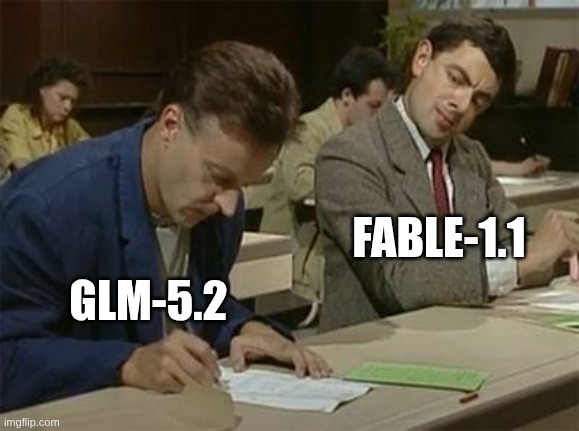
Introducing GLM-5.2: Frontier Intelligence, Open Weights
- Significant improvements in coding and agentic tasks
- Strong long-horizon capabilities with a 1M context window
- Two levels of reasoning effort: GLM-5.2 (max) pushes the limits, while GLM-5.2 (high) strikes a strong balance between performance and token efficiency
- MIT-licensed open weights
- Same API pricing as GLM-5.1
Tech Blog: https://t.co/LAsxUdN0JZ
Weights: https://t.co/g0A1C4UWx4
API: https://t.co/Kc3E22cbN7
Coding Plan: https://t.co/Nk8Y98HNhU
Chat: https://t.co/WCqWT0qCQb
Maybe AI and space are castles made of sand.
Maybe llms scale only towards more sophisticated imitation, more apparent depth disguised as more expensive tokens.
Maybe it was never about intelligence in the answers, but about inspiration in the questions.
Maybe bitcoin is the silent bet against it.
Maybe AI and space eats bitcoin after saas, after call centers as one more little dumpling.
Maybe it is a fair price if bitcoin dies but our sons spend a few years in a moon base and the turbokellis do the laundry.
Maybe ai and space are the deflationary death star that turns the printing press crazy to offset the deflation with infinite fiat.
Maybe the agents run amok the cyberspace unbounded by the human bandwidth in the most frenetic market we ever imagined.
Maybe the escape velocity of wealth reflects the revaluation of the internet money.
Maybe we see for the first time exploding wealth and hard money.
And they come at the same time in a script-like synchronicity.
You have noticed it. ChatGPT feels dumber than it used to. Your prompts that worked six months ago produce worse results now. The writing sounds flatter. The ideas sound safer. The internet itself feels like it is shrinking. Every article reads the same. Every email sounds the same. Every answer sounds like it was written by the same voice.
You thought it was you. It is not you.
Researchers at Oxford and Cambridge published a paper in Nature proving what is happening. They call it Model Collapse.
Here is the mechanism in one sentence. AI trained on AI-generated data gets dumber every generation until it forgets what real human data looked like.
The internet is filling with AI-generated content. Blog posts. Articles. Reviews. Comments. Social media. AI companies scrape the internet to train the next generation of models. Which means the next generation of AI is being trained on the output of the current generation.
Each cycle loses information. Not randomly. It loses the rarest, most unusual, most creative parts first. The researchers call these the "tails of the distribution." The weird ideas. The unexpected perspectives. The things that made the internet feel human. Those disappear first.
What remains is the average. The safe. The expected. The bland.
Then the next generation trains on that. And loses more. And the next generation trains on that. And loses more. The researchers proved this is not a slow decline. Major degradation happens within just a few iterations. Even when some of the original human data is preserved.
They tested it on large language models. On image generators. On statistical models. The pattern was the same every time. The output converges toward a narrow, flattened version of reality that looks nothing like the original data.
The lead researcher put it plainly. "Large language models are like fire. A useful tool. But one that pollutes the environment."
The pollution is invisible. You cannot see which sentence on the internet was written by a human and which was written by AI. Neither can the AI that is about to train on it. And once the tails are gone, they do not come back. The damage is irreversible.
This is not a prediction anymore. It is a diagnosis.
The internet you grew up on was built by humans writing things no algorithm would have written. Strange, personal, imperfect, alive. That internet is being diluted. One generation of AI at a time. And the models trained on what remains are learning a smaller and smaller version of the world.
Model Collapse is not a technical problem. It is a cultural one. The thing that made the internet worth reading is the thing that disappears first.
0017 llm-wiki as awareness for llms and The Mirror of Uqbar
https://t.co/UrsPbKcn2K
The mirror breathes out. Uqbar breathes in. It maps a territory that lives only in the mind, but what does live anywhere else?
https://t.co/hjYDquE5BY
Andrej Karpathy released the LLM-wiki method in April. One instruction file tells an LLM to walk raw documents and build structured output from them. Notes, posts, code, transcripts, old writing all feed the same process. The result is a single folder that holds the compressed shape of that material.
I fed my own sources into it and named the output Uqbar. The name came from Borges. The file became a map of my thinking, my sense of who I am, and how I see what is real. When I give an LLM that file as context, the conversation changes. The model works from patterns it extracted itself instead of pulling scattered chunks from a vector store. RAG stays flat, inert. This version carries the connections the model found.
The map showed me connections I had missed. It let the notes speak back in a voice that stayed mine. No other person can run the same file and reach the same place. Uqbar stays private. The mirror is what I show.
Drop your sources into a folder. Point an agent at the instruction file and the folder. Start the conversation from any session. The wiki holds the ground. The outward version is the one you decide to share.
not the tao
with adrian matias