@streetruffian The argument from the outraged masses isn't that colts retired at 3 don't make good stallions. We're racing fans, we want to see the best race against the best, the breeding $ and inflated yearling prices have impacted the quality of racing detrimentally.
Everything that is wrong about the current funding model right here. Punters raped and pillaged and an incredibly rich tradition of horse betting completely destroyed to fund an insane prizemoney largesse and with it spiralling yearling prices. An absolute boon for a (very) few elite trainers and jockeys and breeders. Here we see two colts that 30 years ago would never have been entertained for stud duties with their very modest CV’s, boasting just one open age Gp1 between them, and that in a pretty average Lightning Stakes. No wonder the high quality mares just completely dominate WFA racing in general. By and large they only compete against geldings, who of course have been denied the use of steroids to boot. 👎👎👎👎👎👎👎
“KISS OF DEATH”
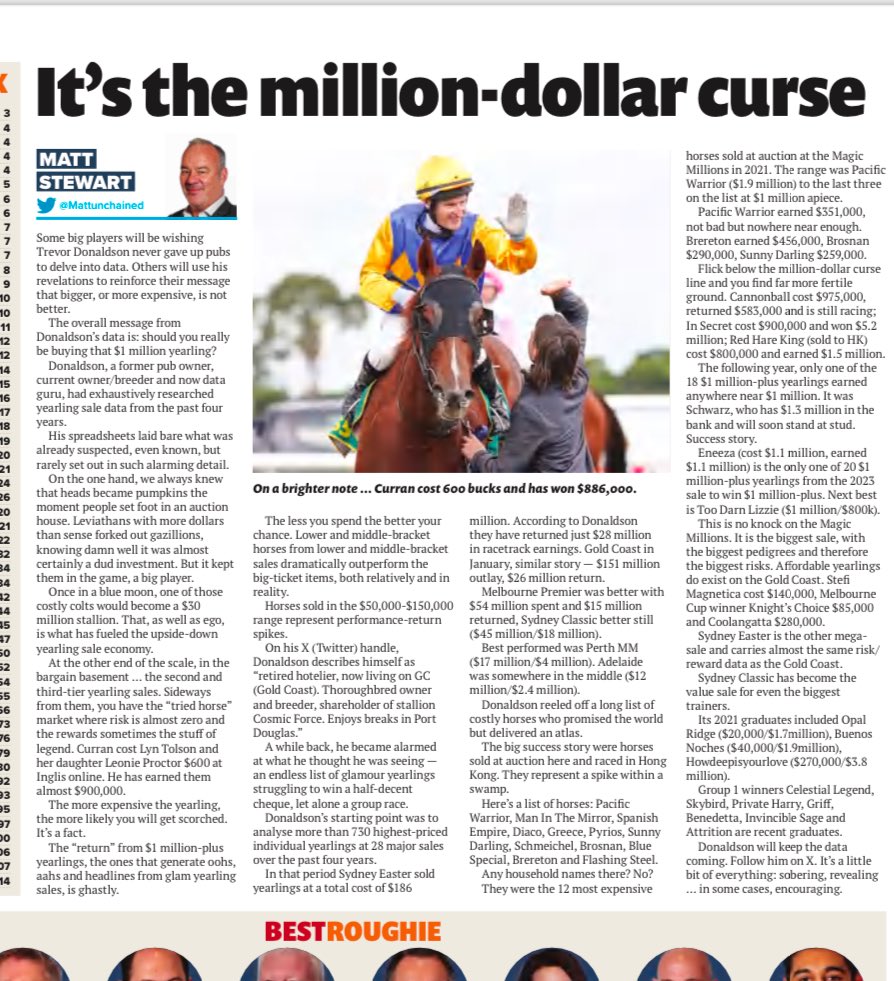
Yearlings $800k and over at the Inglis Easter sale:
PDF of full data on the website:
https://t.co/k9gLlLVFDS
Audio clip of this mornings interview with @m_felgate - “THE VERDICT” in the comments section:
Here is some “eye watering” data on INGLIS EASTER [considered the doyen of class horses at Australian Yearling sales].
Very clear summary of the previous 4 years Inglis sales:
2024 [now 3yo]
2023 [now 4yo]
2022 [now 5yo]
2021 [now 6yo]
Of the 155 collective horses sold “over $800k” - only 10 earned race revenue higher than their puchase price ➡️ 4 of these 10 earnings were in Hong Kong.
131 of these 155 horses have not earned above 25% of their purchase cost and more damning is 104 of the 155 have not earned more than 10% of their purchase cost.
Current 3yo’s [sale of 24’] - Zero horses of 30, or 100% have earned less than 25% of their purchase cost. - these are now 3yo’s and beeen through their two years of opportunity to earn $’s in over priced races.
I do not summarise the 2yo crop [25’ sale - not shown in report], until,the end of the racing year in July….. however:
I can advise you there were 30 yearlings sold over $800k on 25’ and of these, only 1 x 2yo has earned black type status being Hidrix [cost $1.7 million, earned $215k so far].
Further damning on the preponderant buyers that swagger around the sales ring thinking they are the industry icons - paying “highest dollars - presumably with a view to achieve big $ returns in 2yo races - “read this”
10 yearlings [now 2yo] sold over $1.5million each at the 25’ Inglis Easter sale - 9 of them have not started in a race !!!!
The aforementioned Hidrix is the only one of the top 10 [sorted by dollars] to have a race start.
Here @Ross_Greenwood covers the complete and utter failure of Australia’s tobacco regulation.
Taxes down from $16.9B to $7B.
A new multi billion crime industry is born.
And now illegal cheap cigarettes means smoking rates are now increasing.
Well done Australia.
Magic Million Yearling Sale 2022 - now 4yo
Data Set 1 of 4 posts
▪️current 4yo age - The “highest priced” yearlings.
♦️yearlings sold for over $800,000+
This sale had 38 yearlings sold at the high end for $800k+
◽️a positive 35 [92%] of these highest priced [now 4yo’s] made it onto the track.
❌ only 1 horse - SCHWARZ, has earned more prize money than his sales cost.
❌ 6 of the 35 [17%] runners, have not won a race, deep into their 4yo year.
❌ 12 of the 35 [34%], have only won 1 race
🕳️ so 18 of these highest priced 38 yearlings [a;most 50%] have won 1 race or less. This is after rigorous inspections by the experts that shape the breeding industry.
Here is 2023 Inglis Easter ♦️ horses are now 3yo’s ♦️
This highlights the race performances from the top end of the market [“what i consider over priced and under performers”], they have been selected by the industry heavy hitters that shape and influence the market.
This is real data - “facts, not opinions” and as a breeder, i am 100% supportive of the industry.
🚫 Unfortunately, i cannot access 2023 online, as the Inglis site is showing a server error - so i have to present these in a hand written format.
▪️ 43 horses were sold for $800,000 and above.
▪️ Only 1 horse SWITZERLAND has earned prize money above his sales price: $Prize: $1,900,000 $Cost $1,500,000
▪️ Only 1 other horse has earned over $500,000, that is the undefeated AUTUMN GLOW $Prize: $520,000 $Cost $1,800,000
▪️ Only 6 other horses have earned prize money above $100,000 - all at huge losses on purchase price, like Autumn Glow.
▪️ 37 of these 43 horses have made it to race day.
▪️ 19 have won a race [only 3 have won two or more races, the other 16 winners have won just 1 race].
Overall, it’s a bloodbath ….
The next few posts will focus on the positive and show the winning graduates of the last 2 years and how they have succeeded with profits based on prize money over purchase price ✔️
The Coalition wants to cap foreign student enrolments at Australian universities. We look at how many each institution would need to cut, and how much that would cost them in lost revenue, a 🧵.
💬 Should VIC jockeys be paid for jumpouts?
Fair pay for services is a principle most can agree on. But the real debate on this topic isn’t about that; it’s about the cost and how it burdens owners.
This points to a deeper strategic issue in racing: 🏇 Income distribution.
Racing administrators love to highlight skyrocketing prizemoney as a win for owners. However, when you examine the full picture, it's a smokescreen.🤔
A study I did in 2023 of NSW & VIC between 2016-2022 found:
➡️ Approx $212m more prizemoney distributed.
➡️ Approx 200 fewer horses (17.8k total.)
➡️ But… 50% of horses earned just $0–$4.2k more.
➡️ Only 10% earned $16.5k+ more.
➡️The prizemoney boom has disproportionately benefited the top 2% of the horse population who earned $59k+ more.
Meanwhile, costs have soared in the last decade:
📈 Approx $20k/year increase in training fees
📈 At least + $30k increase in the average yearling price.
Who has benefited most from the prizemoney boom?
✅ The top 2% of horses
✅ Trainers & jockeys, whose collective revenue jumped approx 60% in line with prizemoney growth.
That's a staggering growth in the context of the real world and what other industries have experienced.
It's well deserved; there is no issue there, and in the case of Trainers, they've had to cope with many increased costs, workers comp insurance, etc., which is hard to pass on to owners fully. However, when you run the numbers on the income side of the equation, a significant number are far better off, not just the higher profile players.
Approximately 90% of owners are worse off when factoring in rising costs.
If the PRAs are serious about helping owners and the sustainable future of racing, there must be a more thoughtful strategy.
💡 Instead of being obsessed with perpetual prizemoney increases that only benefit the minority and are just as much about marketing, a significant portion of that funding should be invested into:
✔️ Cost-reducing subsidies
✔️ Owner rebates
✔️ Industry-funded services
Racing NSW reports an extra $36m in prizemoney was paid in 2023/24 compared to the season before. It also states:
“Ownership of horses is expensive and there is still a significant disparity between total prize money paid and the total costs of ownership and it is important that Racing NSW continues in its efforts to defray these costs as much as possible.”
Prizemoney increases are one side of the equation and are proven to end up disproportionately allocated. Imagine the benefit to all owners if $25m of that $36m was put into rebates and cost-reducing subsidies. That's what makes ownership more affordable and sustainable across the industry.
🚨Real reform means tackling costs, not just pumping up prizemoney.
Very excited that @MerribekCouncil just voted for my motion to explore higher rates for property investors and lower rates for local residents and businesses. This could slash rates for residents by around $900/year for every home owner and around $2700 for each local business 🧵