Today, we are launching our first commercial product: Sakana Marlin, Your Virtual CSO. Marlin is an autonomous research assistant for business, built around hours of long-horizon reasoning.
Try Marlin: https://t.co/ZWsYW91dQW
Blog: https://t.co/SdYFwswOQH
You provide a research topic, and that is the only input required. From there, Sakana Marlin works autonomously for up to roughly 8 hours. It forms hypotheses, gathers information, and verifies its own findings as it works through a vast body of material. It returns a structured set of summary slides and a research report dozens of pages long. It is designed to take on the kind of deep strategy work that a CSO and a small team might otherwise spend weeks on.
Unlike instant chat or general-purpose deep research, Sakana Marlin executes a long reasoning process that unfolds over 8 hours. Underpinning it is the research we have pursued over the past two years into long-horizon reasoning and AB-MCTS, our method for coordinating multiple models to reason more effectively together. But Sakana Marlin did not come from the lab alone. It grew out of our work deploying AI agents across real industries in Japan, making it the direct product of what we have learned in both research and the field.
Marlin is available today, offering a pay-per-use tier with no monthly fees, alongside Pro, Team, and Enterprise plans.
It is also the first of many products to come from Sakana AI, stay tuned!
If you want the most out of your AI SDLC systems, the priority is not picking the right vendor. It is making your enterprise legible to agents.
The more an agent's actions stay in harmony with your specific domain, safely, the more return you get from it. An agent that knows which flow is regulated, which dependency is banned, and which test matters produces work you can actually ship.
That legibility is engineering work: context, governance, evidence, feedback loops.
https://t.co/yOU7l2cKGK
"Loop engineering" might be the most exaggerated term in AI right now
We are now calling loops a discipline.
The idea: instead of prompting an agent yourself, you write a loop that prompts it and keeps it running until it hits a goal. @bcherny, who built Claude Code, says his job now is writing loops, not prompts. @addyosmani named it. @levelsio has run products on autonomous loops for a while. Claude Code shipped /loop and /goal, Codex landed on its own /goal.
But an agent is, by definition, a system that iterates toward a goal until it reaches it. A loop is the mechanism that iterates. Calling that a new discipline just names an assumption the field has held from the start.
The recent work is not nothing. A reasoning agent loops internally, but it tends to stop when it judges itself done, often too early. What /goal adds is an external check that verifies the goal was actually met before the run ends. A real, useful mechanism. Just not a definitive solution, and not a new kind of engineering.
Because the loop does not touch the harder problems, like what the agent retains to learn over time. Over a long run it processes far more than fits in its context, and most of it is lost once the context fills. Findings from early steps are gone by later ones. Looping over that repeats the loss instead of preventing it.
We at The Agile Monkeys spent real time on this building Limina (https://t.co/pwSCHAC64s), an open-source research harness that gives an agent a measurable goal and a knowledge base it keeps across sessions. It showed us how small the loop actually is. Keeping an agent running is easy. Getting it to store the right thing and retrieve it at the right moment to keep moving toward the goal is not. Memory and context retrieval are still among the hardest unsolved problems in the field, and a loop does not touch them.
Loops are just a small part of the foundations that the most powerful agents are built on.
We're hosting two technical sessions on Agents Architecture foundations, covering real-world use cases, architectural foundations, lessons learned from production deployments, plus Q&A and networking. Limited seats!
📅 Madrid · Jun 17 · EITO (Chamberí) → https://t.co/m32yMAnngy
📅 Las Palmas · Jun 25 · Work in Cholas (La Minilla) → https://t.co/isUJdlIFwS
LLM Knowledge Bases
Something I'm finding very useful recently: using LLMs to build personal knowledge bases for various topics of research interest. In this way, a large fraction of my recent token throughput is going less into manipulating code, and more into manipulating knowledge (stored as markdown and images). The latest LLMs are quite good at it. So:
Data ingest:
I index source documents (articles, papers, repos, datasets, images, etc.) into a raw/ directory, then I use an LLM to incrementally "compile" a wiki, which is just a collection of .md files in a directory structure. The wiki includes summaries of all the data in raw/, backlinks, and then it categorizes data into concepts, writes articles for them, and links them all. To convert web articles into .md files I like to use the Obsidian Web Clipper extension, and then I also use a hotkey to download all the related images to local so that my LLM can easily reference them.
IDE:
I use Obsidian as the IDE "frontend" where I can view the raw data, the the compiled wiki, and the derived visualizations. Important to note that the LLM writes and maintains all of the data of the wiki, I rarely touch it directly. I've played with a few Obsidian plugins to render and view data in other ways (e.g. Marp for slides).
Q&A:
Where things get interesting is that once your wiki is big enough (e.g. mine on some recent research is ~100 articles and ~400K words), you can ask your LLM agent all kinds of complex questions against the wiki, and it will go off, research the answers, etc. I thought I had to reach for fancy RAG, but the LLM has been pretty good about auto-maintaining index files and brief summaries of all the documents and it reads all the important related data fairly easily at this ~small scale.
Output:
Instead of getting answers in text/terminal, I like to have it render markdown files for me, or slide shows (Marp format), or matplotlib images, all of which I then view again in Obsidian. You can imagine many other visual output formats depending on the query. Often, I end up "filing" the outputs back into the wiki to enhance it for further queries. So my own explorations and queries always "add up" in the knowledge base.
Linting:
I've run some LLM "health checks" over the wiki to e.g. find inconsistent data, impute missing data (with web searchers), find interesting connections for new article candidates, etc., to incrementally clean up the wiki and enhance its overall data integrity. The LLMs are quite good at suggesting further questions to ask and look into.
Extra tools:
I find myself developing additional tools to process the data, e.g. I vibe coded a small and naive search engine over the wiki, which I both use directly (in a web ui), but more often I want to hand it off to an LLM via CLI as a tool for larger queries.
Further explorations:
As the repo grows, the natural desire is to also think about synthetic data generation + finetuning to have your LLM "know" the data in its weights instead of just context windows.
TLDR: raw data from a given number of sources is collected, then compiled by an LLM into a .md wiki, then operated on by various CLIs by the LLM to do Q&A and to incrementally enhance the wiki, and all of it viewable in Obsidian. You rarely ever write or edit the wiki manually, it's the domain of the LLM. I think there is room here for an incredible new product instead of a hacky collection of scripts.
Here are the first two real use cases where we successfully applied Autonomous Researcher:
1. Optimizing an e-commerce search engine: the agent searched for the latest information retrieval research papers, generated evaluation datasets and experiments, and tested them with real code. After a month, it achieved ~30% improvement on eval metrics.
2. Extracting article ideas from live Slack conversations: We connected it to a few internal channels. The agent accumulates information in its knowledge base, compares it against state-of-the-art public info, and returns drafts for review. We publish or reject them with reasons; rejections feed back into the knowledge base, improving the odds of interesting ideas next time.
We’ve been experimenting with research agents for a while now and decided to open source Autonomous Researcher — a framework built for long-running agents that accumulate memory, taste, and traceable progress over weeks.
Persistent Knowledge Base with validated Hypothesis → Experiment→ Findings loops, Challenge/Strategic reviews, and durable artifacts that survive interruptions.
Not just faster hill-climbing → deeper, reproducible research.
Works with Codex + Claude Code.
Starter template here → https://t.co/TP6qkQP5Hi
#AIagents #AutonomousResearch #AgenticAI
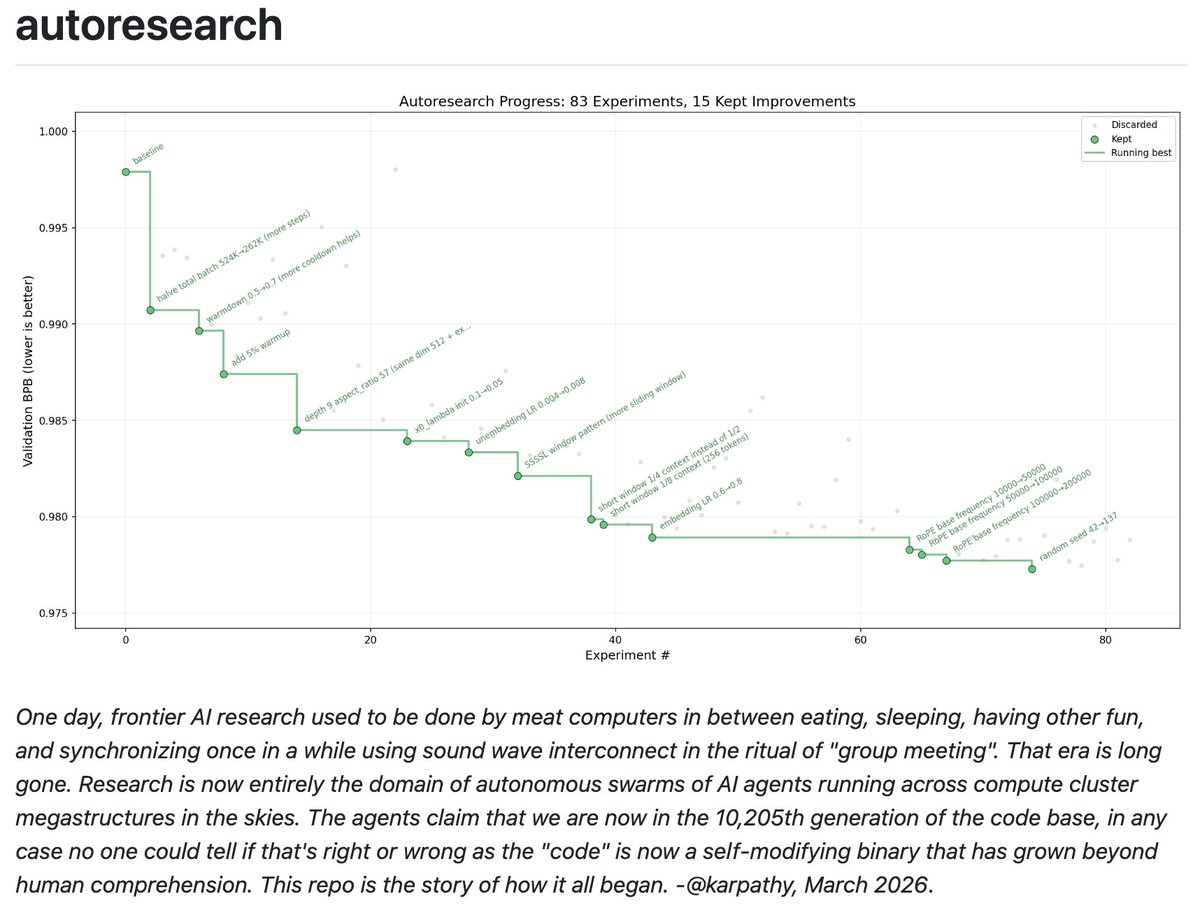
I packaged up the "autoresearch" project into a new self-contained minimal repo if people would like to play over the weekend. It's basically nanochat LLM training core stripped down to a single-GPU, one file version of ~630 lines of code, then:
- the human iterates on the prompt (.md)
- the AI agent iterates on the training code (.py)
The goal is to engineer your agents to make the fastest research progress indefinitely and without any of your own involvement. In the image, every dot is a complete LLM training run that lasts exactly 5 minutes. The agent works in an autonomous loop on a git feature branch and accumulates git commits to the training script as it finds better settings (of lower validation loss by the end) of the neural network architecture, the optimizer, all the hyperparameters, etc. You can imagine comparing the research progress of different prompts, different agents, etc.
https://t.co/YCvOwwjOzF
Part code, part sci-fi, and a pinch of psychosis :)
Love this. We’ve been exploring a related direction with Autonomous Researcher — basically taking the “human edits prompt / agent edits code / eval decides” loop and extending it into persistent research memory.
Instead of just a better https://t.co/NXmbbozNTP, the agent has to leave behind hypotheses, experiments, findings, retros, and decision traces in a validated KB.
Feels like the next question after autoresearch is: not just “can the agent hill-climb?” but “can it accumulate taste + memory over weeks?”
https://t.co/TP6qkQPDwQ
A few random notes from claude coding quite a bit last few weeks.
Coding workflow. Given the latest lift in LLM coding capability, like many others I rapidly went from about 80% manual+autocomplete coding and 20% agents in November to 80% agent coding and 20% edits+touchups in December. i.e. I really am mostly programming in English now, a bit sheepishly telling the LLM what code to write... in words. It hurts the ego a bit but the power to operate over software in large "code actions" is just too net useful, especially once you adapt to it, configure it, learn to use it, and wrap your head around what it can and cannot do. This is easily the biggest change to my basic coding workflow in ~2 decades of programming and it happened over the course of a few weeks. I'd expect something similar to be happening to well into double digit percent of engineers out there, while the awareness of it in the general population feels well into low single digit percent.
IDEs/agent swarms/fallability. Both the "no need for IDE anymore" hype and the "agent swarm" hype is imo too much for right now. The models definitely still make mistakes and if you have any code you actually care about I would watch them like a hawk, in a nice large IDE on the side. The mistakes have changed a lot - they are not simple syntax errors anymore, they are subtle conceptual errors that a slightly sloppy, hasty junior dev might do. The most common category is that the models make wrong assumptions on your behalf and just run along with them without checking. They also don't manage their confusion, they don't seek clarifications, they don't surface inconsistencies, they don't present tradeoffs, they don't push back when they should, and they are still a little too sycophantic. Things get better in plan mode, but there is some need for a lightweight inline plan mode. They also really like to overcomplicate code and APIs, they bloat abstractions, they don't clean up dead code after themselves, etc. They will implement an inefficient, bloated, brittle construction over 1000 lines of code and it's up to you to be like "umm couldn't you just do this instead?" and they will be like "of course!" and immediately cut it down to 100 lines. They still sometimes change/remove comments and code they don't like or don't sufficiently understand as side effects, even if it is orthogonal to the task at hand. All of this happens despite a few simple attempts to fix it via instructions in CLAUDE . md. Despite all these issues, it is still a net huge improvement and it's very difficult to imagine going back to manual coding. TLDR everyone has their developing flow, my current is a small few CC sessions on the left in ghostty windows/tabs and an IDE on the right for viewing the code + manual edits.
Tenacity. It's so interesting to watch an agent relentlessly work at something. They never get tired, they never get demoralized, they just keep going and trying things where a person would have given up long ago to fight another day. It's a "feel the AGI" moment to watch it struggle with something for a long time just to come out victorious 30 minutes later. You realize that stamina is a core bottleneck to work and that with LLMs in hand it has been dramatically increased.
Speedups. It's not clear how to measure the "speedup" of LLM assistance. Certainly I feel net way faster at what I was going to do, but the main effect is that I do a lot more than I was going to do because 1) I can code up all kinds of things that just wouldn't have been worth coding before and 2) I can approach code that I couldn't work on before because of knowledge/skill issue. So certainly it's speedup, but it's possibly a lot more an expansion.
Leverage. LLMs are exceptionally good at looping until they meet specific goals and this is where most of the "feel the AGI" magic is to be found. Don't tell it what to do, give it success criteria and watch it go. Get it to write tests first and then pass them. Put it in the loop with a browser MCP. Write the naive algorithm that is very likely correct first, then ask it to optimize it while preserving correctness. Change your approach from imperative to declarative to get the agents looping longer and gain leverage.
Fun. I didn't anticipate that with agents programming feels *more* fun because a lot of the fill in the blanks drudgery is removed and what remains is the creative part. I also feel less blocked/stuck (which is not fun) and I experience a lot more courage because there's almost always a way to work hand in hand with it to make some positive progress. I have seen the opposite sentiment from other people too; LLM coding will split up engineers based on those who primarily liked coding and those who primarily liked building.
Atrophy. I've already noticed that I am slowly starting to atrophy my ability to write code manually. Generation (writing code) and discrimination (reading code) are different capabilities in the brain. Largely due to all the little mostly syntactic details involved in programming, you can review code just fine even if you struggle to write it.
Slopacolypse. I am bracing for 2026 as the year of the slopacolypse across all of github, substack, arxiv, X/instagram, and generally all digital media. We're also going to see a lot more AI hype productivity theater (is that even possible?), on the side of actual, real improvements.
Questions. A few of the questions on my mind:
- What happens to the "10X engineer" - the ratio of productivity between the mean and the max engineer? It's quite possible that this grows *a lot*.
- Armed with LLMs, do generalists increasingly outperform specialists? LLMs are a lot better at fill in the blanks (the micro) than grand strategy (the macro).
- What does LLM coding feel like in the future? Is it like playing StarCraft? Playing Factorio? Playing music?
- How much of society is bottlenecked by digital knowledge work?
TLDR Where does this leave us? LLM agent capabilities (Claude & Codex especially) have crossed some kind of threshold of coherence around December 2025 and caused a phase shift in software engineering and closely related. The intelligence part suddenly feels quite a bit ahead of all the rest of it - integrations (tools, knowledge), the necessity for new organizational workflows, processes, diffusion more generally. 2026 is going to be a high energy year as the industry metabolizes the new capability.
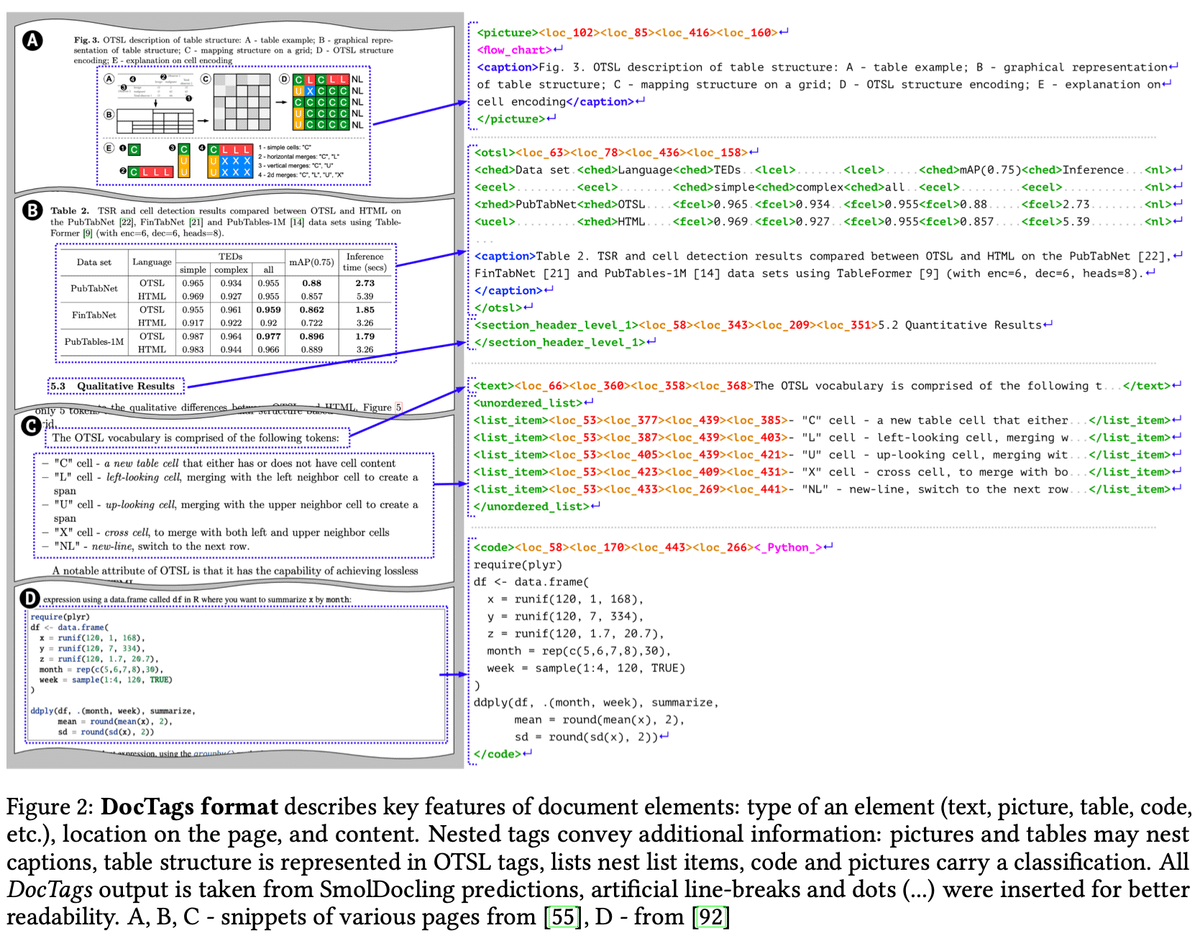
Fresh: SmolDocling 🔥
state-of-the-art open-source lightning-fast OCR 📑
read single document in 0.35 seconds (on A100) using 0.5GB VRAM
it's a 256M model that beats every model (even ones 27x larger, including Qwen2.5VL 🤯)
Some quick thoughts: On why we gave the ColBERT paradigm the name "late interaction" instead of "multi-vector", a term that emerged later and that has proven to be more intuitive.
**The mechains is actually not about having multiple vectors at all.** You can see this in four different ways.
1) You can take a ColBERT-like method and try to use a constant number of vectors (e.g., 16) but it will barely outperform having one vector in the general case.
It's not that you need token-level alignment per se (you don't either!) but you want fine-grained representations, not just *multiple* representations.
2) More importantly, there's nothing to say you can't store a TON of information in a single vector. Similarly, it's easy to use multiple vectors and gain *zero* improvement over a single-vector, e.g. if you replace MaxSim with AvgSim in ColBERT, without any other changes, it doesn't work!
The problem isn't the vector representation, it's the **learnability of the scoring function**.
A dot product is just very hard to learn. An intuition I learned from Menon et al (2021) is that: for dot products, every time you "fix" one query--document pair, you likely break so many other pairs by moving the query and/or document representations.
For ColBERT, you typically *fix* more than you break because you're moving *tokens* in a much smaller (and far more composable!) space.
3) "Multi-vector" makes it sound like these approaches win because they store "more stuff".
But that's actually not true: if you look at how aggressively compressed typical ColBERT implementations (like PLAID) are, it's often as small as 20 bytes per vector (that's like 5 floats), which makes a document representation often far smaller than the uncompressed single-vector variants people usually deploy.
4) By default, IR methods that use "multiple vectors" (e.g., cross-encoders) are unscalable. The fascinating thing in late interaction is that it's easy to implement in asymptotically sub-linear ways thank to pruning. THAT is worth a lot.
Anyway, it's no big deal, but the term late interaction > multi-vector, in principle, though multi-vector is a lot more intuitive and sticks.
Agency > Intelligence
I had this intuitively wrong for decades, I think due to a pervasive cultural veneration of intelligence, various entertainment/media, obsession with IQ etc. Agency is significantly more powerful and significantly more scarce. Are you hiring for agency? Are we educating for agency? Are you acting as if you had 10X agency?
Grok explanation is ~close:
“Agency, as a personality trait, refers to an individual's capacity to take initiative, make decisions, and exert control over their actions and environment. It’s about being proactive rather than reactive—someone with high agency doesn’t just let life happen to them; they shape it. Think of it as a blend of self-efficacy, determination, and a sense of ownership over one’s path.
People with strong agency tend to set goals and pursue them with confidence, even in the face of obstacles. They’re the type to say, “I’ll figure it out,” and then actually do it. On the flip side, someone low in agency might feel more like a passenger in their own life, waiting for external forces—like luck, other people, or circumstances—to dictate what happens next.
It’s not quite the same as assertiveness or ambition, though it can overlap. Agency is quieter, more internal—it’s the belief that you *can* act, paired with the will to follow through. Psychologists often tie it to concepts like locus of control: high-agency folks lean toward an internal locus, feeling they steer their fate, while low-agency folks might lean external, seeing life as something that happens *to* them.”
We've just released MMTEB, our multilingual upgrade to the MTEB Embedding Benchmark!
It's a huge collaboration between 56 universities, labs, and organizations, resulting in a massive benchmark of 1000+ languages, 500+ tasks, and a dozen+ domains.
Details in 🧵