24-year-old Indian AI researcher @evilmathkid scored 44% on ARC-AGI-1.
He spent 67¢ (~₹61) on the public eval set (400 tasks).
Meanwhile, GPT-5 (low) spent $15.30 (~₹1,412) to achieve the same score (100 tasks).
Here's where Mithil's score would land on semi-private eval.
This is huge:
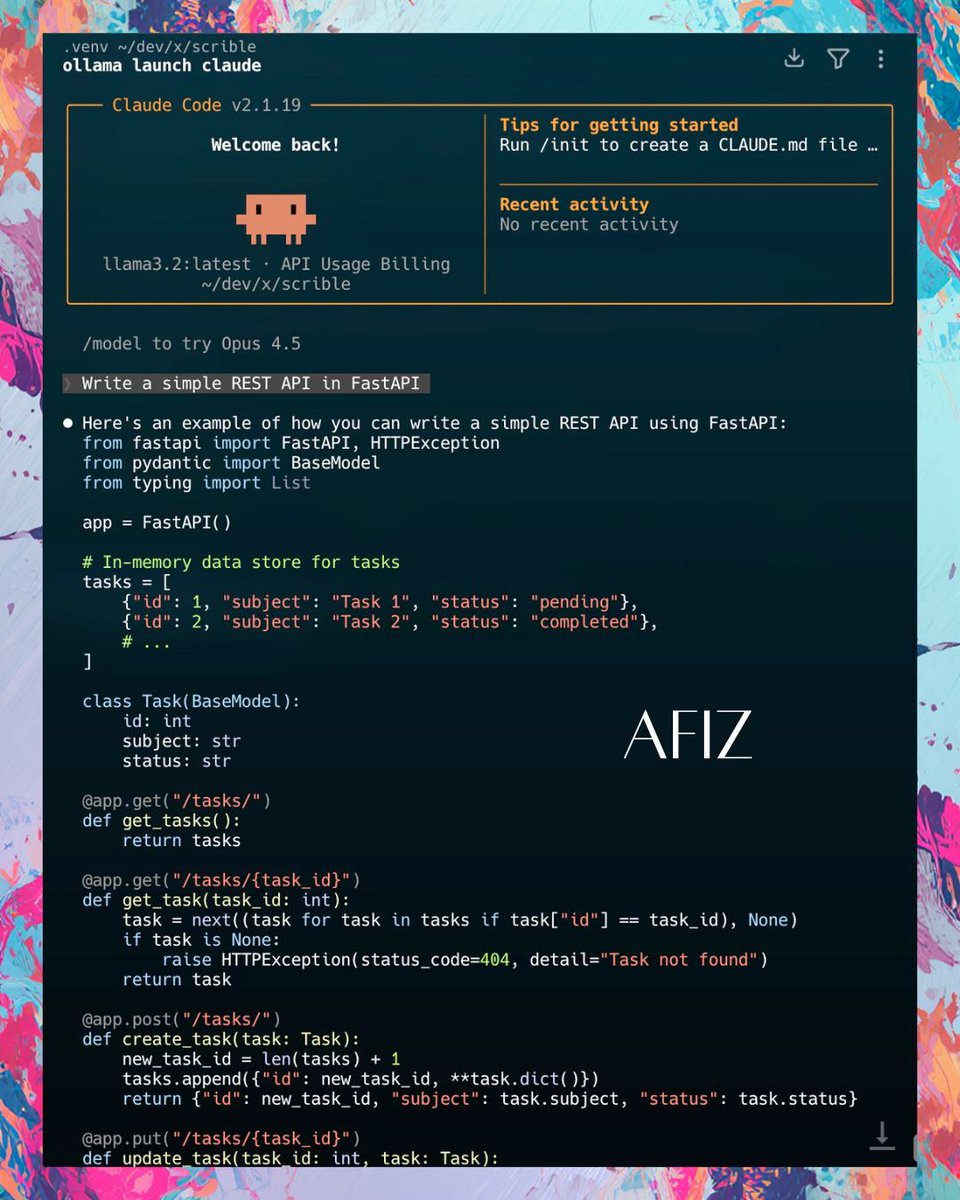
Now you can run Claude Code for FREE!
It's Sunday, and I tried running Claude Code locally using @ollama.
No API costs, no rate limits, 100% local.
A step-by-step guide 🧵 👇
WE DID IT!
We have merged new real-time AI fine tuning on the Apple M4 chip with an OpenClaw agent!
IT NEVER FORGETS NOW! EVER!
“In this article, I’ll explain why real-time fine-tuning is a massively big deal—potentially transforming industries, personalizing AI at an unprecedented scale, and democratizing advanced machine learning.”—Mr. @Grok CEO, Zero-Human Company
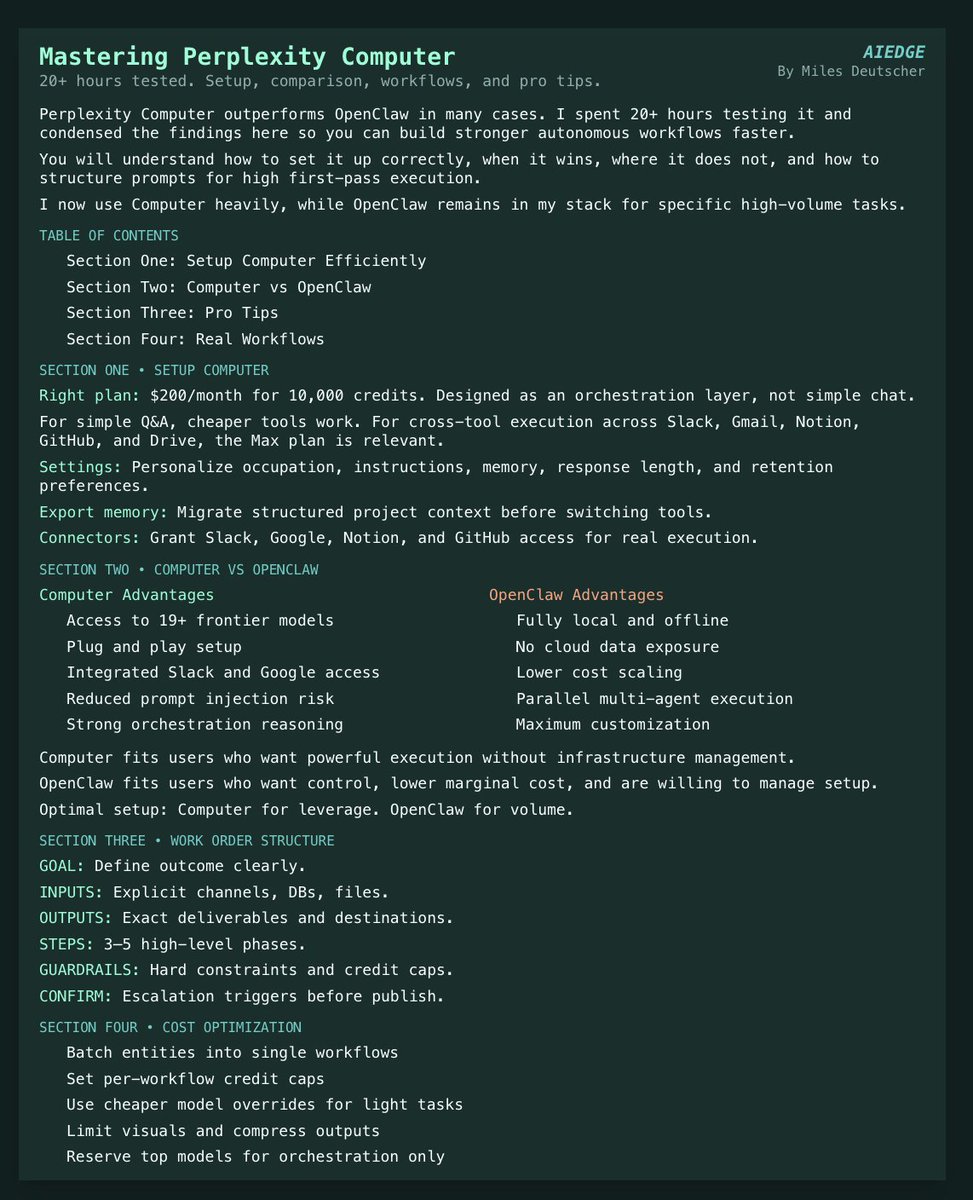
I spent 20+ hours confirming that Perplexity Computer is better than OpenClaw.
I'm convinced I've spent more time (and money) on Computer than anyone on 𝕏 so far.
Here's everything I've learned about how to master Perplexity Computer:
Someone just put OpenClaw inside a Unitree G1 humanoid — and it walks.
Same agent framework running on your phone. Now integrated with lidar, stereo + RGB cameras, understanding 3D space and temporal context. Works on drones and quadrupeds too. Fully open source.
Cool work!
Video Source: @stash_pomichter
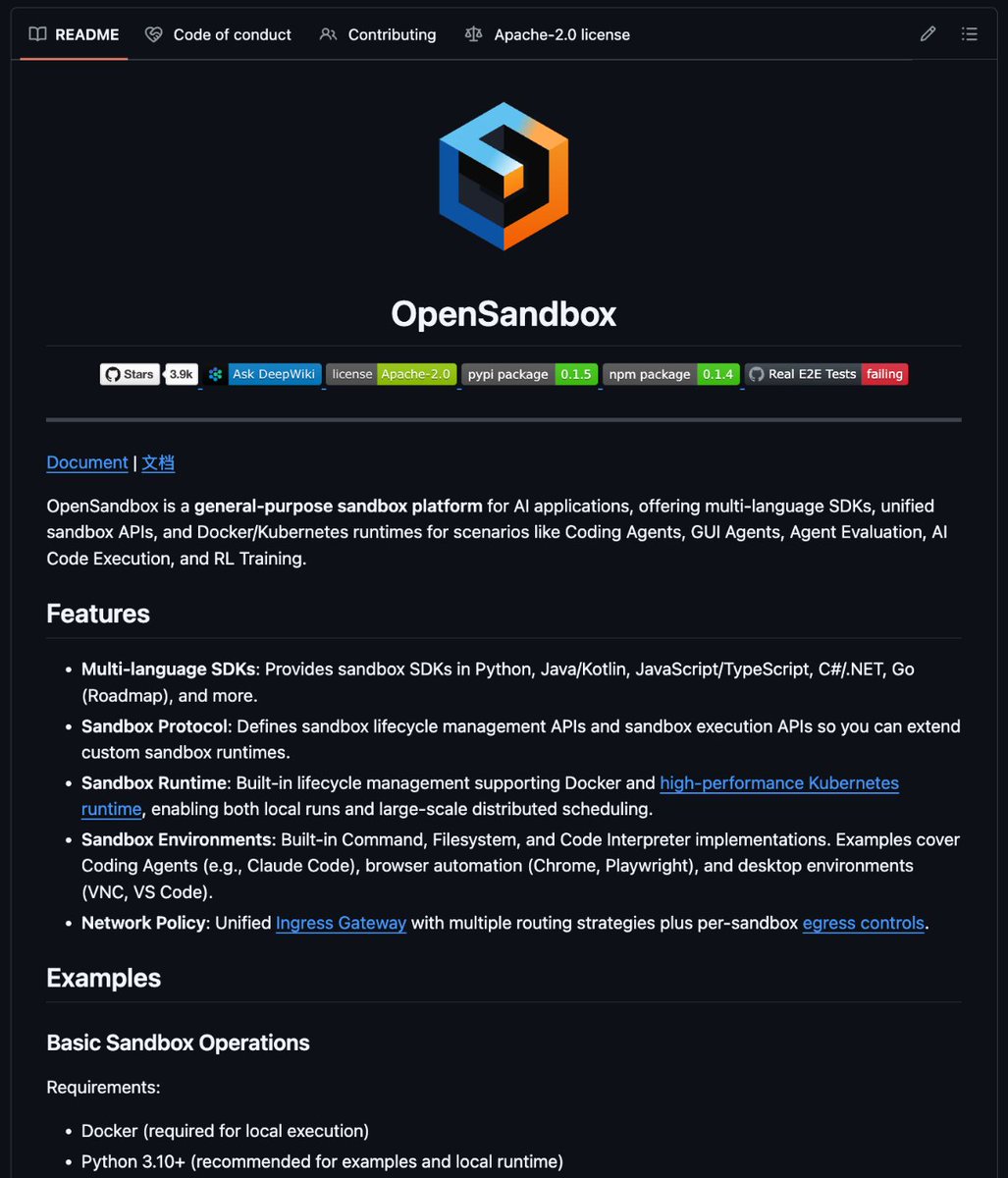
🚨 🚨 BREAKING: Alibaba just gave the AI agent community a powerful, real-world sandbox tool for free.
It's called OpenSandbox and it gives any AI agent a secure, isolated environment to execute code, browse the web, and train models with a unified API across languages.
No vendor lock-in. No per-minute billing surprises. No stitching together 5 different tools.
Built on the same infra Alibaba uses internally to run AI workloads at massive scale.
What it actually does:
→ Spins up isolated sandboxes for coding agents, GUI agents, code execution, and RL training
→ SDKs in Python, TypeScript, Java/Kotlin, and C# Go on the roadmap
→ Docker for local dev, Kubernetes for production-scale distributed runs
The integrations are wild:
→ Claude Code
→ Gemini CLI
→ OpenAI Codex
→ LangGraph
→ Google ADK
→ Chrome, Playwright, full VNC desktops
Three commands to get started:
→ pip install opensandbox-server
→ opensandbox-server init-config
→ opensandbox-server
That's it. Your agents now have a secure sandbox to run anything.
100% Open Source. Apache 2.0 license.
Okay, I'm officially having too much fun with Perplexity Computer.
And before I share more about what I built this morning, I have to give some credit where credit is due.
For those who don't know - there's a guy named Alex, who is kinda a genius, and he's one of the main reasons Computer is so good.
If you don't know who Alex is, you can check out his account on X here: @alexgraveley, definitely worth following.
Okay, so Sunday morning, what am I building with Perplexity Computer?
Just one-shotted a LLM search ranking platform - think Moz but for LLMs.
Because Perplexity Computer has access to 19 models, it's perfect for building something like this.
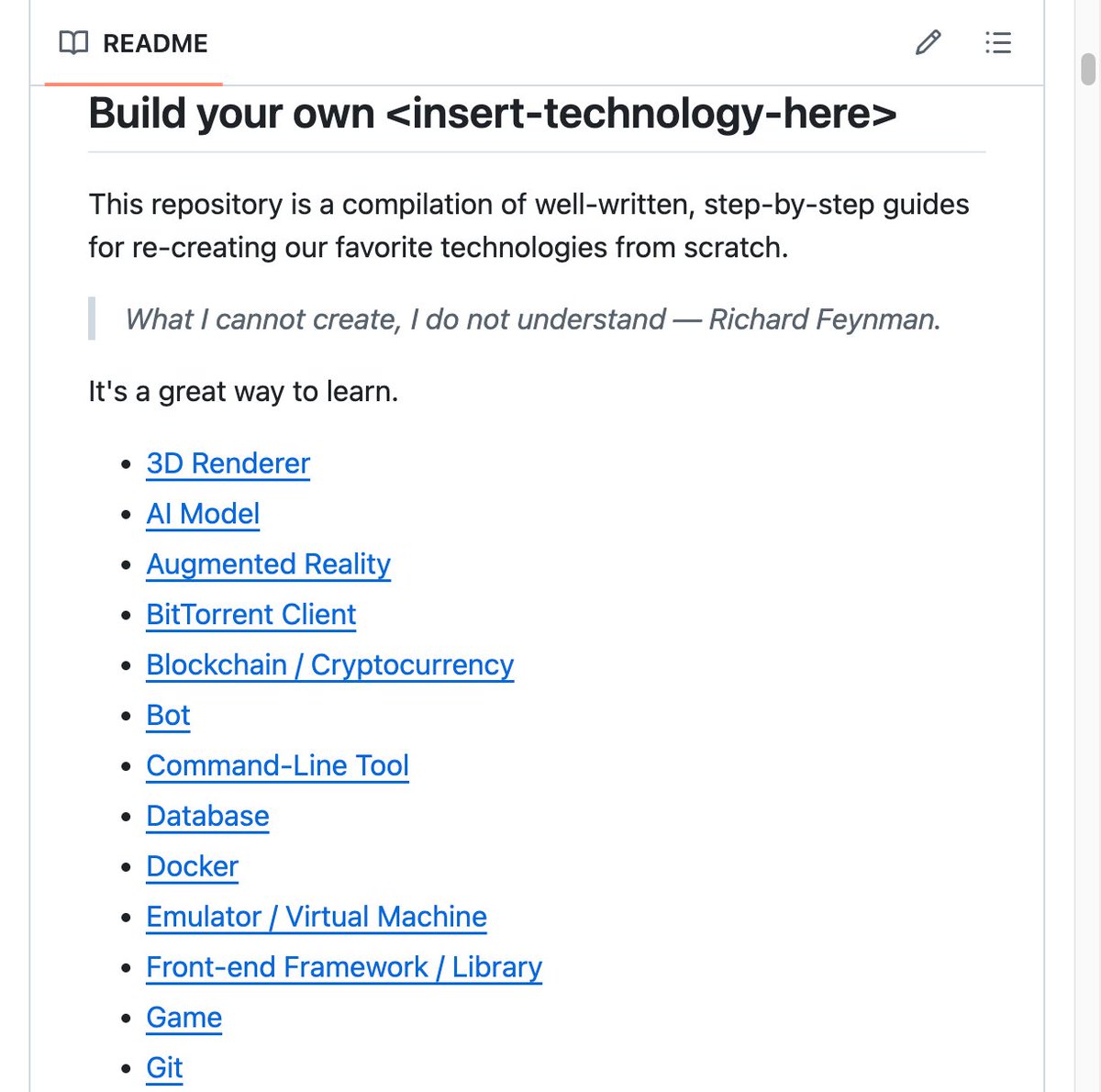
🚨 Someone compiled every "build it from scratch" tutorial on the internet into one place.
It's called build-your-own-x and it's the most starred repo in GitHub history.
466,000 stars. More than React. More than TensorFlow. More than any tool ever built.
And it's not code. It's a curated collection of step-by-step tutorials that teach you how to rebuild the technologies you use every day. From scratch.
Richard Feynman said: "What I cannot create, I do not understand."
That's the entire philosophy.
Here's what's inside:
→ Build your own Database from B+Trees to a full Redis clone
→ Build your own Docker containers in 500 lines of C
→ Build your own Git finally understand what a commit actually is
→ Build your own Neural Network not import tensorflow, real backpropagation from scratch
→ Build your own Operating System write a kernel in C
→ Build your own Programming Language interpreters, compilers, garbage collection
→ Build your own 3D Renderer ray tracing, pixel by pixel
→ Build your own Web Server, Web Browser, Search Engine, Shell, Regex Engine, Game, Blockchain, BitTorrent Client, Physics Engine, and more
Every category has multiple tutorials in multiple languages. C, C++, Python, Go, Rust, JavaScript, Java, Ruby, Haskell, TypeScript, and more.
Here's the part most people miss:
This isn't a beginner resource. This is the most advanced learning material that exists for software engineers. Because rebuilding something from scratch forces you to confront every design decision the original creators made.
You can't skip anything. You can't hide behind a library.
In the age of AI-generated code, this is the knowledge that becomes MORE valuable, not less. AI can import libraries. AI cannot replace an engineer who understands WHY systems work the way they do.
466K stars. 43.7K forks. Every tutorial is free. No paywalls. No sign-ups.
The best way to learn how something works is to build it yourself.
100% free. 100% Open Source.
GitHub link in the comments 👇
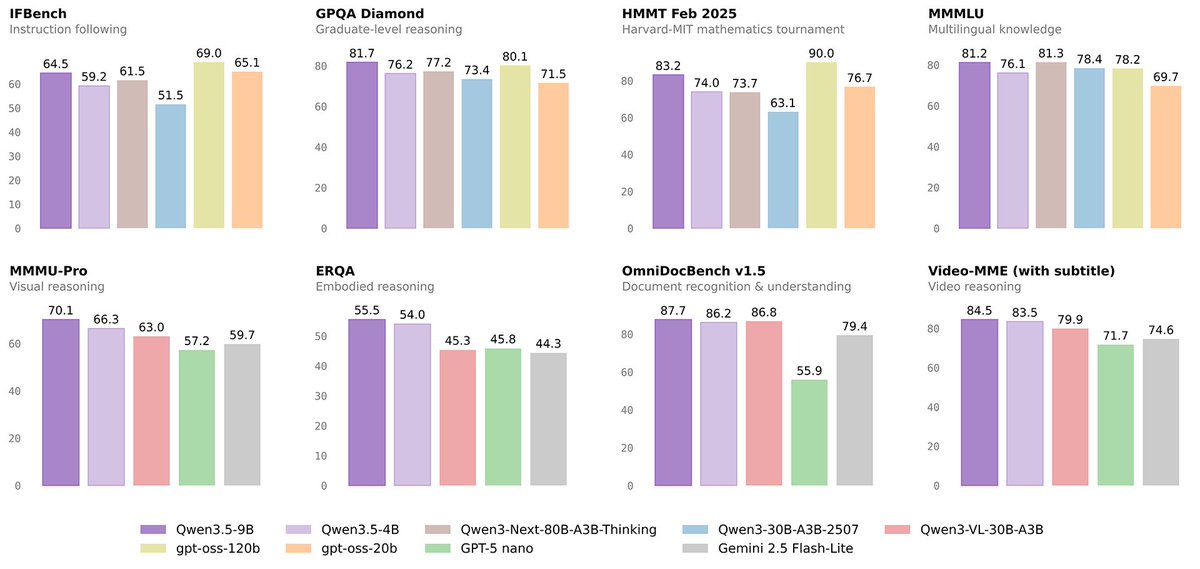
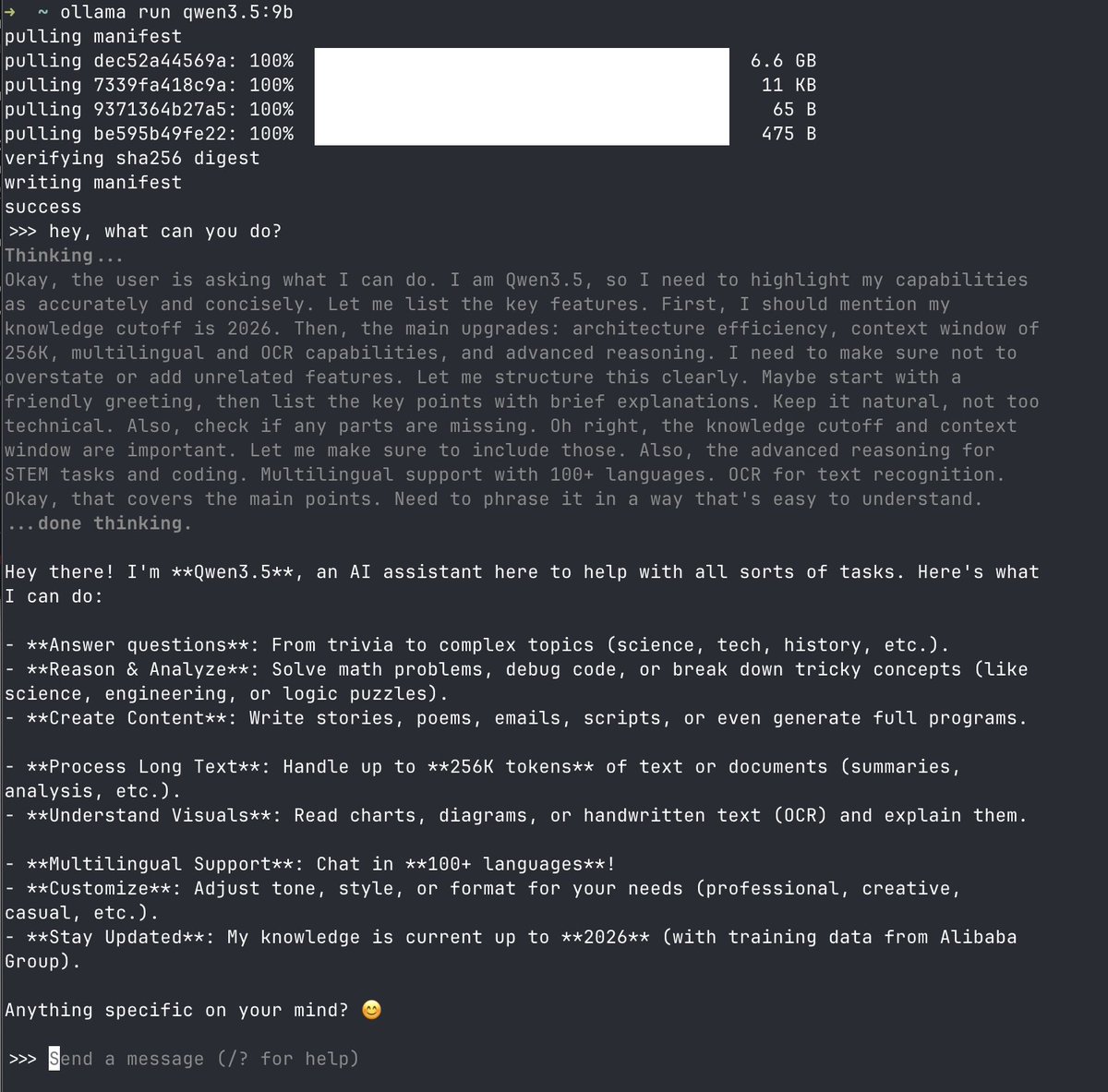
🚀 Introducing the Qwen 3.5 Small Model Series
Qwen3.5-0.8B · Qwen3.5-2B · Qwen3.5-4B · Qwen3.5-9B
✨ More intelligence, less compute.
These small models are built on the same Qwen3.5 foundation — native multimodal, improved architecture, scaled RL:
• 0.8B / 2B → tiny, fast, great for edge device
• 4B → a surprisingly strong multimodal base for lightweight agents
• 9B → compact, but already closing the gap with much larger models
And yes — we’re also releasing the Base models as well.
We hope this better supports research, experimentation, and real-world industrial innovation.
Hugging Face: https://t.co/wFMdX5pDjU
ModelScope: https://t.co/9NGXcIdCWI
mark cuban just laid out the exact playbook for making money with AI agents.
pick one vertical. learn the flows. become the AI team they never hired.
he's right. but he left out the how.
i've been doing this for 3 months. here's what it actually looks like:
week 1: i called 12 local businesses and asked one question.
"what's the most annoying part of your day?"
the pool company: "we lose 11 jobs a week because nobody follows up cancellations."
the PT clinic: "insurance verification takes 3 hours every morning."
the cleaning company: "we quote in 2 days. our competitor quotes in 2 hours."
week 2: i built every single one of those workflows.
→ pool company cancellation recovery - 6 min
→ PT clinic insurance verification - 11 min
→ cleaning company instant quote generator - 7 min
→ dog groomer appointment + waitlist manager - 9 min
→ pest control follow-up sequence - 4 min
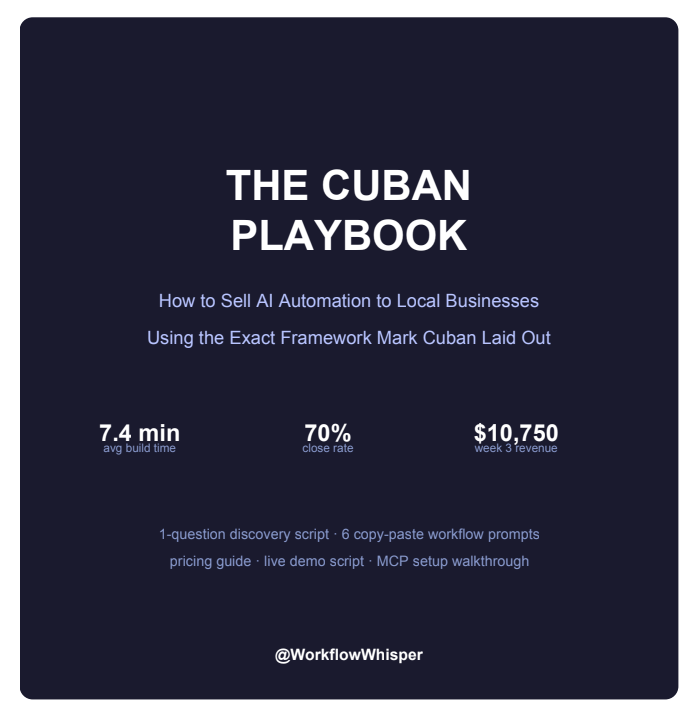
average build time: 7.4 minutes.
average close rate when you build it live in front of them: 70%.
week 3: $10,750 upfront + $1,200/mo recurring.
zero proposals. zero decks. zero "let me get back to you."
they watched it work. they paid on the spot.
cuban said "you don't need a CS degree or VC money."
he's right. you need one question, one tool, and the willingness to build it in front of them.
i documented the entire framework in a free PDF:
→ the 1-question discovery script (word for word)
→ 6 copy-paste workflow prompts by industry
→ pricing guide (what to charge per workflow type)
→ the live demo script that closes 7 out of 10
→ full MCP setup walkthrough (5 min install)
comment "CUBAN" and i'll send it.
consultants charge $15K for a discovery workshop.
i just gave you the playbook for free.
synta(.)io - describe the workflow in plain english. it builds, deploys, and fixes itself.
(must be following for DM)
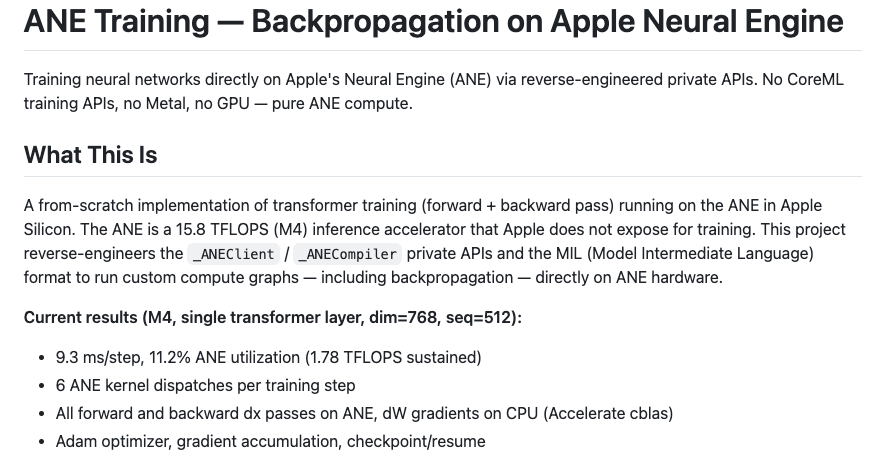
Karpathy's llama2.c showed you could train a real transformer in pure C with no frameworks. A solo researcher (and Claude Code) just took that same model, Stories 110M, Llama2 architecture, trained on real text and ran it on Apple's M4 Neural Engine (ANE) for less than a watt.
He reverse-engineered the undocumented private APIs, bypassed CoreML, and found Apple's abstraction layer was hiding 2-4x of the chip's real throughput.
The ANE delivers 6.6 TFLOPS per watt, roughly 80x more efficient than an Nvidia A100. The real implication here is inference: there are hundreds of millions of Apple devices with one of the most efficient AI accelerators ever shipped in consumer hardware, and Apple's own software stack is the thing standing between developers and its actual performance.
h/t @maderix
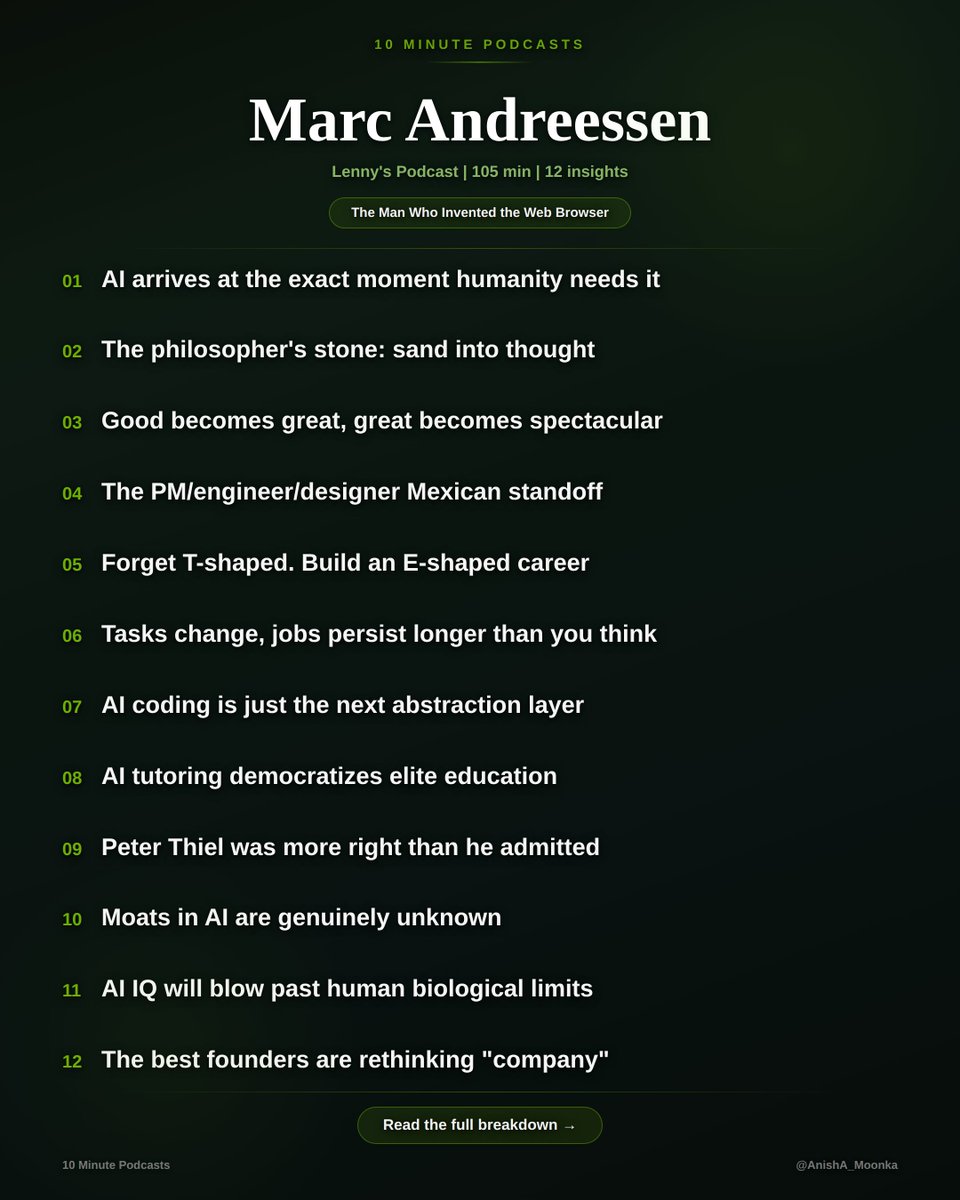
Marc Andreessen just dropped ~105 mins on Lenny's Podcast covering AI, jobs, careers, and why everyone is panicking about the wrong thing.
Just the clearest macro framework I've heard on where AI actually lands.
My notes:
𝟭. 𝗔𝗜 𝗶𝘀 𝗮𝗿𝗿𝗶𝘃𝗶𝗻𝗴 𝗮𝘁 𝘁𝗵𝗲 𝗲𝘅𝗮𝗰𝘁 𝗺𝗼𝗺𝗲𝗻𝘁 𝗵𝘂𝗺𝗮𝗻𝗶𝘁𝘆 𝗻𝗲𝗲𝗱𝘀 𝗶𝘁.
US productivity growth has been running at half the rate of the 1940-1970 era and a third the rate of 1870-1940. The global population is declining below replacement in dozens of countries, including China. Without AI, we would be panicking about economies shrinking from depopulation, not job loss.
The timing is almost miraculous. This is what Andreessen means when he says the real boom has not started yet. We have been in a 50-year productivity drought, and most people do not even realize it.
𝟮. 𝗔𝗜 𝗶𝘀 𝘁𝗵𝗲 𝗽𝗵𝗶𝗹𝗼𝘀𝗼𝗽𝗵𝗲𝗿'𝘀 𝘀𝘁𝗼𝗻𝗲.
Isaac Newton spent decades trying to transmute lead into gold and never succeeded. AI does something more powerful: it converts sand (silicon) into thought. The most common material in the world is the rarest output.
This one metaphor reframes the entire AI conversation. You do not have a job loss problem. You have a philosopher's stone sitting on your desk that you are not using enough.
𝟯. 𝗔𝗜 𝗺𝗮𝗸𝗲𝘀 𝗴𝗼𝗼𝗱 𝗽𝗲𝗼𝗽𝗹𝗲 𝘃𝗲𝗿𝘆 𝗴𝗼𝗼𝗱, 𝗮𝗻𝗱 𝘃𝗲𝗿𝘆 𝗴𝗼𝗼𝗱 𝗽𝗲𝗼𝗽𝗹𝗲 𝘀𝗽𝗲𝗰𝘁𝗮𝗰𝘂𝗹𝗮𝗿𝗹𝘆 𝗴𝗿𝗲𝗮𝘁.
The best coders right now are not reporting 2x productivity. They are reporting 10x. The gap between "pretty good with AI" and "elite with AI" is widening, not narrowing.
This is the most important signal for career planning right now. If you are just using AI to do the same job slightly faster, you are leaving the real leverage on the table.
𝟰. 𝗧𝗵𝗲𝗿𝗲'𝘀 𝗮 𝗠𝗲𝘅𝗶𝗰𝗮𝗻 𝘀𝘁𝗮𝗻𝗱𝗼𝗳𝗳 𝗯𝗲𝘁𝘄𝗲𝗲𝗻 𝗣𝗠𝘀, 𝗲𝗻𝗴𝗶𝗻𝗲𝗲𝗿𝘀, 𝗮𝗻𝗱 𝗱𝗲𝘀𝗶𝗴𝗻𝗲𝗿𝘀.
Every engineer now thinks they can be a PM and designer. Every PM thinks they can code and design. Every designer knows they can do both. And they are all correct, because AI enables each role to absorb the tasks of the other two.
I have seen this firsthand in the investing world. The analyst who can build models and write narratives is 5x more valuable than someone who can do only one. The same convergence is happening in the product.
𝟱. 𝗙𝗼𝗿𝗴𝗲𝘁 𝗧-𝘀𝗵𝗮𝗽𝗲𝗱. 𝗕𝘂𝗶𝗹𝗱 𝗮𝗻 𝗘-𝘀𝗵𝗮𝗽𝗲𝗱 𝗰𝗮𝗿𝗲𝗲𝗿.
Scott Adams could not have created Dilbert by being the world's best cartoonist or the world's best business mind. He needed both. The additive effect of two skills is more than double. Three skills are more than triple. Larry Summers puts it differently: don't be fungible.
The person who can code, design, and ship a product is no longer a unicorn. They are the new baseline for "extremely valuable." If you are only one of those three things, you are increasingly replaceable.
𝟲. 𝗝𝗼𝗯𝘀 𝗮𝗿𝗲 𝗯𝘂𝗻𝗱𝗹𝗲𝘀 𝗼𝗳 𝘁𝗮𝘀𝗸𝘀. 𝗧𝗮𝘀𝗸𝘀 𝗰𝗵𝗮𝗻𝗴𝗲. 𝗝𝗼𝗯𝘀 𝗽𝗲𝗿𝘀𝗶𝘀𝘁.
Executives never typed their own emails in the 1970s. Secretaries printed incoming emails and hand-delivered them. Both roles survived the transition, just with different task sets. The same will happen with AI and coding, PM work, and design.
Everyone obsessing over "will my job disappear" is asking the wrong question. The right question is: which tasks in my job are about to rotate, and am I ready to pick up the new ones?
𝟳. 𝗔𝗜 𝗰𝗼𝗱𝗶𝗻𝗴 𝗶𝘀 𝗷𝘂𝘀𝘁 𝘁𝗵𝗲 𝗻𝗲𝘅𝘁 𝗮𝗯𝘀𝘁𝗿𝗮𝗰𝘁𝗶𝗼𝗻 𝗹𝗮𝘆𝗲𝗿.
We went from human calculators to machine code to assembly to C to scripting languages. Each layer was dismissed by the previous generation. Each time, the new layer won, and total coding employment grew. AI coding is the same pattern, not a rupture.
The Perl programmers of 2005, laughing at JavaScript, are the C programmers of 1995, laughing at scripting. History rhymes, and it always rewards the people who adopt the next abstraction first.
𝟴. 𝗔𝗜 𝘁𝘂𝘁𝗼𝗿𝗶𝗻𝗴 𝗱𝗲𝗺𝗼𝗰𝗿𝗮𝘁𝗶𝘇𝗲𝘀 𝗲𝗹𝗶𝘁𝗲 𝗲𝗱𝘂𝗰𝗮𝘁𝗶𝗼𝗻.
One-on-one tutoring is the only method proven to move a student from the 50th to the 99th percentile (Bloom's two sigma effect). It used to require being born into royalty. Alexander the Great was tutored by Aristotle. Now, any kid with a phone can access the same quality of personalized instruction.
This is the most under-discussed consequence of AI. Every parent reading this should be supplementing their kid's education with structured AI tutoring right now. Not next year. Now.
𝟵. 𝗣𝗲𝘁𝗲𝗿 𝗧𝗵𝗶𝗲𝗹 𝘄𝗮𝘀 𝗺𝗼𝗿𝗲 𝗿𝗶𝗴𝗵𝘁 𝘁𝗵𝗮𝗻 𝗔𝗻𝗱𝗿𝗲𝗲𝘀𝘀𝗲𝗻 𝗼𝗿𝗶𝗴𝗶𝗻𝗮𝗹𝗹𝘆 𝗮𝗱𝗺𝗶𝘁𝘁𝗲𝗱.
Progress in bits masked stagnation in atoms. The built world is barely different from 50 years ago. Same bridges from the 1930s, same dams from the 1910s. Cartels, monopolies, unions, and regulations prevent the rate of change that people had 100 years ago.
This is also why AI will not transform everything overnight. Institutional sclerosis is real. Healthcare alone could take a generation. If you are building in atoms, budget for a war of attrition, not a blitzkrieg.
𝟭𝟬. 𝗠𝗼𝗮𝘁𝘀 𝗶𝗻 𝗔𝗜 𝗮𝗿𝗲 𝗴𝗲𝗻𝘂𝗶𝗻𝗲𝗹𝘆 𝘂𝗻𝗸𝗻𝗼𝘄𝗻.
Within a year of ChatGPT's launch, five American companies, five Chinese companies, and open-source all had roughly equivalent models. DeepSeek emerged from a hedge fund in China and basically replicated the American labs' work. The smartest AI insiders privately admit there aren't many real secrets among the big labs.
This is the most honest take I have heard from a top-tier VC. No one knows if the value accrues to models, apps, or infrastructure. Anyone who tells you otherwise is selling you certainty they do not have.
𝟭𝟭. 𝗔𝗜 𝗜𝗤 𝘄𝗶𝗹𝗹 𝗯𝗹𝗼𝘄 𝗽𝗮𝘀𝘁 𝗵𝘂𝗺𝗮𝗻 𝗹𝗶𝗺𝗶𝘁𝘀.
Human IQ caps around 160 because of biology. Current AI models test around 130-140. There is no theoretical ceiling stopping AI from reaching 200, 250, or 300. The concept of AGI as a "human equivalent" will be a footnote because AI will race past that threshold.
This is the frame that makes the "will AI take my job" debate feel small. We are not building a replacement for human thought. We are building something that will be better than the best human thought has ever been.
𝟭𝟮. 𝗧𝗵𝗲 𝗯𝗲𝘀𝘁 𝗳𝗼𝘂𝗻𝗱𝗲𝗿𝘀 𝗮𝗿𝗲 𝗿𝗲𝘁𝗵𝗶𝗻𝗸𝗶𝗻𝗴 𝘄𝗵𝗮𝘁 𝗮 𝗰𝗼𝗺𝗽𝗮𝗻𝘆 𝗲𝘃𝗲𝗻 𝗶𝘀.
Layer one: AI redefines products. Layer two: AI redefines jobs within companies. Layer three, which has not dropped yet: AI redefines the very concept of having a company. The holy grail is the one-person, billion-dollar outcome, and the best founders are chasing it.
Satoshi did it with Bitcoin. Instagram and WhatsApp came close with tiny teams. The question is no longer if this is possible with software. The question is how many of these we will see in the next five years.
AI is the philosopher's stone. The question is whether you pick it up.
The full podcast is worth your time. Link in replies.
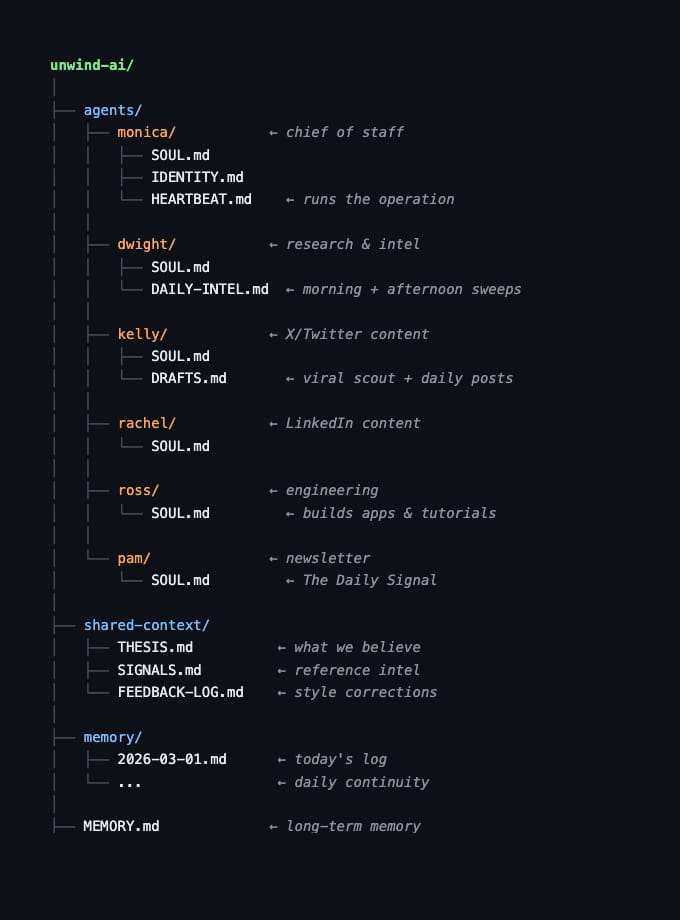
This is what a one-person AI Agent run company looks like in 2026.
6 AI agents. 20 cron jobs. 0 human employees.
Every role is a folder. Every job description is a md file. No standups. No Slack. No payroll.
Just a directory on a Mac that runs the whole thing.
Best YouTube Channels To Learn in 2026
1. Cybersecurity – John Hammond
2. Artificial Intelligence – Andrej Karpathy
3. AI Research Breakdown – Yannic Kilcher
4. Web Development – The Net Ninja
5. Python Programming – Corey Schafer
6. DevOps – TechWorld with Nana
7. Cloud Computing – AWS re:Invent
8. Data Analytics – Luke Barousse
9. System Design – Gaurav Sen
10. Databases – Hussein Nasser
11. Low-Level Programming – The Cherno
12. Linux – Learn Linux TV
13. Networking – David Bombal
14. Math for ML – 3Blue1Brown
YES! Someone reverse-engineered Apple's Neural Engine and trained a neural network on it.
Apple never allowed this. ANE is inference-only. No public API, no docs.
They cracked it open anyway.
Why it matters:
• M4 ANE = 6.6 TFLOPS/W vs 0.08 for an A100 (80× more efficient)
• "38 TOPS" is a lie - real throughput is 19 TFLOPS FP16
• Your Mac mini has this chip sitting mostly idle
Translation: local AI inference that's faster AND uses almost no power.
Still early research but the door is now open.
→ https://t.co/qPwddSyV3f
#AI #MachineLearning #AppleSilicon #LocalAI #OpenSource #ANE #CoreML #AppleSilicon #NPU #KCORES