A new milestone in automatic formalization:
We translated an entire graduate math textbook into Lean using 30K LLM agents.
Open-source, large-scale multi-agent inference that actually works
> Blueprint+Lean: https://t.co/YkhG2g1cWp
> Codebase+preprint: https://t.co/EH3IphOKZ3
1/7
How are mathematicians facing the wave of rapidly advancing AI-for-math capabilities?
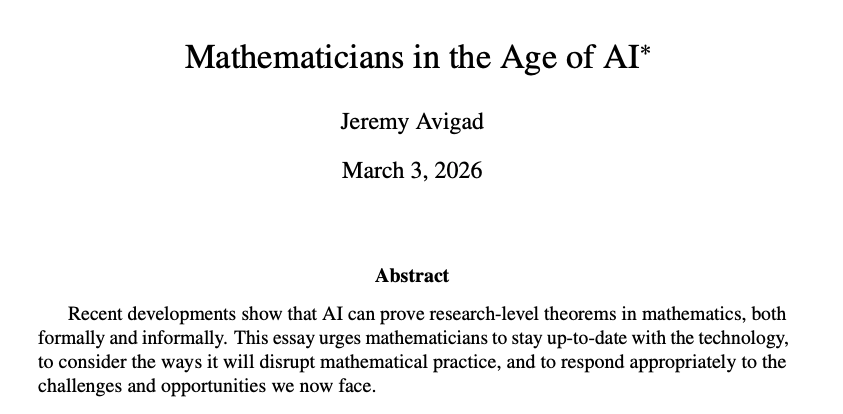
Jeremy Avigad (CMU prof and co-author on the original 2015 system description paper for Lean) just posted a paper with his thoughts in the wake of the Math, Inc. announcement on sphere packing.
https://t.co/vMpRguL2AE
There are a lot of interesting passages in here, including a bit of the back story of the Math, Inc. bomb drop and how it was initially received by the humans working on the formalization project.
But, as for how mathematics proceeds, here's the key last passage:
"We need to remember our strengths: mathematicians are problem solvers and theory builders extraordinaire. Rather than fight the use of AI in mathematics, we should own it. It is not enough to keep up with current events and design benchmarks for AI researchers; we need to play an active role in deploying the technology and molding it to our purposes. We also need to learn how to raise our students with the wisdom to use the new technologies appropriately, and we need to be careful that we still manage to impart core mathematical intuitions and understanding. Figuring out how to use AI effectively to achieve our mathematical goals won’t be easy, but mathematicians have always embraced challenges—indeed, the harder, the better. If we face AI head-on and stay true to our values, mathematics will thrive. We just need to show up and get to work."
The next few years should be a golden era for mathematics. For those of us working on the frontier, I hope we do well by our mathematician colleagues.