काल लोकशाही न्युज चॅनेलवर 'लोकशाही विशेष' मध्ये 'मग जैन धर्मीयांनाच वेगळा न्याय का' ह्या विषयावर व्यक्त झालो.!
सहभाग
राजू वाघमारे - कांग्रेस प्रवक्ता
महंत सुधीर दास - हिंदू पुजारी
नौशाद उस्मानी - इस्लाम अभ्यासक.
@news_lokshahi
@PravinAlai@honraoprerana@keshavupadhye
Whether #StateElectionCommission Promoting Congress..?
महाराष्ट्र राज्य निवडणूक आयोगाने आपल्या वेबसाईटवर खालील प्रमाणे एक पोस्ट प्रसिद्ध केलेला आहे. ज्यात "हातभार" या शब्दामध्ये एका राजकीय पक्षाचे चिन्ह दिसत आहे.
एक नागरिक म्हणून मला या पोस्ट ला तीव्र आक्षेप आहे.
@ECISVEEP
Election Commission of India I would urge look into the issue, it clearly promoting a particular party "Election Symbol".
Must direct State Commission to withdrawn with immediate effect.
#Elections2024#ElectionCommission
निवडणूक आयोग ही कुठल्याही पक्षाची नसून एक स्वतंत्र स्वायत्त संस्था आहे, याप्रकारच्या जनजागृती च्या मेसेज मधून निवडणूक मध्ये असे एखाद्या पक्षाचे आठवण करून देणारे चिन्ह वापरू नये. हे पक्षपाती ठरेल.
मी सविस्तर तक्रार आयोगाकडे देत आहे..
#MaharashtraElection
#ViksitBharatAmbassador
"I call upon every young individual in the country to become a 'Viksit Bharat Ambassador.' Take leadership in fulfilling the aspirations of a developed India," - PM Modi
via NaMo App
@LokshahiMarathi वरील कारवाई ही निंदनीय आहे.
चॅनेल वरील कारवाई ही Programme Code अंतर्गत Section 05 Read with Section 16 of Cable TV network Act 1995 नुसार केली असेल,
तर या आदेशा विरुद्ध चॅनल मा. उच्च न्यायालयात Art - 226 खाली याचिका दाखल करू शकते.
@kamleshsutar#lokshahimarathi
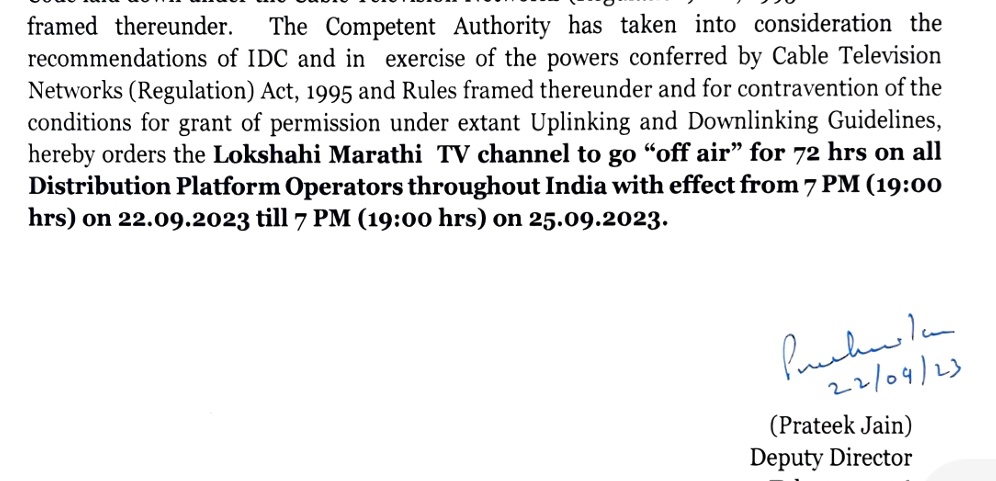
किरीट सोमय्या बातमी प्रकरणी माहिती प्रसारण मंत्रालयाने #लोकशाही वाहिनी आज संध्या.७ वा.पासून पुढील ७२ तास बंद करण्याचे आदेश दिले आहेत.
आदेश वाहिनीला संध्या.६.१३वा. प्राप्त झाले.सदर आदेशाबाबत कायदेशीर सल्ला घेत आहोत.
कोरा कागद निळी शाही,आम्ही कुणाला भीत नाही.
#lokshahimarathi
Chandrayaan-3 Mission:
Chandrayaan-3 ROVER:
Made in India 🇮🇳
Made for the MOON🌖!
The Ch-3 Rover ramped down from the Lander and
India took a walk on the moon !
More updates soon.
#Chandrayaan_3#Ch3
My suggestions on #UCC submitted to Law Commission is shared with you here under:
Dated 29-6-2023
From:
M. Nageswara Rao IPS (Retired)
Former Director, CBI
To,
The Member-Secretary
Law Commission of India
Subject: Uniform Civil Code
Dear Sir/Madam,
With reference to your Public Notice dated 14-6-2023 seeking views and ideas from public about Uniform Civil Code, my considered submissions are given as under:
1. Do we at all need a Uniform Civil Code?
1.1 There have been any number of reports, articles, and papers on the desirability or otherwise of a Uniform Civil Code for India as mandated by Article 44 of the Constitution. The sum and substance of the arguments against a Uniform Civil Code is that India is not a homogenous country and therefore legislative uniformity in personal and family matters cannot be at the expense of diversity as it obliterates the differences among communities, their religions, cultures, customs, etc. This contrarian view has been predominant in academic, intellectual, political, establishment circles and to some extent even in legal and judicial circles. Therefore, successive Law Commissions have shied away from addressing the vital issue and drafting a Unform Civil Code Bill.
1.2 This argument in a country that is wedded to secular democratic republic under a written Constitution which guarantees equality before law and equal protection of laws to all citizens irrespective of religion, sex, etc, is not only flawed but is also fraught with dangerous consequences. By applying this argument India cannot and should not have one Constitution, because it has people of different religions, languages, cultures with divergent historical experience in different regions, etc. Should we, therefore, abolish the Constitution and allow people of different States to frame their own Constitutions or follow their traditional and customary modes of governance?
1.2 Secondly, although Hindu society is not homogenous with so many languages, cultures, customs, etc, yet Nehru and Ambedkar against all opposition shoved down the throat of Hindu society a uniform set of personal laws for all Hindus. A fundamental objection to the Hindu Code Bill was that there was nothing Hindu in those laws except the name. It was alleged that Ambedkar and Nehru simply paraphrased the English common law principles and enacted them by mendaciously naming them as Hindu personal laws. As the logic against Uniform Civil Code applies in equal measure to the Hindu Code, should we repeal the Hindu Marriage Act, the Hindu Succession Act, the Hindu Minority and Guardianship Act, and the Hindu Adoption and Maintenance Act, and allow various segments of Hindu society to follow their own customary personal laws?
1.3 Thirdly, India has uniform criminal law even though various religious communities had their customary criminal law for eons. So, based on the argument against a Uniform Civil Code, should we repeal all the common criminal laws which are common for all irrespective of religion, etc and allow different communities to follow their diverse customary criminal laws?
1.3 If the answers to these questions are in the affirmative, then we should not have a Uniform Civil Code. And instead, we should start the project of repealing the Constitution, common Hindu personal laws, and common criminal laws. And if they are in the negative, then without further ado we must have a Uniform Civil Code.
2. Should Uniform Civil Code be enacted gradually or in one go?
2.1 Evidently, a Uniform Civil Code covers matters relating to marriage, divorce, inheritance, succession, adoption, maintenance, guardianship, and other family/personal matters. Achieving uniformity in all these matters in one go by enacting a Uniform Civil Code not only requires investment of huge political capital but it may also lead to avoidable strife. Therefore, it would be prudent to progress gradually through piecemeal legislations by initially taking up most important issues that are against the constitutional principles of equality before law and equal treatment of laws, and gender parity and justice. The following are the two most important issues that need immediate action in our endeavour to progress towards attainment of a Uniform Civil Code. They are namely:
2.2 Uniform age of consent for marriage between all citizens irrespective of religion, sex:
2.2.1 The 21st Law Commission in its Consultation Paper on Reform of Family Law issued on 31-8-2018 at Paras 2.20 and 2.21 thereof, recommended uniform age of consent for marriage between all citizens irrespective of religion, sex, etc, which are reproduced hereunder for ready reference:
“Age of Consent For Marriage:
2.20. A uniform age of consent between all citizens of marriage warrants a separate conversation from a discussion about prevention of child marriages for the simple reason that maintaining the difference of eighteen years for girls and twenty-one years of age for boys simply contributes to the stereotype that wives must be younger than their husbands.
2.21. If a universal age for majority is recognised, and that grants all citizens the right to choose their governments, surely, they must then be also considered capable of choosing their spouses. For equality in the true sense, the insistence on recognising different ages of marriage between consenting adults must be abolished. The age of majority must be recognised uniformly as the legal age for marriage for men and women alike as is determined by the Indian Majority Act, 1875, i.e. eighteen years of age. The difference in age for husband and wife has no basis in law as spouses entering into a marriage are by all means equals and their partnership must also be of that between equals.”
2.2.2 It goes to the credit of this Government that they promptly acted on the recommendation and introduced the Prohibition of Child Marriage (Amendment) Bill, 2021 in Parliament on 20-12-2021. The Bill has since been referred to a Select Committee of Parliament under the Chairmanship of Dr Vinay Sahasrabuddhe @Vinay1011, and its current status is not known.
2.2.3 While appreciating the Government for this progressive legislative initiative, I had disagreed with it only on the point of 21 years as minimum age of marriage for the reasons mentioned in my thread of tweets dated 21-12-2021.
2.2.3 In any case, the Bill is undoubtedly progressive as it provides for uniformity of age of consent for marriage irrespective of religion, sex, etc and therefore it must be enacted immediately as an important step in towards achieving a Uniform Civil Code.
2.3 Banning Polygamy:
2.3.1 While section 494 of Indian Penal Code prohibits polygamy but permits the same for Muslims and some tribals through a subterfuge. It is reproduced hereunder for ready reference:
“494. Marrying again during lifetime of husband or wife: Whoever, having a husband or wife living, marries in any case in which such marriage is void by reason of its taking place during the life of such husband or wife, shall be punished with imprisonment of either description for a term which may extend to seven years, and shall also be liable to fine.” (Emphasis added)
2.3.2 As per 2011 Census (that is the latest available census data), the sex ratio was 943 females per 1,000 males. Of the total of about 121 crores of population, 62.31 crores were males and 58.75 crores females. Thus, there were 3.56 crore more males than females in the year 2011.
2.3.3 Further, out of the total population, about 58 crore were married (excluding those divorced, widowed, etc) of which 29.3 crore were married females and 28.7 crores married males. That there are about 66 lakh more married females than married males suggests that at least that many women are in polygamous marriages.
2.3.4 From the general mean distribution of Indian population, more than 60 per cent are in the 21-60 age group. Therefore, out of 3.56 crore more men than women in 2011, about 2 crore men would be in this age group of 21-60, which is also sexually active age group. For sheer lack of availability of women due to a skewed sex ratio, they are deprived of marriage or female companionship.
2.3.5 To this number of 3.56 crores excess men than women, one must add another 66 lakh unmarried men due to the fact that many women are in polygamous marriages. Consequently, there is humongous gender imbalance in matrimony with unmarried men in excess of 4.22 crore as of 2011 in sexually active age group, which creates extraordinary social, familial, criminological and psychological stress on the population.
2.3.6 Disregarding the legal position and the overwhelming census data, the 21st Law Commission, in its Consultation Paper on Reform of Family Law issued on 31st August 2018, at Para 2.63 thereof, falsely accused Hindus of practising bigamy based on anthropological evidence without citing any reference thereto. The said para is reproduced hereunder:
“2.63. Anthropological evidence has shown that bigamous arrangements among Hindus continue to exist and have local recognition despite their being a law against it. In fact, data suggests that many Hindus convert to Islam in order to practice bigamy as highlighted by the Sarla Mudgal v. Union of India in 1994.”
2.3.7 Furthermore, how did it not occur to the 21st Law Commission that if “bigamous arrangements among Hindus continue to exist and have local recognition despite their being a law against it”, why would “many Hindus convert to Islam in order to practice bigamy”? On top of that false vilification of Hindus, its conspiratorial silence in the said Paper, against polygamy among Muslims and section 494 IPC that permits it, is deafening.
2.3.8 In my article dated 30th November 2020 published in @SwarajyaMag (https://t.co/V2ZUfWOpGK), I had argued that the menace of Love Jihad is a direct consequence of legally permitted polygamous hunger for more women among Muslim men, which the Muslim society cannot supply as nature limits percentage of women to around 50% in any community. They, therefore, poach non-Muslim women. With the disappearance of communal protection of women in non-Muslim societies in the modern period there is heightened vulnerability among non-Muslim women. The Christian Church especially in Kerala has been very vocal on the menace of Love Jihad, which is a direct consequence of polygamy among Muslims.
2.3.9 Apart from all the above, there are many perfectly secular reasons to ban the practice of polygamy. It is baffling how a secular country that is wedded to and guarantees equality before law, parity between sexes and gender justice allows the evil of polygamy to exist as it cuts at the very roots of secularism?
2.3.10 Moreover, on every measure of social welfare, polygamous societies fare far worse than the monogamous. It is empirically evident that polygamous societies are more prone to violence and instability, have more crime, less education, less freedoms for women, acute gender discrimination and subjugation of women, etc.
2.3.11 Further, polygamy is an important contributor of disproportionately high growth of Muslim population leading to destabilisation of religious demographic balance, causing lot of anxieties among non-Muslims. Any disturbance in the relative religious demography in a multi-religious society is fraught with long term deleterious consequences on the national unity and integrity.
2.3.12 Therefore, it is imperative from every conceivable progressive point of view that the evil of polygamy must be banned immediately as it is an important step in accomplishment of a Uniform Civil Code.
2.3.13 Having established that polygamy is evil, the question is modalities of banning it. There are two options namely; (i) Amendment of the Muslim Personal Law (Shariat) Application Act, 1937; or (ii) Amendment of section 494 IPC.
2.3.14 The first option (that is amendment of the Muslim Personal Law (Shariat) Application Act, 1937) will be incomplete as it covers only Muslims but not the polygamy practising tribal communities. Therefore, this route is not recommended.
2.3.15 Criminal law including offences relating to marriage, is common to all people of all religions and genders except for some northeastern States excepted by Articles 371A, 371B, 371C and 371G of Constitution. That is to say, sections 304B (dowry death) and 498A (marital cruelty) IPC and their corresponding sections 113A (presumption as to abetment of suicide by a married woman) and 113B (presumption as dowry death) of IEA, the Dowry (Prohibition) Act, 1961 etc are applicable to all persons irrespective of religion, sex, etc. Even in the northeast the respective States do adopt most criminal laws enacted by Parliament. As such there is near uniformity in application of criminal laws throughout the country.
2.3.16 Therefore, the second option of amendment of section 494 IPC to delink the personal law from its ambit, will universally criminalise the evil of polygamy. Hence, it is prudent to amend section 494 IPC by omitting the words, “in any case in which such marriage is void by reason of its taking place” from it.
2.3.17 The northeastern States that are excepted by Articles 371A, 371B, 371C and 371G of Constitution, may in due course take appropriate decision about extending the amended 494 IPC to their respective States.
2.3.18 Thus, this simple and easily doable amendment of section 494 IPC will go a long way in our efforts at attainment of a Uniform Civil Code.
Thank you for your kind courtesies.
M. Nageswara Rao IPS (Retired)
Former Director, CBI
#UniformCivilCode
#Uniform_Civil_Code
@MLJ_GoI
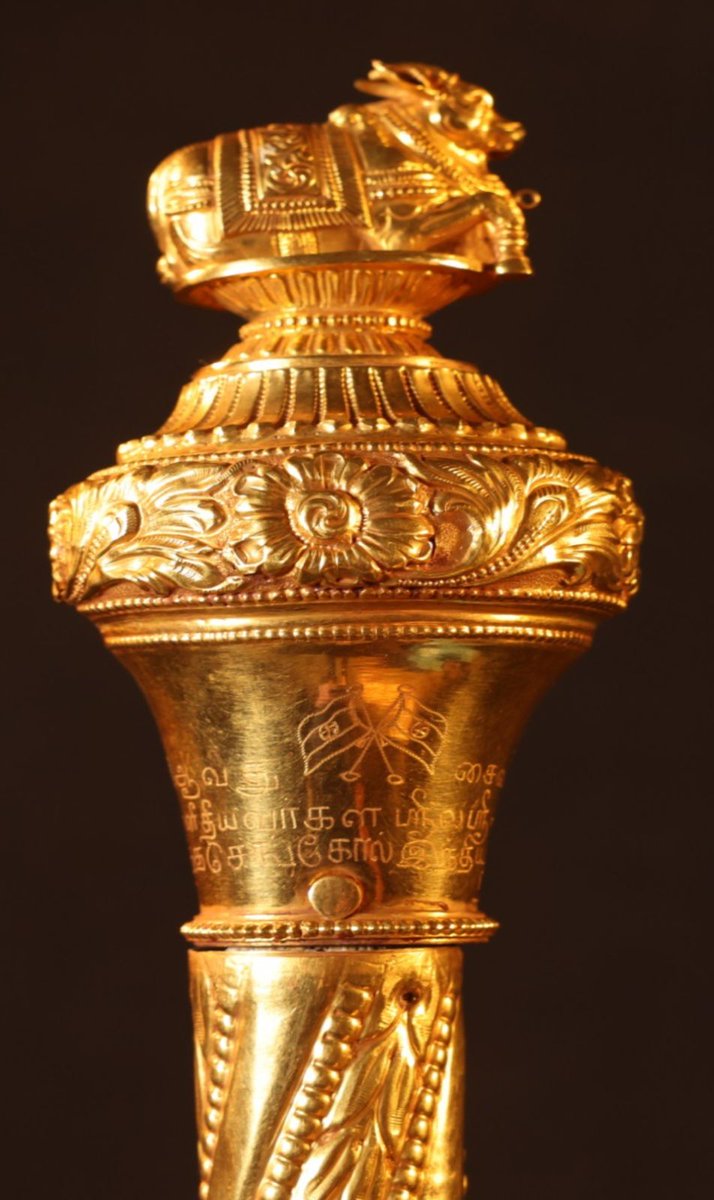
Prime Minister Shri Narendra Modi’s decision to install the sacred Sengol in the New Parliament building is a historic moment. The sacred Sengol is of national significance and holds historical importance. It was first received by Jawaharlal Nehru on August 14, 1947, in presence of leaders like Shri Rajendra Prasad, from priests specially flown in from Tamilnadu.
A solemn and sacred Tamil tradition of Sengol Vesting Ceremony accompanied by a recital of 11 verses from the Theveram text, invoking the blessings of Shiva, for the ruler took place just before Pandit Nehru hoisted the national flag and made his ‘Tryst with Destiny’ address, symbolising the transfer of power from British Viceroy Lord Mountbatten to Indian Prime Minister Jawaharlal Nehru. The Sengol represents the highest moral authority to rule
I thank the Prime Minister for bringing back to life this very important aspect of our history - that the transfer of power to the people of India from a foreign ruler was not direct but through a spiritual process, as known to ancient India. This also emphasises the emotional and spiritual integration of India, from North to South.
There is no more appropriate occasion than Azadi ka Amrit Mahotsav to recall the event on the eve of India’s independence and no better place for the sacred Sengol, than the hallowed portals of the New Parliament.
#SengolAtNewParliament
#सत्ता संघर्ष निकाल इतक्यात नाहीच--
सत्ता संघर्षावर निकाल येत्या ४-५ दिवसात लागेल अशी बातमी सगळी कडे चालवली जात आहे व त्यास प्रामुख्याने कारण म्हणजे घटना पीठापैकी एक न्यायाधीश जस्टीस शाह निवृत्त होत असल्याने लवकरच निर्णय होईल असे सांगितले जात आहे, परंतु हे कारण पुर्णतः चुकीचे आहे.
◆Judge who hear the case not necessarily deliver the judgement.
◆Court Gives the Judgment not Judge.
निर्णय कोर्ट देते न्यायाधीश नाही. म्हणून एखादा न्यायाधीश निवृत्त झाले तरी एखादा निर्णय प्रलंबित राहू शकतो.
माझ्या मते सत्ता संघर्षावरील निर्णय कोर्ट कुठल्याही क्षणी देऊ शकते परंतु फक्त एखादे न्यायाधीश निवृत्त होत आहेत म्हणून लवकर निर्णय घ्यावा हे शक्य नाही.
सुप्रीम कोर्टात दर ३-६ महिन्यात एखादे न्यायाधीश निवृत्त होत असतात, त्यात त्यांनी ऐकलेले केसेस मधील काही केसेस चे निर्णय देतात व काही त्यांच्या जागी नव्याने आलेले अथवा त्यांच्या जागी रुजू झालेले अथवा सेवा जेष्ठतेने रुजू झालेले न्यायाधीश निर्णय देतात.
◆ सुट्टी काळात निर्णय तयार होऊ शकते..?
काही वेळा सुप्रीम कोर्टाला २-२ महिने सुट्ट्या का पाहिजे असे प्रश्न केले जाते, परंतु या काळात न्यायाधीश सुट्टी उपभोगत नसून प्रलंबित व क्लीष्ट प्रकरणाची अभ्यास करून निकाल तयार करीत असतात, मुळात याच कारणावरून सुप्रीम कोर्ट प्रदीर्घ सुट्टी घेत असते.
महाराष्ट्र सत्ता कारण प्रकरण सुद्धा गुंतागुंतीची व क्लिष्ट अशी आहे यावर निर्णय देताना अभ्यासपूर्ण द्यावा लागतो, त्यातच ०७ सदस्यीय खंड पिठाकडे वर्ग करायचे की नाही यावर सुद्धा सुप्रीम कोर्ट निर्णय देऊ शकतो.
त्यामुळे इतक्यात निर्णय अपेक्षित नाही.
◆ एखाद्या प्रकरणात सुप्रीम कोर्ट पूर्ण ऐकून घेलल्याबर किती दिवसात निर्णय देऊ शकते..?
१) सुप्रीम कोर्टाने निर्णय कधी द्यावा यावर कोर्टास असे काही बंधने नाहीत.
२) परंतु सुप्रीम कोर्टाने २००१ साली #अनिल राई वि स्टेट ऑफ बिहार मधून उच्च न्यायालय ऐकून घेतल्यानंतर ०३ महिन्यात निर्णय घ्यावा असे निर्देश दिलेलं आहे.
Matter reserved for judgment and delivered after span of a period - सुनावणी नंतर निर्णयास दीर्घ काळ प्रलंबित राहून निकाली आलेले प्रकरण ...
१) 2Specturm Case सुनावणी नंतर निंर्णय राखून ठेऊन तब्बल ४३३ दिवसांनी निर्णय.
२) कलम ३७७ समलिंगी विषयक निकाल - सुनावणी नंतर तब्बल ६२४ दिवसानंतर निकाल दिला.
म्हणून सत्ता संघर्षावरील निर्णय इतक्यात येईल यात शंका आहे. निकालाची शक्यता कमीच.
@LokshahiMarathi@News18lokmat@ABPNews