https://t.co/fLNmyY0rTZ Fantastic project to be involved with. Combining a passion for aerodynamics with cycling. What a fantastic machine @JLaverackTi have made - cutting edge in so many ways. @lborouniversity
Recent @lboroalumni Axel Dopfer smashed the prestigious German hour record with the help of @LboroEng and @LboroSSEHS researchers 👏
Alex cycled 51.755km, beating the decade long record.
Read more ➡️ https://t.co/rpeVTQgHPE
Getting ready for Day 2 of #PedalForParis! 🚲
Today, @Chris_Boardman will be calling in on @PaddleUK to explore the risk of water pollution to its sports, then on through the East Midlands to Loughborough.
Some exciting roles now open with @TudorProCycling in our innovation team and coaching department for next season. #cyclingjobs#jobsinsport#borntodare
https://t.co/wKXVGE0ARS
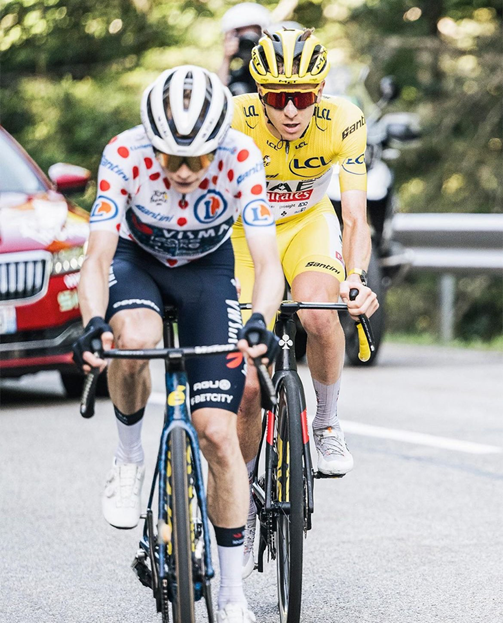
My calculations were based on Stage 15 of the TdF - Plateau de Beille. I took the average values for Pogačar - 15.63 km, 7.9% in 40 minutes. Yes, the gradient and speed varied, and yes, he didn’t get a draft for the whole climb, but the numbers are enough to show it is important.
Uphill drafting?
(📷: charlylopezph)
Several pundits have asked how much drafting helps uphill. Enough to save 5% of the riders’ effort. 20-25 watts depending on mass, speed and gradient. Absolutely enough to make a difference. Shows how important those mountain domestiques are.
How did I work this out? If you want to get into the science have a look at the excellent research of Thijs van Druenen and Bert Blocken (https://t.co/2tJyqKdPO3). I had the pleasure of meeting Professor Blocken at last week’s International Conference on the Engineering of Sport.
van Druenen and Blocken show a drafting rider saves about 55% in terms aerodynamic drag. Being proportional to speed squared this is dwarfed on climbs by the effect of gravity. However, elite cyclists are as light as 60 kg and ride at amazing speeds so aerodynamics is in play.
We’re thrilled to be supporting @RollsRoyce with their groundbreaking hydrogen research project which today has taken a huge step towards achieving #netzero aviation. ✈️
Read more ⤵️https://t.co/EvKxrb6Xhg
.@lborouniversity Doctoral Researcher Ashley van Bruygom talks to @shinisomara@TheIET about her work in the field of hydrogen combustion
Ashley is based at the University's National Centre for Combustion and Aerothermal Technology
Read more here 👇
https://t.co/OvyuBXP5LL