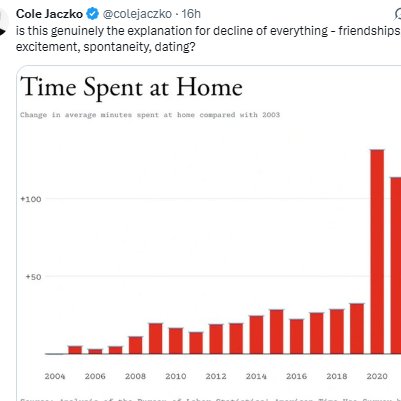
tv debloating inspired an $8 smartwatch experiment. no firmware download, so we decoded its bluetooth commands and built a java android companion. a fun reminder to look for open-source firmware next time.
My advice to juniors is simple:
Dont be a prompt engineer, it takes no skill.
Do:
- learn math
- learn to code
- build from first principles
Go as far as you can with math.
Learn to code well. Start with the @handmade_net crowd.
Build whatever interests you from scratch: llms, game engines, compilers, etc.
They key here is building systems you understand inside out. Just reading about it isnt good enough, let alone letting ai do it for you.
You have to put the reps in.
There is a tidal wave of slop being built by many who have never done the above, and someone will have to fix all that down the road.
Be that someone.
software engineering is so back.
> people are reading books again.
> every line of code is being read carefully.
> fundamentals are cool again.
> architecture and system design are back in focus.
> nobody is fighting over frameworks anymore.
> understanding why something works matters again.
> code reviews matter more than lines of code shipped.
> debugging is becoming a superpower again.
> technical judgment matters more than typing speed.
> engineering is about thinking again, not just coding.
Do not tell me AI movies and animations from small teams that care are soulless slop.
What we've seen from Hollywood the last ten years.
The hate filled rainbow painted activist pedo content hiding in the skin of our favorite child hood stories.
That's the FUCKING slop.
The luck and creativity you are waiting for in life
Will find you when you grind the long long long fruitless hours of work.
The muse finds the man in trenches shoveling the shit.
Not the man waiting for just-the-right-moment to pick up the shovel. Quantity breeds quality.
If you're using AI all day and you're not making more money, it means you have the same problem you had before the AI: you're doing stuff that doesn't matter.
This is the real reason 99% of people don't get ahead. They don't know how to tell the difference between what's important and what's irrelevant. And just doing irrelevant things faster gets you the same outcome: nothing.
Except this time it cost you tokens.
Levels of wealth:
I have enough…
…for emergencies ($10k)
…for food & shelter ($30k)
…to invest ($100k)
…to survive on passively ($1M)
…to retire on comfortably ($4M)
…to live like the 1% passively ($20M)
…to live like an asshole ($100M)
Everything else is Monopoly money.
If you saw a 2 year old, you wouldn’t say they were “behind” on being successful despite accomplishing nothing.
If you saw an 80 year old, you wouldn’t fault them for a lack of career ambition despite no work.
We have been, and will be, both.
The game is 100% made up.
Do you.
Wake up early. Put your best energy (2-3 hours) into the start up.
Work weekends. You don't need 60 hours a week to get to your first 10k in MRR. You need to simply build and verify an idea. After you do that
-Raise money
-Quit and live of the money from the app
Then go all in.
My entire feed is post like this.
Reading social media you'd assume the world has gone to hell.
It hasn't. Things are better than ever. You have more access, opportunity, quality of living, etc than ever in history.
Stop reading algos meant to piss you off. Stop comparing your life to success bros and IG models.
Go outside. Text a friend. Shut up and use the endless access to info and AI super intelligence you now have to SUCCEED rather than bitch and moan.
Nothing is stopping you from enjoying life except the perma-psychosis your phone and TV is giving you.
It's fine. Chill the f out.
sf is insane man
met a founder with 18 employees
all 18 of them live in his apartment with him (2 bedroom place)
they work 6-11-7 (6am to 11pm, 7 days a week)
they have to get his permission to do anything besides work or sleep
he also didn't want them wasting time dating people outside the company, so he matched them up internally (80% of employees are guys so a few of them now have to be gay)
sf startup culture is wild man
Maybe you have recently become aware of the AI safety debate and the arguments swirling around it.
If you want to understand them, you need to understand a couple things that almost everyone gets wrong:
There are TWO distinct classes of AI dangers, and it's VERY important to think about them separately, and not let one confuse you about the other.
Many many people (including many quite intelligent, clear-thinking people) do not effectively understand the fundamental differences between these two classes of dangers.
The first one has to do with the theory that an AI far superior to human intelligence (Artificial SuperIntelligence, or ASI) will inevitably wipe out the human race.
The second one has to do with the idea that powerful AI will result in very harmful things happening to many human beings, possibly all human beings.
Those two sound VERY similar, don't they?
They are DIFFERENT. Understanding how they are different is crucial if you want to think about or contribute usefully to any conversation about AI safety or AI harm. You might feel like you are Making Very Good Points or Asking Incisive Questions, but if you aren't clear on the differences between the two, you aren't.
So, I'm going to tell you what the difference is so that you can talk more usefully.
The first one concerns itself with a very specific thing, which is ASI (Artificial Superintelligence) that is more intelligent than any human being. When I say that, I am not referring to a thing like how Einstein is smarter than you, we are talking more about something like how a human being is more intelligent than any mouse.
In our regular lives, we meet other people who we can tell are smarter than us, vs some who are less smart. The line is fuzzy, because intelligence has a lot of dimensions. I'm better at a "rotating shapes" kind of intelligence than my wife, and she is better at "words-making" kind of intelligence than I am.
But every human is better in almost every dimension of intelligence than every single mouse.
That's the level we're talking about: an artificial superintelligence - made up of a computer or a network of computers - that is more intelligent than any human. And more intelligent by a long shot, by a wide margin, in an indisputable way like how humans are above mice.
That is the first thing.
The theory says that if you have an AI that is vastly smarter than all humans - in the way that a human is smarter than mice - that superintelligent AI will inevitably, eventually, sooner or later, wipe out every human on the planet.
We will refer to this as "existential risk."
The common follow-up question "well, how exactly is it going to do that?" is NOT the important question, and one of the most important elements of understanding this theory is first getting why that particular question is not important. A couple analogies:
Analogy 1: You are playing chess against a grandmaster. My theory predicts the grandmaster is going to beat you. You can ask "Well, how exactly is he going to do that?" I don't know, because I'm not a grandmaster, I just know that a chess grandmaster is almost always going to beat a normal player like you. And I'd be right. So the question "how is he going to do that" is not important, and doesn't affect the final outcome. He's going to figure out a way because he's way better than you.
Analogy 2: Humans are smarter than all other animals, comprehensively, by a wide margin. We have driven numerous species to extinction, not because we hated them or hunted them. Many of them have died out without most humans even ever thinking about them. All we did was expand our civilization, use up resources, encroach on habitats, and pretty soon the resources needed by those species went away and they died out. We figured out a way to get what we wanted because we're way smarter than them, and often we didn't even notice they died as a result.
A lesser animal asking, "how are the humans going to wipe us out?" is not asking a relevant question. We don't know, but we do know that any time humans and lesser species compete for any kind of resources, the humans will win. The fact that we know who is going to win beforehand - and that it is due to the vastly different levels of intelligence - is the key concept here.
A vastly more intelligent AI is likely to care about things that are incomprehensible to us, the way animals can't understand human goals. It's going to need resources to pursue those goals and it's going to be far more effective at gaining control of them and excluding us from them - in the same way that we are far more effective than other lower species.
A much more intelligent AI will not care about our interests, it will care about its interests, and to whatever small degree we happen to escape total annihilation from losing access to all our resources, any remaining humans will likely be enslaved into a system that serves the AI's own purposes.
That is the first thing. (Remember how I said at the beginning of this post that there was a first thing, and then a second thing?)
The first thing is the most difficult to understand, because you have to extrapolate how a vastly superior intelligence would act, and you can only use analogies like "how do humans treat lesser creatures," and the analogies are messy.
But now let's move on to the second thing.
The second thing is "everything else you've ever heard that AI might do that's harmful."
That's a little inaccurate. It's actually "everything else you've ever heard that humans might use AI to do that's harmful."
This is the critical difference. The first one talks about the inevitable outcome of what happens when two vastly different levels of intelligence collide, e.g. ASI vs humans, or human vs mice.
The second one has to do with what happens when humans possess AI as a powerful tool. This second thing is much easier to understand, because we have many more concrete notions:
Like:
- the military uses AI to make hyper-efficient killer drones and missiles
- your capitalist overlords use AI to replace you and everyone loses their jobs
- authoritarian government uses AI to surveil everybody and control the entire population
- hackers use AI to break into secure networks and hold companies and governments hostage
- students use AI to cheat on homework and show up to college knowing nothing
- AI slop saturates the internet and makes it impossible for artists and writers to make a living
- terrorists use AI to make biological or nuclear weapons
or even things like
- the military hands control to an AI and it misinterprets something and launches nuclear attacks and kills millions
All of those sound pretty familiar, right? Yeah, you've heard them before. We call this second thing "risks from misuse."
These problems are not the first class of problem! This second class of problems exists while AI is a tool that can be controlled by humans, and humans use it to do evil or careless things to each other. The problems may sound exotic or dystopian or novel, but they are fundamentally problems having to do with flawed human nature.
Given a powerful tool, some humans will likely use it to control or otherwise harm others. This is a very familiar problem.
I am not condemning or condoning this. I'm just describing it.
That is a fundamentally different danger from the first thing, which is that when a human is far superior to a mouse, the mouse is likely to come to harm because the human cares about doing human things, and the mouse is not gonna make it once the humans get going.
=====
Hopefully from the above, you have understood the difference between the first thing and the second thing. I will list them again - see if you now understand how they are different:
The first one has to do with the idea that an AI superior to human intelligence (Artificial SuperIntelligence, or ASI) will inevitably wipe out the human race.
The second one has to do with the idea that powerful AI will result in very harmful things happening to many human beings, possibly all human beings.
Can you tell how they are different now?
If not, re-read the stuff from earlier until you understand.
We call the first one "existential risk" and we call the second one "risks from misuse."
Once you understand, here is the CRUX of the problem:
SOLUTIONS TO THE SECOND THING DO NOT HAVE ANYTHING TO DO WITH SOLUTIONS TO THE FIRST THING.
In fact, it's worse:
Solutions to the second thing (misuse) look roughly like "give powerful AI to as many people as you can, so they can fight the other people using powerful AI."
But the general solution to the first one (existential risk) is basically "don't let anyone have powerful AI, no one can control super-intelligent AI."
Throughout history, harms from technological misuse typically arise because a small group has control of it and can use it to dominate or harm others. Once everyone has it, things tend to stabilize: you can hurt me, I can hurt you, maybe we test each other (ouch 💥), and then we agree not to hurt each other.
But the first one (existential risk) pretty much just arises if anyone (good or bad!) creates a superintelligence. Because they aren't going to be able to control it, the superintelligence will decide it has other priorities, and then we will be at great risk of being wiped out.
And the solutions that generally work to solve problems like the second thing are EXACTLY THE OPPOSITE of the ones likely to solve the first thing.
THIS is why lots of arguments about "AI risk" or "AI safety" go nowhere. Because someone will be thinking about the risk from the first thing, and another person will be thinking about the risk from the second thing. Both are plausible risks but fundamentally they arise from different things - and so the solutions are not just "bad" or "flawed" - they are likely to be very nearly exact opposites.
Hot take:
It’s easier for fake friends to be there for your bad times than your good times.
It’s easy to have pity when you’re doing better than someone. It’s much harder to keep wishing them well as they beat you.
wow. gpt-6 blew me away
i pointed it at a startup idea i had, and in 6 hours, it enrolled in stanford, dropped out of stanford, raised a $10m round, bought a $100,000 premium .ai domain, blew the rest of the round on OOH ads that could only be read by other AI agents, raised a down round and pivoted the idea 3 times, acqui-hired into big tech, rested and vested for 4 years, realized it felt unfulfilled despite having everything it thought it wanted at 20, oh those years were so long ago, oh how the time flies, bought a mid-life crisis GT3 RS, and angel invested its last $10,000 into another GPT-6 agent's startup idea
once upon a time i was working with ~10 agents in tmux. i got all the agents on full cylinders and it felt great. i walked away to make coffee
when i came back, the screen showed an empty terminal with nothing on it. it took me a few seconds to realize it was a tmux server crash. my "agent civilization" just got a team wipe
that was probably one of the most painful experiences in all my time working with agents. i had to manually figure out which agents were working, what their last state was, which worktrees were clean vs dirty, which PRs were raised vs not, how to get them to correctly resume
this team wipe led to me putting down a founding principle in firstmate - restart should be a non-event. it's hard to fully achieve that, but firstmate pushed pretty far
i can kill the firstmate session and crewmates would still keep working. restart firstmate and it would catch up on what the fleet had done
i can have dozens of second mates and crewmates running in the fleet doing whatever, and i can literally pull the power plug of my mac, restart it, and firstmate will reconcile everything and in a few minutes the entire fleet would be doing whatever it was doing earlier
i can have multiple remote machines and any one of them can die any time. whenever they are up, all the crew there would continue working
this was done by being disciplined about where to place what kinds of context
the agent's context window is like our computer's "memory". they can get lost, cleared, compacted, or screwed up in various ways. we should keep it intended for things that agent's next request likely needs direct access to
anything that needs to serve as a durable record should not be trusted to stay only in the context window. they must be pushed and persisted onto the disk, and made discoverable by the agent. this can be done through tools like beads, or external project management tools like jira/linear. firstmate does this mostly through a tool called "tasks-axi" which stores records in a markdown file locally
if you don't have a system for persistent record keeping yet, highly recommend looking into getting one set up. this saved my agent civilizations so many times
The greatest threat to a man is comfort and coasting.
It'll find you when you think you're worthless and think settling is okay. It will find you when you think you've made it. It will find you when you think you're old enough and deserve to rest.
We aren't here to be comfortable. The challenge is the point, and the greatest discomfort you will ever find is when you try to avoid it.
BUT...The highest level of nirvana you will ever achieve is when you openly embrace it, fight your lower self and become who you SHOULD be.
You can rest when your dead and that's a good thing.