'Cross-linguistic' and 'typological' have often been used interchangeably in papers.
(1) Are these synonymous?
(2) Does your work often involve a sample of languages?
Feel free to explain the difference in comments.
My collaborators and I will present shortly about the Proto-Indo-European nasal infix *–ne–. It's the only infix — what's up with that? You can find our answer here: https://t.co/Dv4T5XBbEz
Tomorrow (25.10) is the first day of the 35th Annual UCLA Indo-European Conference! We start at 9:30 PDT. The conference is free and open to the public (in Royce 314). It will also be streamed on Zoom; you can register to receive the link here: https://t.co/V1sDBTrf55
@MWeissOHCGL@Mellohi_enwikt I take *-ei- to be a different suffix already at the PIE stage (Hitt. utne- is usually put here, though the neuter gender is odd); that it also made nouns with HK-type mobility is interesting (and seems unlikely to be coincidental), but I don’t have any real view as to why.
@MWeissOHCGL@Mellohi_enwikt Right, as Michael says here, my claim is only that animate nouns formed with the suffix *-oi- are reconstructible with HK-type accentual mobility.
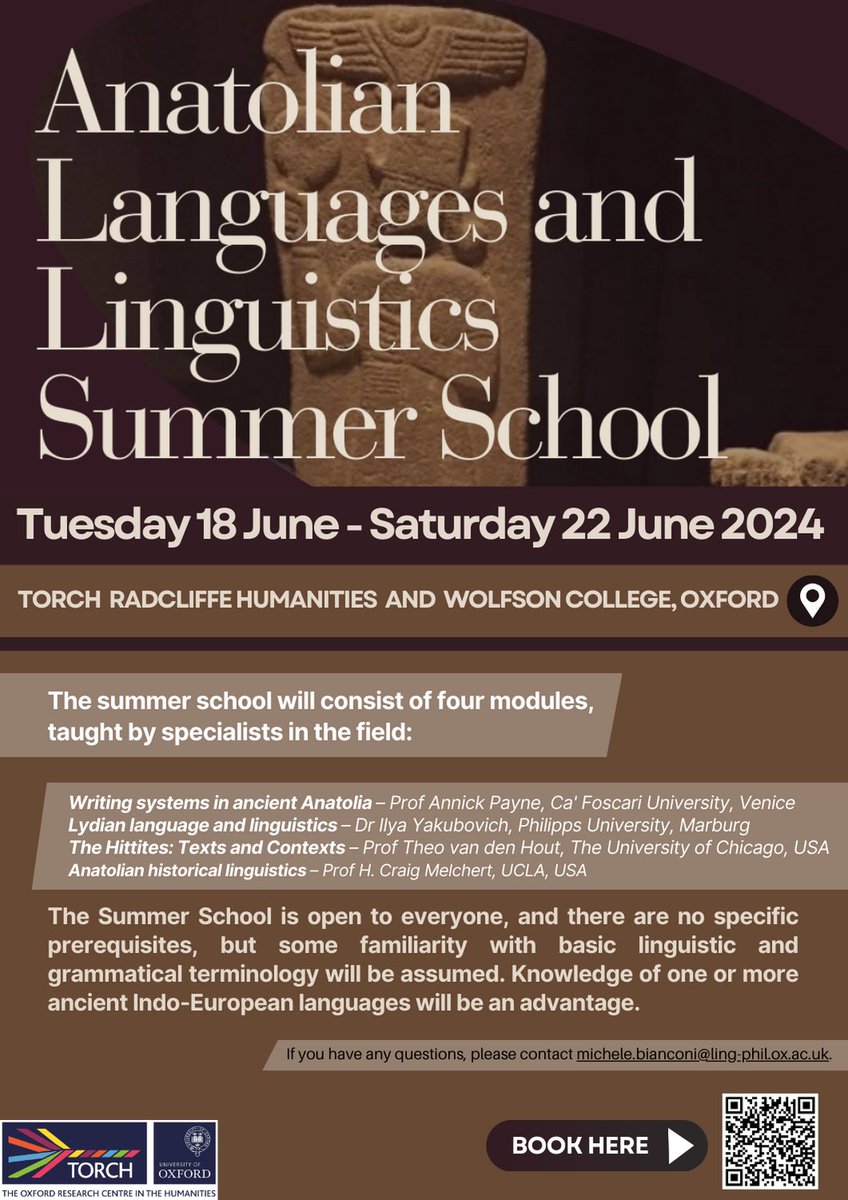
I was reminded yesterday of a fantastic upcoming opportunity for aspiring Anatolianists/IEists: Oxford’s Anatolian Languages and Linguistics Summer School! A neat chance to learn from some of the best — and registration is now open!
@silmeth @lagorton @Norsebysw But thanks for making me clarify! As for the Irish — cool! I’m not opposed to seeing ergativity as a language-internal development, i just think that it often gets (plausibly) invoked as a factor in the change.
@avzaagzonunaada If we were all being as precise as we should be and consistently used pre-Proto-Greek to refer to the internally reconstructed ancestor of Proto-Greek, I suppose we could just keep “pre-Greek” as is. But I maintain that we’re better off ditching it.