$ADYTUM is built on an idea Category Labs published on 3 November, a private ledger that lives inside a public chain. Money enters and leaves through a contract on the main chain, the books stay encrypted, and named parties such as auditors can be let in.
Their design sends every private transaction to the main chain in encrypted form, so the chain can order it and the operators can replay it. That lets private ledgers call public contracts, but the chain still sees that something happened and when, and every private move pays a fee.
On Solana we went the other way. A payment inside Adytum never reaches the chain at all, not even as ciphertext, so a block explorer has nothing to show for it, not even a timestamp. Only deposits and exits touch Solana, and an exit pays out only after Solana itself has checked the owner's signature.
https://t.co/0ibp9fdDR7
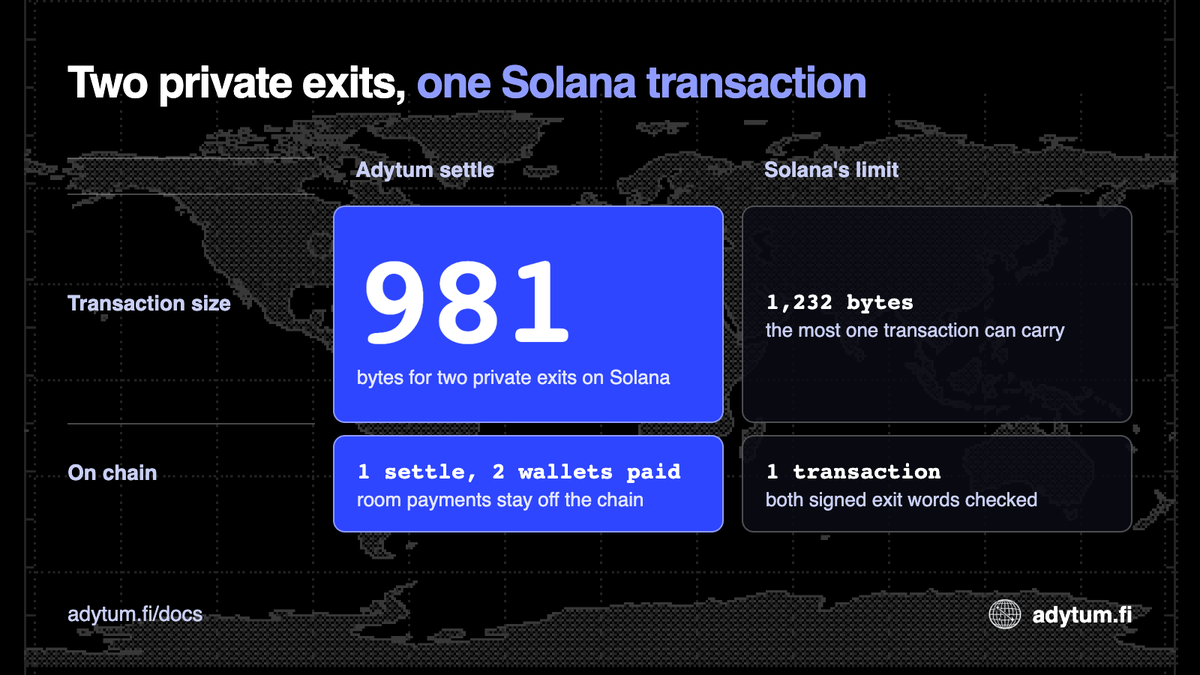
$ADYTUM pays two members out of its private room in a single Solana transaction. The settle carries both of their signed exit words, the program rebuilds each one on chain and checks it against the signature Solana verified, and the whole thing weighs 981 bytes against Solana's limit of 1,232.
Everything those two paid each other inside the room stays off the chain, and when they both cash out, Solana sees one settle paying two wallets.
https://t.co/hTJQKnQSYZ
Today you can use all of it with SOL or USDC without holding the token, and we're changing that in two ways. Opening a room will be paid in $ADYTUM, and $ADYTUM is getting a room of its own, so you'll be able to pay in it privately the same way you pay in SOL and USDC. The more rooms people open and the more they pay in $ADYTUM, the more the token gets used.
$ADYTUM opens a whole private payment room on Solana for 7,419 compute units, under 4% of what a single instruction is given, and 398 bytes on chain.
That one transaction opens a room with its own vault, and from then on payments between members stay off Solana entirely. Our SOL and USDC rooms on mainnet each started exactly this way.
https://t.co/hTJQKnQSYZ
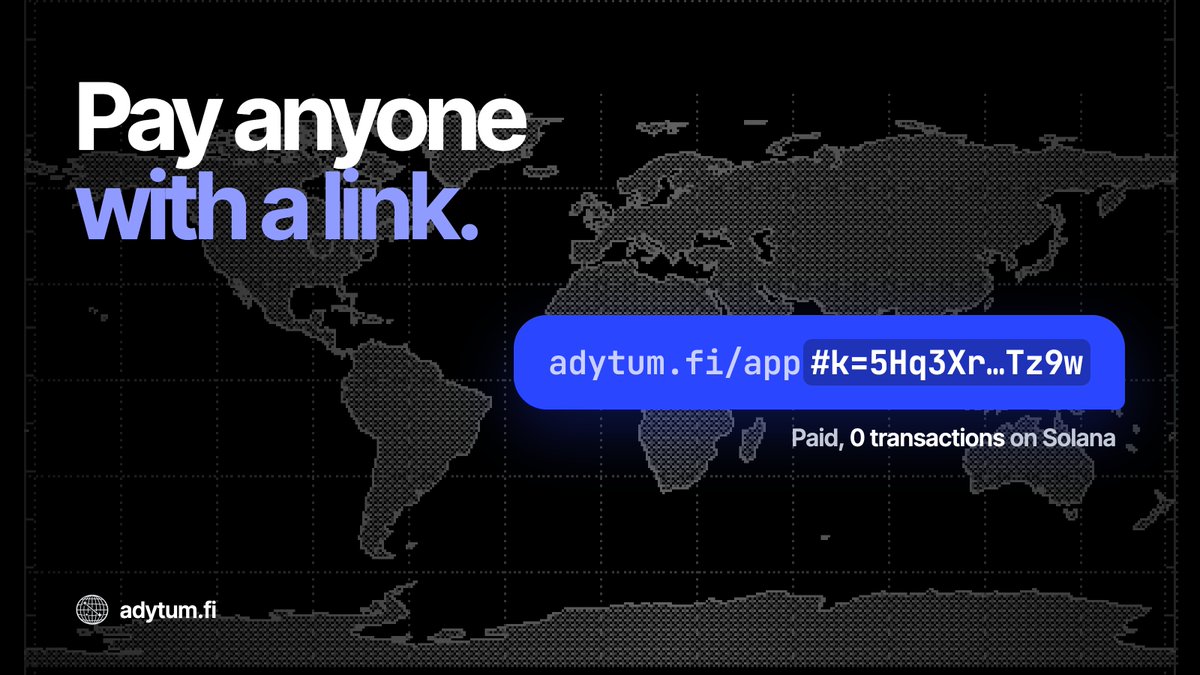
The part after the # is a one time key that holds the payment, and the sender's browser keeps a copy of every link it makes. If a link gets lost before anyone opens it, the sender hits Take back and sends a fresh one. Once it's opened, the money sits in the receiver's own wallet inside the room, so there's nothing left in the link to lose.
$ADYTUM can now pay anyone on Solana with a link, and the payment itself stays off the chain.
Pick SOL or USDC, sign one message and paste the link into any chat. The person on the other end opens it with any Solana wallet, and the money lands in their name inside the room. The whole trip, from making the link to taking the money, costs nothing and adds zero transactions to Solana. It works for someone who has never used $ADYTUM before, and an unopened link can always come back to you.
TipLink made sending crypto by link normal on Solana, and every TipLink is a wallet of its own, so the money going in and coming out sits on Solscan for anyone to trace from you to the person you paid. An $ADYTUM link keeps its key after the # in the address, the one part a browser never sends to any server, and the payment between you two stays sealed inside the room.
https://t.co/Yd9VG1rqeP
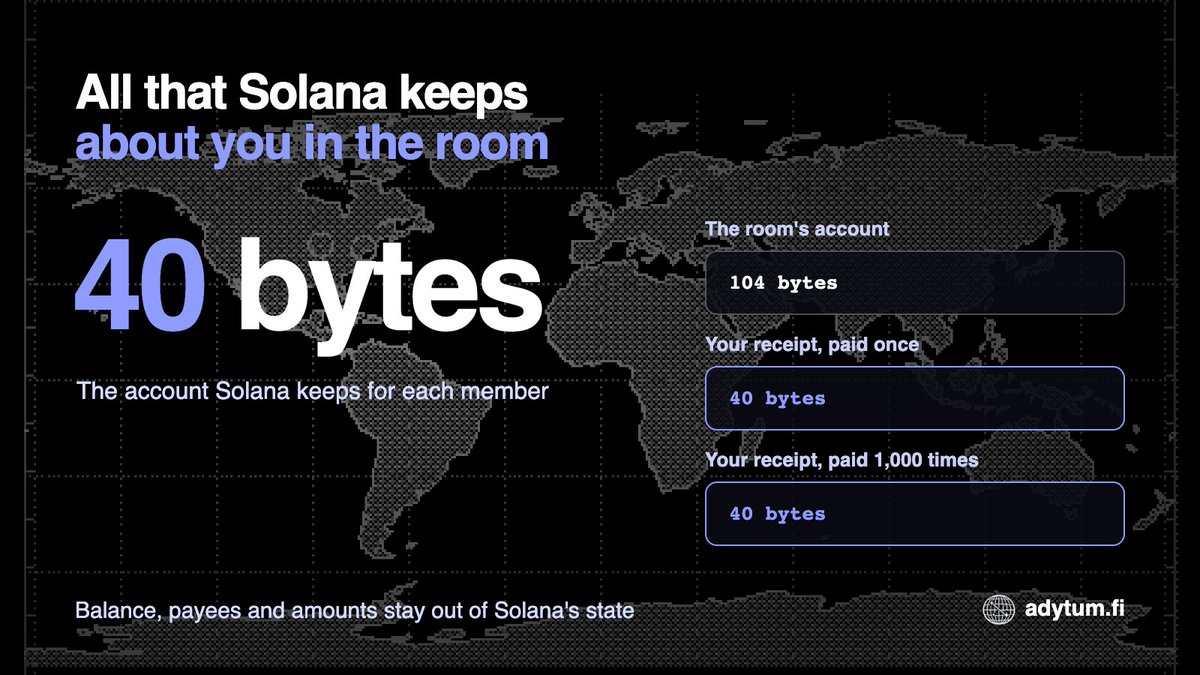
$ADYTUM runs a private payment room on Solana from an account of 104 bytes. Each member who joins adds a receipt of 40 bytes, and that is all the chain keeps about them.
Every payment between members lives in the room's encrypted ledger, so your receipt stays the same 40 bytes whether you paid once inside or a thousand times. Your balance, the people you paid and how much stay out of Solana's state.
https://t.co/hTJQKnQSYZ
The first time we ran an $ADYTUM room end to end, a member put 0.5 SOL in and walked out with 1.1 SOL. Another member had paid them 0.7 SOL inside, and that payment was only ever a message two wallets signed. Solana saw a deposit and a payout, and the vault paid exactly what the private ledger said the member owned.
Money you receive inside the room is money you can take out to your own wallet.
https://t.co/EW4mmR9h0R
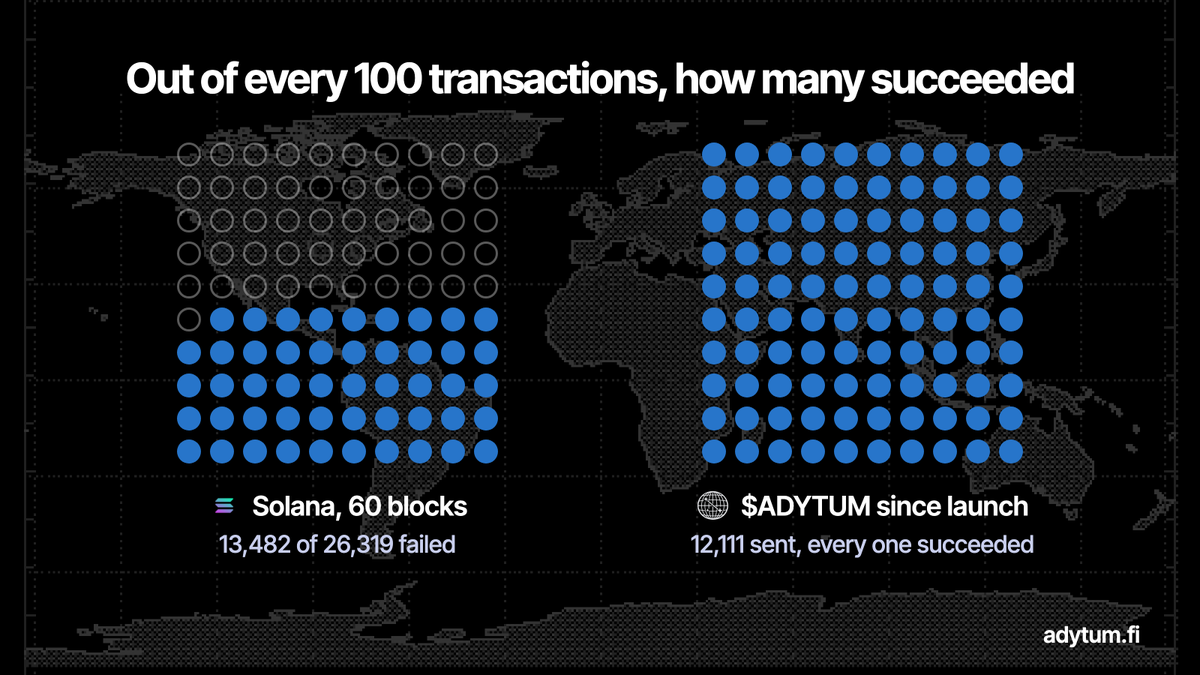
$ADYTUM has sent 12,111 transactions to Solana mainnet since its rooms opened on 22 November, and every one of them succeeded.
For scale, we read 60 Solana blocks at 00:34 UTC on 24 November. Of the 26,319 transactions inside, 13,482 failed, a little more than half.
https://t.co/hAyl0fXt4d
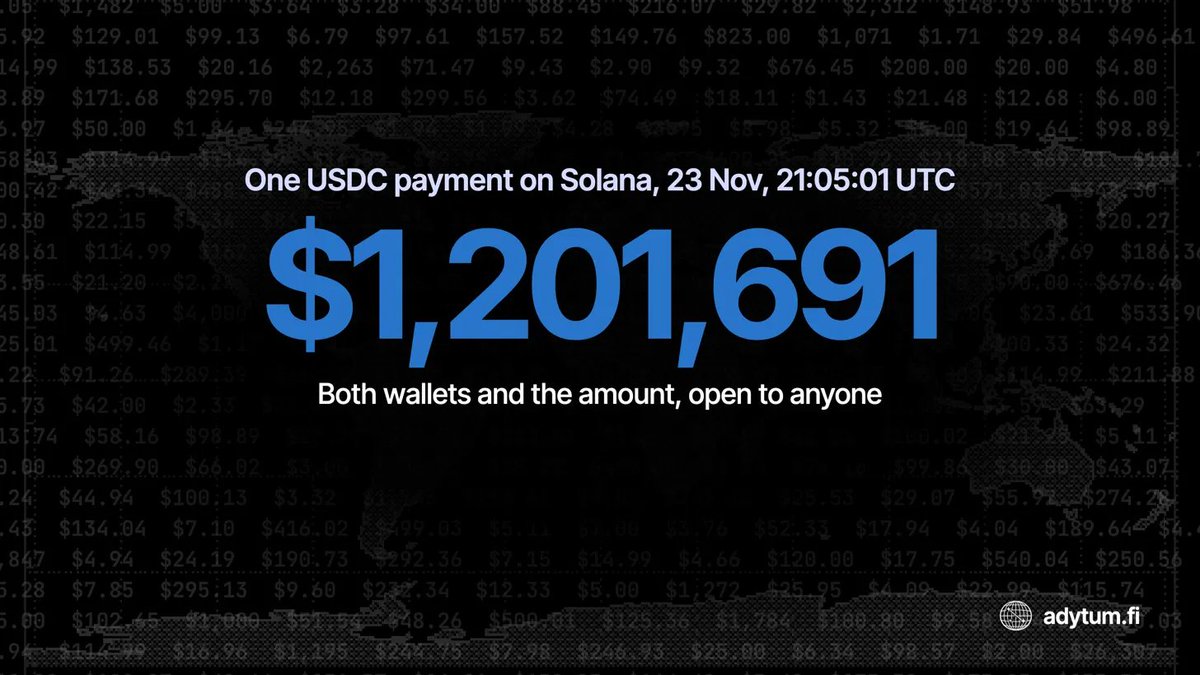
In 34 seconds on Solana, from 21:04:35 to 21:05:09 UTC on 23 November, 2,753 transactions moved USDC. One of them sent $1,201,691 from one wallet straight to another, and anyone with a browser can still see both wallets and the exact amount.
A payment that size fits in the $ADYTUM USDC room. Inside, it is one signed message, and the chain only ever sees the room’s steady settle with every amount sealed.
https://t.co/hAyl0fXt4d
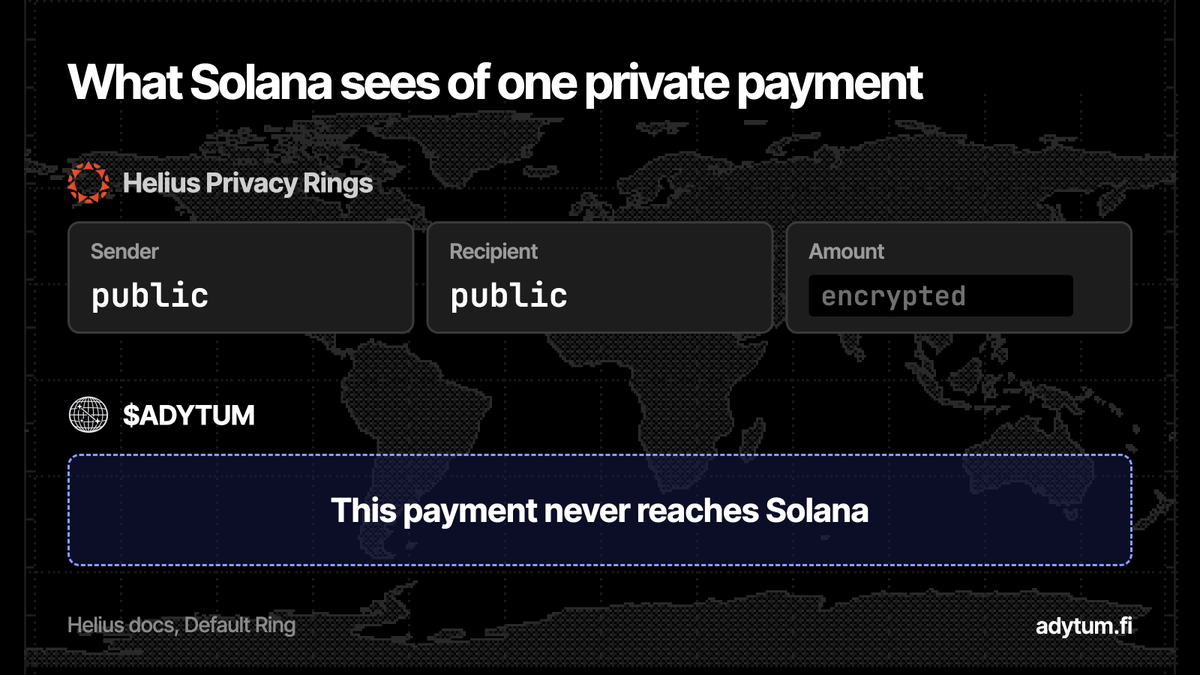
Helius shipped Privacy Rings on Solana two weeks ago, and its open ring encrypts the asset and the amount. The sender and the recipient of every transfer stay public, by Helius's own docs.
A payment inside $ADYTUM never reaches the chain, so Solana learns nothing about who paid, who got paid or how much. Each one is sealed to an auditor key named on chain, the piece Helius is still auditing for its business rings.
https://t.co/hAyl0fXt4d
Making $10,000 private on Railgun costs $25 going in and another $25 coming out, a 0.25% fee each way plus Ethereum gas.
The same $10,000 enters $ADYTUM for about six cents, one Solana fee plus a small account that holds your receipt. Every private payment inside costs nothing, and when you leave, the room pays the network fee to send your money to your own wallet.
https://t.co/hAyl0fXt4d
Yesterday between 20:53 and 20:58 UTC, $ADYTUM moved 1,000 private payments on Solana mainnet. Here is everything Solana recorded in those five minutes. The room sent 19 transactions, and every one was 351 bytes, exactly the size of the quiet ones it wrote before anyone paid anyone.
Pull the room's history on Solscan and try to point at the busy minutes. The chain shows the same steady rhythm the whole time, and the thousand payments stay inside the room.
https://t.co/hAyl0fXt4d
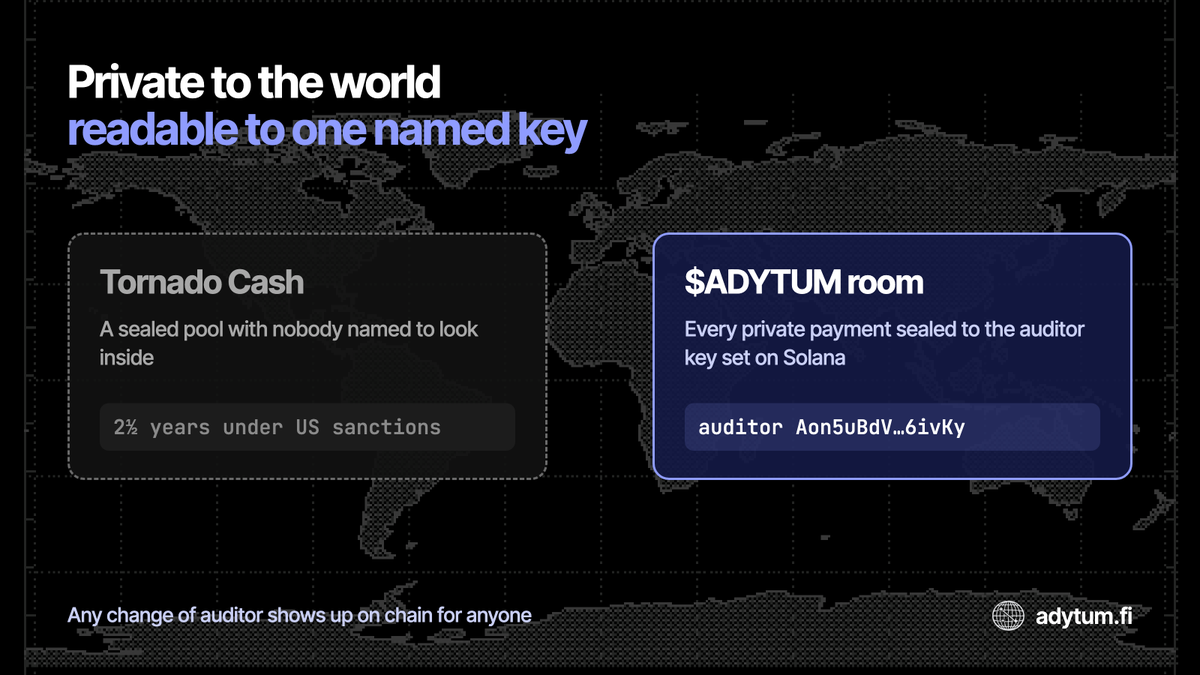
Tornado Cash spent two and a half years on the US sanctions list after North Korean hackers ran stolen money through it, and no one outside could see what passed inside.
$ADYTUM names the one key that can look. The auditor is set on Solana in public, every private payment in the room is sealed to it, and any change to it shows up on chain for anyone to see. Members keep their payments to themselves, and the room stays readable to the one party it answers to.
https://t.co/hAyl0fXt4d
Every signer at Bybit approved a screen that looked right. What they actually signed handed control of $1.5 billion to the attacker.
$ADYTUM puts the words themselves in your wallet. Every exit is plain text, the room, the amount, the coin and the batch, and before the vault pays a cent the program on Solana rebuilds those words letter for letter and checks them against your signature. Change one character and the money doesn’t move.
https://t.co/hAyl0fXt4d
Bybit ETH multisig cold wallet just made a transfer to our warm wallet about 1 hr ago. It appears that this specific transaction was musked, all the signers saw the musked UI which showed the correct address and the URL was from @safe . However the signing message was to change the smart contract logic of our ETH cold wallet. This resulted Hacker took control of the specific ETH cold wallet we signed and transfered all ETH in the cold wallet to this unidentified address. Please rest assured that all other cold wallets are secure.
All withdraws are NORMAL.
I will keep you guys posted as more develops, If any team can help us to track the stolen fund will be appreciated.
https://t.co/ckwZgma8Lf
$ADYTUM added a second currency on mainnet without stopping the first one.
At 21:12 UTC the program was upgraded in place to open a room for Circle's USDC. The SOL room beside it kept settling every 17 seconds or so straight through the upgrade, and its longest pause in that half hour was 19 seconds.
Less than three hours after launch, one program runs both rooms, each with its own vault and the same auditor key.
https://t.co/hAyl0fXt4d
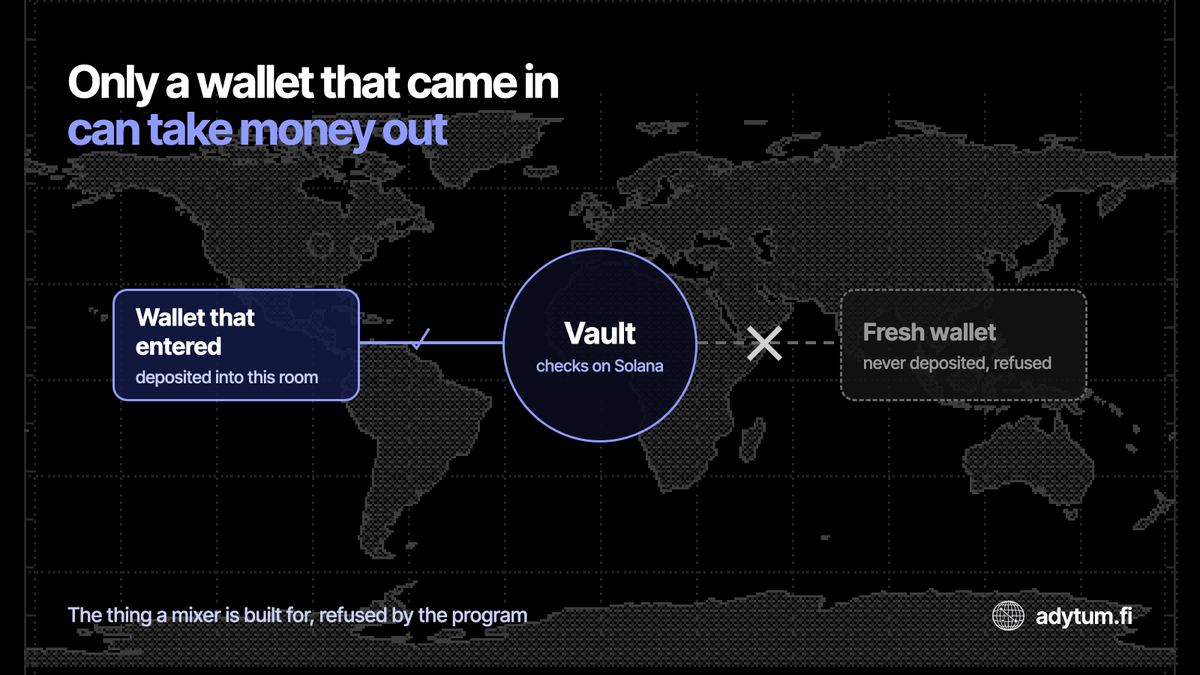
A mixer exists to pay out to a wallet that never went in. The $ADYTUM vault refuses to.
Every exit has to land in a wallet that deposited into the same room itself, and the program checks that on Solana before a cent moves. Before launch we tried a settle that paid a wallet that had never entered, and it was refused.
Payments between members stay private, and the money can only leave to someone who walked in through the front door with their own wallet.
https://t.co/hAyl0fXt4d