... With respect to us, however, it is Misery. For although GOD in our Election does not regard our merit, He does nevertheless behold our misery, by which His innermost parts are moved.
— Philip Hanneken., Theological Disputation concerning Predestination unto Salvation.
Hanneken on the external impulsive causes of election:
"The external impulsive cause of Election can be considered in two ways: (1) either with respect to GOD, (2) or with respect to us.
... with respect to GOD is the merit of CHRIST. For GOD could not have chosen us unless Christ by His merit and passion had first reconciled us to the wrathful GOD, and had made the severe avenger of sins a kind Father.
... You see, we are not saying that faith is the meritorious or efficient cause of election, nor that God has elected us because of our faith.
— Rev. Johann Gerhard., Loci Theologici, De Electione et Reprobatione, §. 170.
Rev. Johann Gerhard on Election:
(2) However, it does not follow that if consideration for faith is involved in the act of election, then God does not elect us but we elect ourselves..
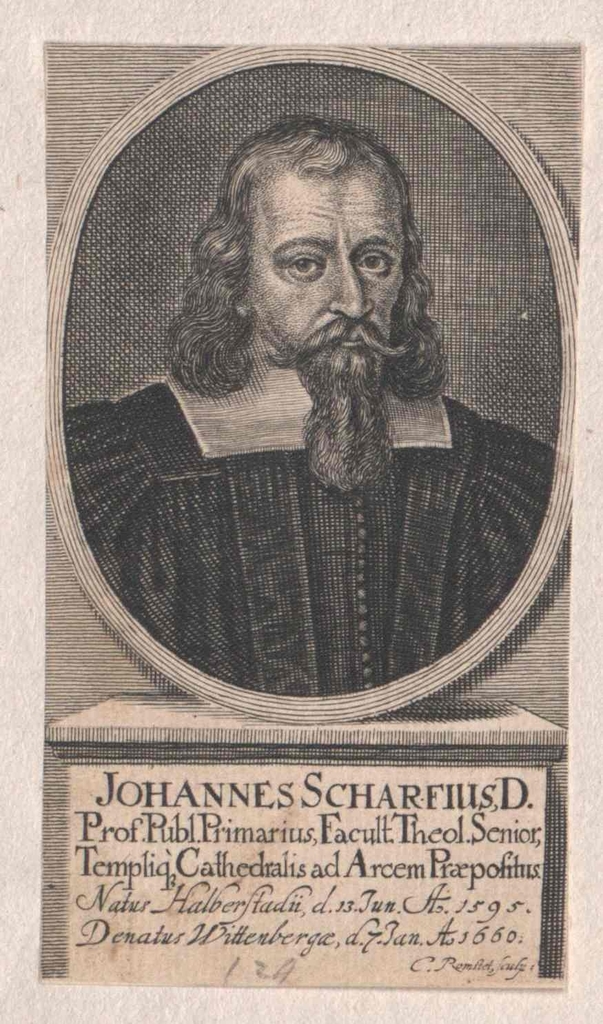
even though it is an individual intelligent incommunicable substance, does not have the character of a person — because it never had a distinct substance outside the Son of God through itself, but is sustained in another — namely in the person of the Logos.
— Johann Scharff, Met.
Especially so that it may in some way be understood how in Christ there are two natures that are individual, intelligent, incommunicable — and yet are not two persons. But one Redeemer and Savior — one Christ — and so one person of Christ. For the human nature in Christ....
(3) that a reward is due to the justified and to their works by reason of the divine promise. ... [Therefore] the Scotists, together with us, hold the opinion of the Catholic Church."
— Abraham Calov, Exegesis of the Augsburg Confession.
> "[W]e teach: (1) that a reward is given by God to good works, including both spiritual and bodily rewards, as well as an increase of glory; (2) that there is a debt of rendering a reward according to the divine promise;
...establish our assertions by reasons than by frequent citations of Aristotle's authority (though we shall not omit these either), since Aristotle's testimonies carry no weight unless they are supported by reason.
—Fr. Bartholomew Mastri., O.F.M. Cursus Phil, Met. disp. 12, q. 4
And because it is not pure and pagan Aristotelian philosophy — which is distinguished from true philosophy, or from philosophy in itself that we are writing, as we have professed many times from the beginning of our work and throughout its course: we shall take more care to...
@Arma__Christi@Jerrsosaved @1552prop @LutheranPrince That isn't grok, its a part of Fr. Berti's text that's saved on a server. You shouldn't jump to such conclusions, its rather uncivilized of you. One would not prefer to hold a normal civilized conversation with you if you keep going on like this
The Seraphic Doctor responds, omitting some responses, that human will was not contrary to Divine, because divine willed human according to reason of nature and flesh to fleee death.
- Bartholomew Barbieri O.F.M.



![aegidus0's tweet photo. > "[W]e teach: (1) that a reward is given by God to good works, including both spiritual and bodily rewards, as well as an increase of glory; (2) that there is a debt of rendering a reward according to the divine promise; https://t.co/nZmwFAfF3s](https://pbs.twimg.com/media/HTFQ_MMaIAAmPoy.png)