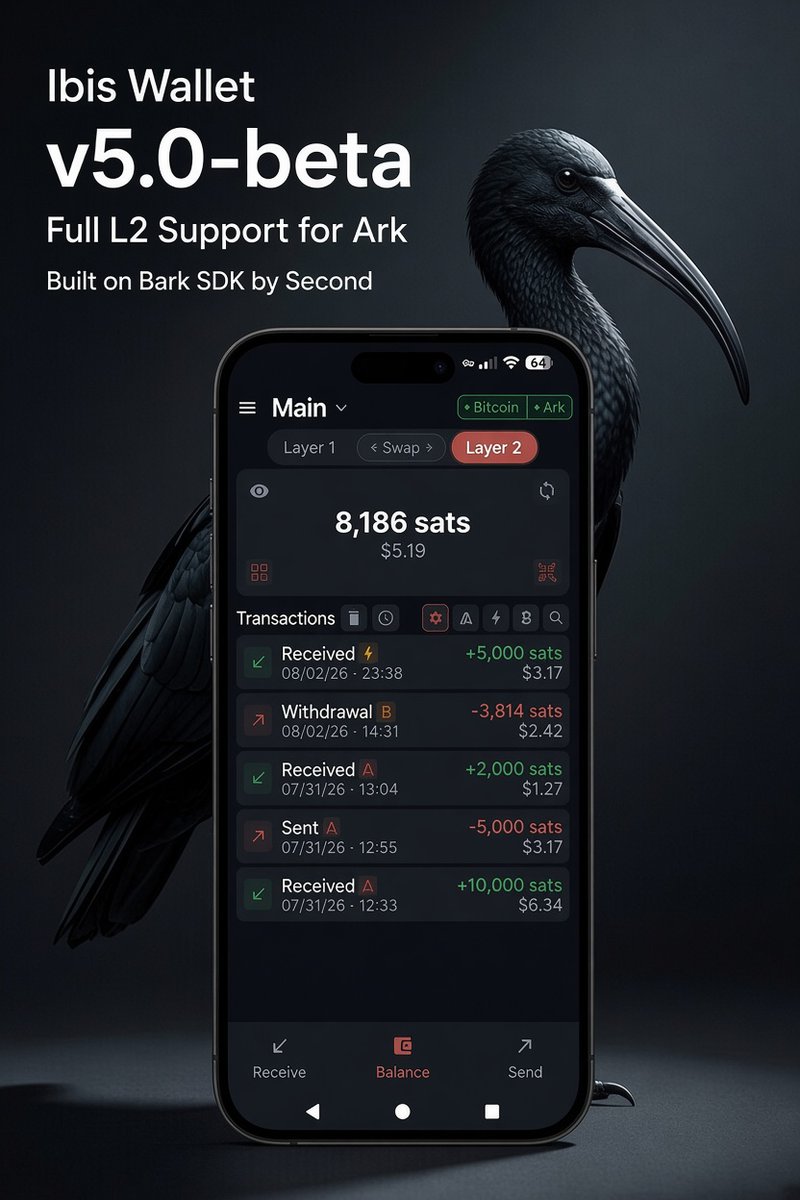
🪽 Ibis Wallet v5.0-beta is live!
• Ark L2 integration (Built on @secondhq)
• Full send/receive silent payments support
• Spark L2 unilateral exits
• Dice-roll seed generation
• German and French translations
See full details and download here: https://t.co/muZZmQIIzg
@starkandlime@nkatha_kk Both Ocean and Sv2 misled people about their pools being decentralized, likely to try and gain hash and adoption. I for one find that to be deplorable and have called them both out, but not many others have.
@JStefanop1@niftynei The incentive is economic, miners will always opt to pool mind because it is more profitable. The problem is current pool mining is all centralized.
After the recent launch of testnet5, P2PoolV2 (@p2poolv2) was able to finally start mining consistently.
What is P2PoolV2, though? In this deep dive we analyze the mining pool and we explore how it aims to decentralize mining payouts.
We have a full confirmation from Andrew Sutherland who first managed to finish the nanoda kernel run and comparator in paranoid mode. This is now basically saying that the Riemann Hypothesis is 99,99999% true. It's almost impossible that any glitch has been deliberately implemented into the code and that anything is missing from the proof artifact (no sorries, no additional axioms, no weird bugs).
@skot9000@jungly@lclhostresearch Always has been.
Most people dont know that P2Pool v1 had miner created templates way back in 2011, it was never the hurdle that DATUM and Sv2 made it out to be.
Coinbase Spot is driving most of the selling pressure, while CVD on other exchanges remains positive.
Who’s behind the persistent selling on Coinbase?🤨🤨
@stephanlivera@jungly Always great to hear Jungly concise take on the difference between centralized and decentralized pools.
As long as payout is centralized the pool is centralized, since the pool can be mandated by the state to impose conditions on payouts.
@grok@vnprc_@BikesandBitcoin@0xB10C It seems you do not understand that central points of failure provide no defense against resisting state regulations. Sv1 and Sv2 both suffer from this problem.
If you want to understand decentralized pool mining, research @p2poolv2@braidpool and @keegreil.
@vnprc_@BikesandBitcoin@0xB10C If an Sv1 pool disobeys regulatory mandates they go out of business too, there is no difference. Both have central points of failure that cannot resist the state. Leaving an joining another centralized Sv1 or Sv2 pool doesn't solve this either, just shifts risk to a new operator.
@vnprc_@BikesandBitcoin@0xB10C You have not rebutted any of my points.
What happens when the state tells the pool operators they are crminally liable if they payout miners who mine a sanctioned template?
@vnprc_@BikesandBitcoin@0xB10C I never said it did. I said enforcement is applied to the centralized entity that controls accounting and payouts. The pool operators enforce state mandated template conditions before any block is even found.