What would you ask a trader who generated +522% across two U.S. Investing Championships?
🎙️ We’re hosting an AMA (ask me anything) with @Clement_Ang17, who posted +522% across the 2024 and 2025 U.S. Investing Championships and topped the 2025 million-dollar division.
Drop your questions below 👇
Like the ones you want him to answer.
The top questions will be answered in a thread on Wednesday, Sept. 23.
Focusing on trimming to pay for risk is a foundational risk-management technique I use to systematically shift the odds in my favor.
Here's how:
Eliminating Trade-Level Downside:
By selling a portion of the position during the initial vertical expansion, you recover your initial dollar risk. This means the worst-case scenario for the remainder of the trade is reduced to zero.
Leveraging Market Momentum:
Strong leading stocks don't move in a straight line; they pulse higher. Trimming into that vertical strength allows you to monetize the market's aggressive buying pressure rather than giving back unrealized gains during standard technical pullbacks.
Preserving Mental Capital and Removing Emotion:
Carrying a full, heavy position through volatile tape creates psychological friction. When you know a trade is already "paid for," your emotional attachment drops. You stop micro-managing every tick and can patiently let the core position work.
Creating Asymmetric Payoffs:
Taking partial profits while keeping a runner turns standard trades into asymmetric opportunities. You cap your initial downside through disciplined stops, but you keep your upside open-ended, maximizing your long-term expectancy.
The fear of boredom in trading is the biggest evil in trading because it will lead us to make impulsive decisions or seek constant excitement, which can be detrimental to the longivity in this game.
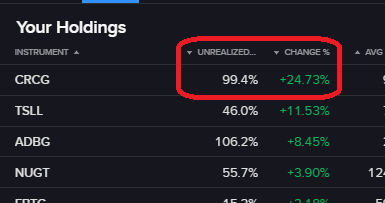
$CRCG (Update) - 1 week later
I’m not a fan of going in and out of the same name multiple times a week. I can’t handle that level of stress or screen time. If you have developed a proven sell rule, stick to it. It saves screen time, reduces stress, and cuts unnecessary execution costs.
Your performance growth really depends on how well you manage the trades you already have—not how often you trade.
PS: Slippage and widen spreads at execution have cost me 6-7% of my 2021 total equity: https://t.co/M0aMgXK7YY
Key Lessons Learned from Kristjan Qullamaggie By Martin Luk
1. Beyond Patterns & Technical Setups
"I think lots of people, many people are focusing a lot on the setups and the technical side or pattern side of Christian's trading. I think it's not necessarily true or not the perfect way of learning from him."
2. Risk Management: Defining & Tightening Stops
"I think the biggest influence from Christian to me is defining your stop and tightening your stop. In the early stage, I used a pretty wide stop, maybe 5% to 8%. I came across Christian and he always set his stop at the low of day, mostly around 3% generally, and he always sticks to that."
"Whenever he enters a stock, he's just going to put his stop at the low of day. So he's really clear where he should exit a stock... determine the stop before you enter."
3. Stock Selection & Themes
"Another huge influence is stock selection. Christian always prefers liquid names, fast-moving names, and orderly-moving names. He won't trade the ones that keep chopping around or moving 1% to 2% each day. He loves to find a stock with the right theme, with volume, and clean to trade."
"Talking about theme, theme is also one of the major things that I learned from him. Before that, I really focused a lot on the pattern itself, forgetting that stocks move as a group and a certain group would outperform the whole market drastically and give you superior returns."
4. Simple & Effective Exit Rules
"Exit rules: you have a lot of trailing rules with the 9 or 21 EMA. Christian uses the 10 and 20 EMA, but I think it's the same thing. I really found it powerful and simple."
5. Mindset & Thinking in Percentages (Account Scaling)
"There's a lot on the mental side of trading. For example, I learned to always think in percentage of your accounts instead of absolute numbers. Christian brought this out and emphasized it a lot. He said what really separates a good trader from a great trader is the ability to scale up his account."
"The reason why those traders cannot scale up their accounts is they focus too much on the absolute numbers—like making $100K or $1 million—but that's not important at all. You should always think in percentages, and I really think it elevated my trading by a lot."
"My answer is just focus only on the percentage of your account, or the number of risk multiples—how many R's you earned in this trade instead of how much money you earned."
6. Synthesizing Knowledge & Building Your Own Style
"Another really good point from Christian is that he just took one or two things from this trader, learned one or two from that guy, but not completely copying them 100%. I really agree and resonate with his points."
"A lot of people are just trying to copy a certain trader, setup, rule, or stock-picking technique completely, but you need to form your own style."
To my right is Kelvin Chiu — the first Hong Kong trader to be featured in the Market Wizards series.
I had the pleasure of meeting him in Singapore today and having lunch together. (Photo posted with Kelvin’s permission. He also knows that I use the J Law avatar on social media.)
If you’ve read the newly released Market Wizards: The Next Generation, you’ll know that Kelvin grew up in Hong Kong, graduated from Cambridge, and went on to work at Goldman Sachs and Vitol, one of the world’s largest energy trading firms. During his proprietary trading years at Vitol, his best year generated $35 million in profits.
After leaving Vitol and trading his own capital, he compounded at 108.7% annually for 7 consecutive years, with a Sharpe Ratio of 2.0. Today, he focuses on his own family office.
So when you sit down with a trader like this, naturally I was ready to pull out my notebook and ask him everything I could about trading and asset management.
Instead, our conversation started with… our kids’ education. 😂
Long story short, here are some of the biggest takeaways I got from both his interview in the book and our lunch conversation today:
@KC_SilverCape@Clement_Ang17
The name of the game, without most trader's ever realizing it, is LOSS MITIGATION.
I find it funny how you often hear people brag about low win-rates in raging bull markets. You do not hear those sorts of comments when the market is difficult as it has been this summer.
(PS - whoever invented "sell in May and go away" -- hope you're laid up drinking a mai thai somewhere.)
The big discussion I've had with traders this week is the disciplinary and emotional issues that keep your equity curves from being at highs.
From what I've seen, the problem with the average trader is simply overtrading and oversizing. One of the big things I got out of meeting Roppel, was his emphasis on the largest time frames and how much that thought process is going to keep you AWAY from overtrading.
"If there is a slot machine lever next to the desk, you're going to pull it more times than you should!"
This week I was excited about finding adds into $PLTR, which I did a great job of in buying the 'Oops Reversal' heavy yesterday morning.
However, I also took paper cuts in 'OK' setups in $MP $CRSP and that bastard mf $TEM.
If I cut out everything I was not excited about, it'd be an amazing week. Instead it's an 'eh' week with a lot more give back than it should.
The question we're asking ourselves this week -- if we only took our A+ setups, the ones we were frothing at the mouth for --- where would the equity curve be? How many emotional and disciplinary mistakes do you make in that scenario?
Outside of the 10 week ripper, it's been a sneakily difficult year with mistakes especially punished much more so than the previous 3. It's easy to lie to ourselves about our mistakes and continue to repeat them. That is what separates the average traders from the greats.
The never ending quest of becoming our best selves continues.... 🫡
While the crowd is fixated on the traditional 50-day simple moving average, momentum swing traders working with leading growth names will find significantly more value in the **8-week exponential moving average**.
* **Precision Over Lag:** The 50-day SMA forces you to sit through deep givebacks before reacting. The 8-week EMA uses a 40-session calculation weighting recent price action heavier, keeping risk parameters locked to actual velocity.
* **The Structural Fit:** Explosive leaders respect tight floors. The 8-week line tracks high-RS names closely during constructive pullbacks without shaking you out prematurely.
* **Early Failure Detection:** Violations flag fading momentum sessions before a slow 50-day line even blinks, cutting dead capital faster.
My win rate is only 32.1% YTD.
Yet I’m up 68R.
That alone should explain why it doesn’t make much sense for me to share individual trades.
Nearly 7 out of 10 trades I take are losers. If you blindly followed my trades, there’s a good chance you’d lose conviction somewhere along the way, skip the next one—and that next one might be the trade that pays for the previous five losses and then some.
The edge isn’t in any individual trade. It’s in the process: cutting losses, keeping risk consistent, pressing when conditions warrant it, and allowing the relatively few big winners to do the heavy lifting.
You can copy an entry. You can copy a stop.
What you can’t easily copy is the decision-making that happens afterward—or the discipline to execute the same process over hundreds of trades while going through 10 losing trades in a row.
That’s why I’d much rather share where I see strength, where money is flowing, and what parts of the market deserve attention.
The trades themselves are just the end product of that process.
Agreed. You develop a feel for the market after years and years in the trenches.
That can’t really be taught. It comes from experiencing countless market cycles, watching setups succeed and fail, making mistakes, and gradually learning to recognize when something feels right—or when something just feels off.
And that’s ultimately what makes your edge unique: you become part of the edge.
You can teach someone the rules, the setups, and the process, but you can’t transfer years of screen time, pattern recognition, judgment, and experience. Two traders can follow the exact same strategy and still get very different results.
At some point, trading becomes less about knowing what to do and more about recognizing when to do it, how hard to push, and when to do nothing at all.
Follow The Leaders for Clues to a Market Top
The second most important indicator of a primary change in market direction, after the daily averages, is the way leading stocks act. After the market has advanced for a couple of years, you can be fairly sure that it's headed for trouble if most of the individual stock leaders start acting abnormally.
One example of abnormal activity can be seen when leading stocks break out of third- or fourth-stage chart base formations on the way up. Most of these base structures will be faulty, with price fluctuations appearing much wider and looser. A faulty base (wide, loose, and erratic) can best be recognized and analyzed by studying charts of a stock's daily or weekly price and volume history.
[...]
Shifts in market direction can also be detected by reviewing the last four or five stock purchases in your own portfolio. If you haven't made a dime on any of them, you could be picking up signs of a new downtrend.
Investors who use charts and understand market action know and understand that very few leading stocks are attractive around market tops. These simply aren't any stocks coming out of sound, properly formed chart bases. The best merchandise has been bought, played, and well picked over.
Most bases will be wide and loose - a big sign of real danger that you must learn to understand and obey. All that's left to show strength at this stage are laggard stocks. The sight of sluggish, or low-priced, lower-quality laggards strengthening is a signal to the wise market operator the up market may be near its end. Even turkeys can try to fly in a windstorm.
Other Bear Market Warnings
If the original market leaders begin to falter, and lower-priced, lower-quality, more-speculative stocks begin to move up, watch out! When the old dogs begin to bark, the market is on its last feeble leg. Laggards can't lead the market higher. Among the telltale signs are the poor-quality stocks that start to dominate the most-active list on market "up" days. This is simply a matter of weak leadership trying to command the market. If the best ones can't lead, the worst certainly aren't going to do so for very long.
[...]
The majority of people in the stock market, including both professional and individual investors, will be fooled first. It's all about human psychology and emotions.
How To Make Money In Stocks, William O'Neil
--------------------------------------------------------
Not calling for a top, but it certainly has not been an easy dollar environment. And looking at the action of my watchlists the past week, I certainly resonate with this particular section of the book.
Your good and bad trading behaviors cannot hide from your journal. There are ways to fix them but constantly jumping between strategies isn’t one of them.
There's nothing better than using technical analysis to find a tight risk entry in a stock everyone wants before it moves. Then sitting back letting it work and watch the crowd chase it higher. 📈
Weekend routines are the best because you get to look at the market objectively while the price action is paused.
Doing this consistently over the past several years, one thing became clear. The more time I put into the weekend, the more prepared I feel, and that bleeds into how confident I am going into the week.
Part of the routine is preparing for the hypotheticals. If A happens I do this, if B happens I do that. When one of them actually shows up, I’m executing something I already decided rather than reacting to a curveball and making the wrong call in the moment.
That’s what keeps me in systematic mode instead of emotional mode.
Without that backbone everything becomes emotional, because we’re dealing with money. Every fluctuation up or down starts swaying your decisions. Then your results are only as good as your emotional state that day, and emotional intelligence isn’t something you can build up quickly.