Three weeks ago, my 23-year-old neighbor was kidnapped on her way to Kontagora in Niger State.
While in captivity, the bandits repeatedly raped her taking turns sleeping with her night after night. Still, they kept bargaining with her father over the phone, demanding ransom even as they violated her.
Her father fought with everything he had. He hustled day and night, borrowed from everyone, took loans, sold whatever he could determined to bring his daughter home.
When he finally gathered the full amount, he called the bandits and begged them, ‘Please, give the phone to my daughter. Let me speak to her. I want her to know I’m coming for her.’
They gave her the phone.
In a broken, traumatized voice, she told her father: ‘Dad, do not suffer yourself looking for the money. They have been sleeping with me. I’m traumatized. I can’t forgive myself. Even if I’m released, I’ll kill myself. Don’t bother paying the ransom.’
Those were the last words she ever spoke to him.
While her father was still holding the phone, he heard the gunshot. He heard his daughter being killed. Moments later, the bandits sent pictures of her remains to him, a final act of cruelty.
A 23-year-old girl. My neighbor. Someone’s daughter, someone’s sister, someone’s friend gone in the most horrific way possible.
This is not just one story. This is the nightmare too many families are living in Niger State and across Nigeria. Young women snatched on the roads, violated, used as bargaining chips, and discarded like nothing.
Living in Nigeria has become truly scary. You wake up, you step out, and you don’t know if you or your loved ones will return home. The fear is constant. The pain is constant. And too often, justice never comes.
Rest in peace to my neighbor.
Three weeks ago, my 23-year-old neighbor was kidnapped on her way to Kontagora in Niger State.
While in captivity, the bandits repeatedly raped her taking turns sleeping with her night after night. Still, they kept bargaining with her father over the phone, demanding ransom even as they violated her.
Her father fought with everything he had. He hustled day and night, borrowed from everyone, took loans, sold whatever he could determined to bring his daughter home.
When he finally gathered the full amount, he called the bandits and begged them, ‘Please, give the phone to my daughter. Let me speak to her. I want her to know I’m coming for her.’
They gave her the phone.
In a broken, traumatized voice, she told her father: ‘Dad, do not suffer yourself looking for the money. They have been sleeping with me. I’m traumatized. I can’t forgive myself. Even if I’m released, I’ll kill myself. Don’t bother paying the ransom.’
Those were the last words she ever spoke to him.
While her father was still holding the phone, he heard the gunshot. He heard his daughter being killed. Moments later, the bandits sent pictures of her remains to him, a final act of cruelty.
A 23-year-old girl. My neighbor. Someone’s daughter, someone’s sister, someone’s friend gone in the most horrific way possible.
This is not just one story. This is the nightmare too many families are living in Niger State and across Nigeria. Young women snatched on the roads, violated, used as bargaining chips, and discarded like nothing.
Living in Nigeria has become truly scary. You wake up, you step out, and you don’t know if you or your loved ones will return home. The fear is constant. The pain is constant. And too often, justice never comes.
Rest in peace to my neighbor.
Give Us Four Years, We’ll Raise Nigeria’s Power Supply To 10,000MW - Obi
This is something we have carefully studied, and we are not going to come into government and start making excuses about why it cannot be done. It is completely unacceptable that a country of over 200 million people generates and distributes only about 4,000 megawatts of electricity while millions of Nigerians still lack access to reliable power. Countries like South Africa and Egypt, despite having significantly smaller populations, each generate and distribute over 40,000 megawatts. Nigeria is not even producing one-tenth of what those countries generate, and that must change. We will also tackle unemployment through honest and transparent policies by supporting micro, small, and medium-sized businesses with tax incentives, financial support, and access to affordable credit so they can grow, create jobs, and drive economic development.
Peter Obi, NDC 2027 Presidential Candidate
"Some men change their party for the sake of their principles; others change their principles for the sake of their party." Winston Churchill
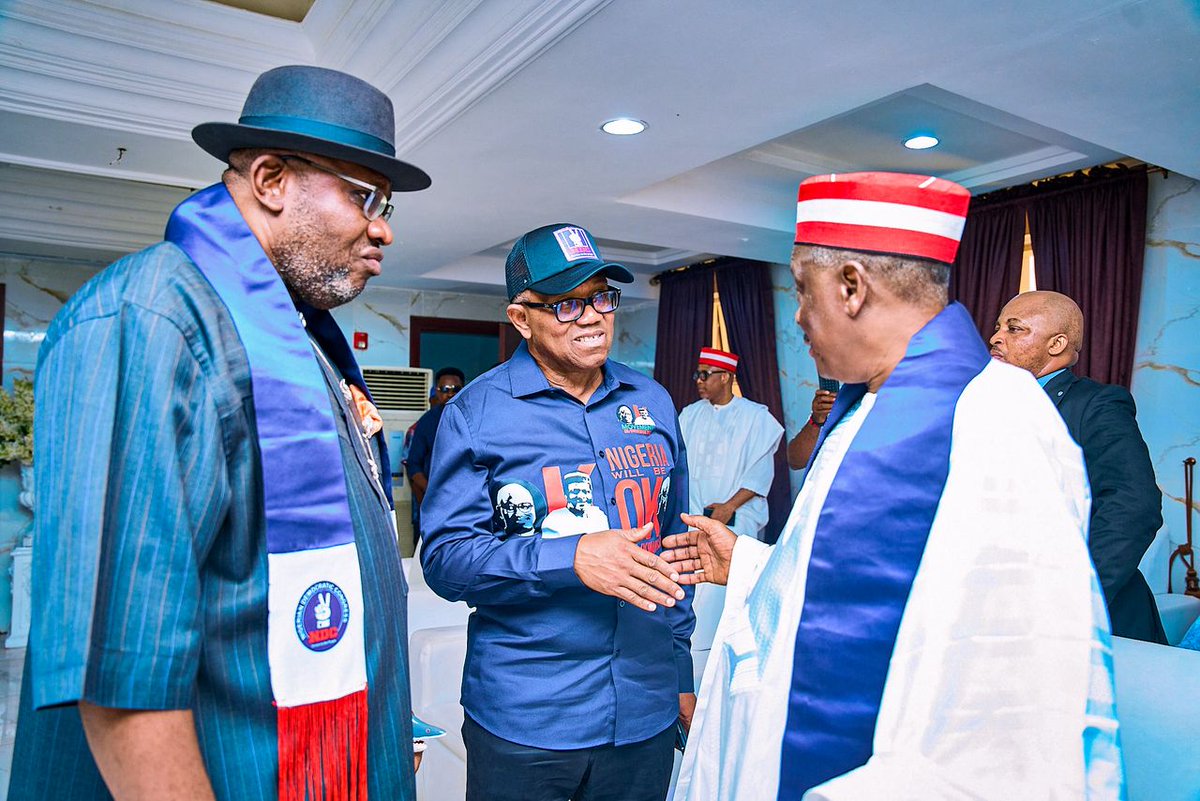
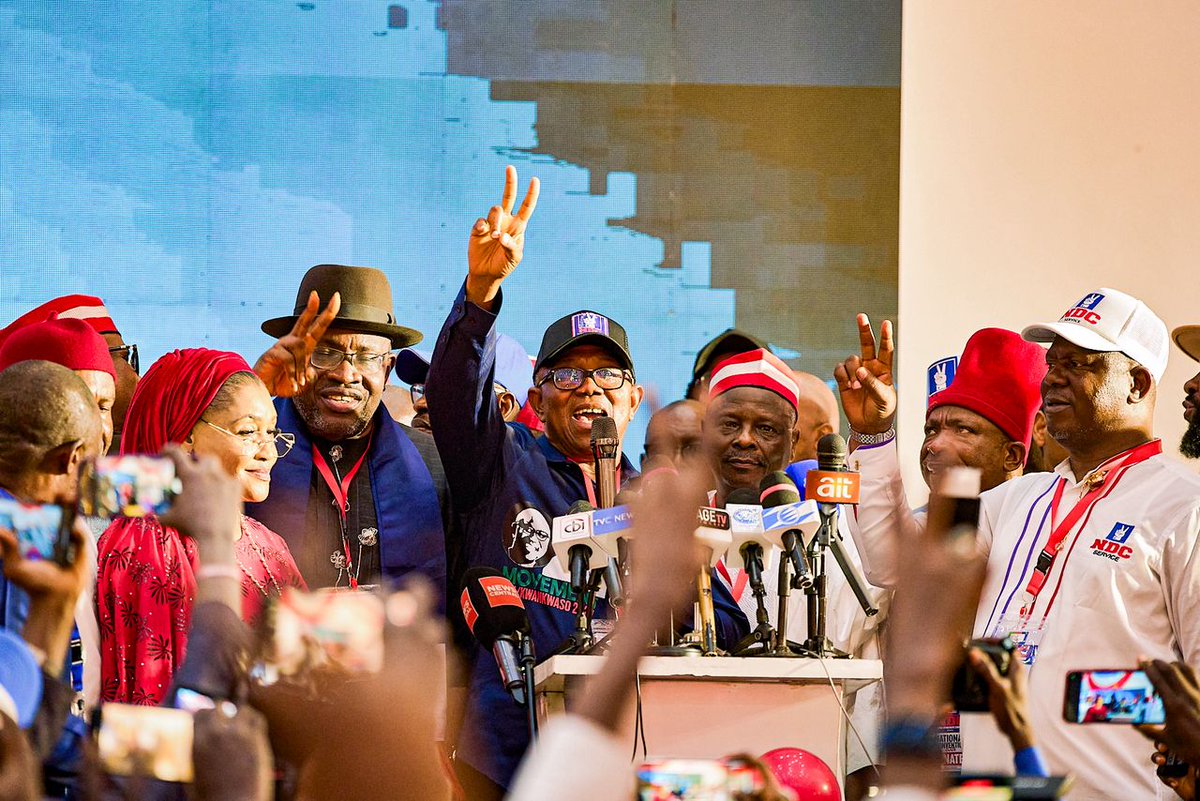
Today, May 9th, I attended the 1st convention of my latest party, the Nigeria Democratic Congress (NDC) in Abuja, Nigeria. The convention was successful and continued to show the resilience of Nigerians to change
I express my sincere appreciation and gratitude to the NDC family, led by the distinguished Senator Henry Seriake Dickson, for inviting us and for the generosity of spirit with which they have accommodated us at this critical moment in our national journey.
I also wish to express profound gratitude to the African Democratic Congress(ADC), particularly Distinguished Senator David Mark, for providing a democratic platform and showing uncommon understanding when the ongoing litigation forced us out of the Labour Party and the New Nigeria People's Party, NNPP respectively. That spirit of solidarity must remain the foundation upon which a better Nigeria will be built.
Today, the most painful aspect of our political existence is that many who once benefited from democratic governance have now become willing accessories to the destruction of democracy itself. Those who once fought for justice now openly celebrate electoral injustice. Those who once spoke against impunity now defend coercion, manipulation, intimidation, and outright political gangsterism, especially against opposition voices. What we are witnessing is not politics; it is a systematic assault on democracy and the will of the people.
Nigeria today stands at a dangerous crossroads. Our democracy is under severe threat. Our nation is drifting without direction, and our people are passing through immense suffering. Across the world, Nigeria is increasingly described as a failing and disgraced nation. This is not the destiny God ordained for our great country. It was not always so, and it must never be allowed to remain so.
Across virtually every recognised indicator of good governance - accountability, political stability, rule of law, control of corruption, government effectiveness, regulatory quality, and the separation of powers - Nigeria continues to record alarming failures. The institutions that should protect the people are weakening daily, while the burden on ordinary citizens grows heavier with each passing moment.
Today, over 140 million Nigerians live in multidimensional poverty. Tens of millions of young people remain unemployed or underemployed. Inflation continues to crush families. Businesses are shutting down. Farmers can no longer safely access their farms. Communities live in fear. In this month alone, hundreds of innocent Nigerians have lost their lives to insecurity, while many others have been kidnapped, displaced, or thrown deeper into poverty.
The most heartbreaking question confronting us is this: Who consoles the grieving mother whose child was abducted on the way to school? Who speaks for the father who can no longer feed his family despite working every day? Who defends the young Nigerian whose dreams have been destroyed by a nation that rewards connections over competence and corruption over character?
Our present tragedy is not accidental. It is the direct consequence of years of deliberate sabotage by a political class that prospers by dividing the people and weakening the nation. Nigeria is not a poor country; rather, we are being looted into poverty. We have abundant human and natural resources, yet we remain trapped in deprivation because leadership has failed to place the common good above personal interest.
Our choice as a people is therefore clear: whether to surrender to despair and national decline, or to summon the courage to rescue our country and rebuild it on the foundations of unity, equity, justice, competence, and productivity.
"The condition of our nation and the urgent need to rescue Nigeria, informed my decision to leave ADC for NDC."
Yesterday, I formally joined the Nigerian Democratic Congress (NDC), alongside my dear brother, Engr. Dr Rabiu Musa Kwankwaso, with one clear purpose: to continue the struggle for a new Nigeria built on justice, competence, accountability, and compassion for the ordinary Nigerian.
As I stated yesterday, this decision was not made out of anger, personal ambition, or convenience. It came after deep reflection on the present condition of our nation and the urgent need to rescue Nigeria from the dangerous path it is currently heading.
Over the years, I have remained steadfast in my conviction that politics should never be about individuals, positions, or personal gain. It must be about the people, especially the millions of Nigerians who today can no longer afford necessities, whose businesses are collapsing, whose children are losing hope, and whose future is becoming increasingly uncertain.
I left the ADC for the same reason I left the Labour Party: the severe, orchestrated litigation and internal crises deliberately designed to ensure that I, alongside many other notable individuals, do not effectively participate in the electoral process. I sincerely appreciate and remain deeply grateful to the Leadership of ADC for the opportunity to work together in pursuit of a better Nigeria. I am particularly grateful to ADC Chairman Senator David Mark for his exceptional Leadership. I also deeply appreciate my Leader and elder brother YE, Atiku Abubakar, as well as other respected leaders within the party.
As we join the NDC, I sincerely appeal to the Nigerian Government against the encouragement of unresolved litigations and the infusion of crises within political parties. Democracy must never become a weapon against the people. A healthy democracy thrives on strong institutions, credible alternatives, and the freedom of citizens to make choices without intimidation, manipulation, or fear. Opposition parties must not be weakened or destroyed, because when democracy loses balance, the people ultimately suffer.
Nigeria today is passing through one of the most difficult periods in its history. Poverty is rising. Hunger is widespread. Insecurity continues to threaten lives and livelihoods. Businesses are shutting down daily. Our young people are becoming discouraged, and many citizens have lost faith in the system. At a time like this, leadership must be driven not by propaganda or division, but by competence, capacity, character, and compassion.
Our decision to join the NDC is therefore not an abandonment of values, but a continuation of the same mission we have always stood for: building a Nigeria where leadership is about service, where public resources are managed responsibly, where institutions function independently, and where every Nigerian, regardless of tribe, religion, region, or social status, can live with dignity, security, and hope.
I remain committed to working with all Nigerians of goodwill across political, ethnic, and religious lines. The task before us is bigger than any individual or political party. It is about the future of our children and the survival of our dear nation.
I thank Nigerians, especially our youths and women, for remaining peaceful, resilient, and hopeful despite the enormous challenges confronting the country. I urge you not to lose faith in Nigeria. Nations do not change because people surrender to hopelessness; they change because people continue to believe, continue to sacrifice, and continue to stand for what is right.
A new Nigeria is still POssible. -PO
Fellow Nigerians, good morning.
I woke up this morning after my church service with a deeply reflective heart, and despite every constraint, I felt compelled to share these thoughts with you.
Many people do not truly understand the silent pains some of us carry daily—the private struggles, emotional burdens, and quiet battles we face while trying to survive and serve sincerely in difficult circumstances.
We now live in an environment that has become increasingly toxic, where the very system that should protect and create opportunities for decent living often works against the people—a society where intimidation, insecurity, endless scrutiny, and discouragement have become normal.
More painful is when some of those you associate with, believing you would find understanding and solidarity among them, become part of the pressure you face. Some who publicly identify with you privately distance themselves or join in unfair criticism.
We live in a society where humility is mistaken for weakness, respect is seen as a lack of courage, and compassion is treated as foolishness—a system where treating people equally is questioned simply because you refuse to worship status, tribe, class, or power.
Personally, I have never looked down on anyone except to uplift them. I have never used privilege, position, or resources to oppress others, intimidate the weak, or make people feel small. To me, leadership has always been about service, sacrifice, and helping others rise.
Let me state clearly: my decision to leave the ADC is not because our highly respected Chairman, Senator David Mark, treated me badly, nor because my leader and elder brother, Alhaji Atiku Abubakar, or any other respected leaders did anything personally wrong to me. I will continue to respect them.
However, the same Nigerian state and its agents that created unnecessary crises and hostility within the Labour Party that forced me to leave now appear to be finding their way into the ADC, with endless court cases, internal battles, suspicion, and division, instead of focusing on deeper national problems and playing politics built more on control and exclusion than on service and nation-building.
Even within spaces where one labours sincerely, one is sometimes treated like an outsider in one’s own home. You and your team become easy targets for every failure, frustration, or misunderstanding, as though honest contribution has become a favour being tolerated rather than appreciated.
And when you choose to leave so that those you are leaving can have peace, and you step out into the cold, you are still maligned and your character is questioned. Despite all your efforts to continue working for a better Nigeria and engaging people with sincerity and goodwill, those who do not wish you well continue to attack your character and question your intentions.
There are moments I ask God in prayer: Why is doing the right thing often misconstrued as wrongdoing in our country? Why is integrity not valued? Why is the prudent management of resources, especially when invested in critical areas like education and healthcare, wrongly labelled as stinginess? Why are humility and obedience to the rule of law often taken to be weakness rather than discipline?
Let me assure all that I am not desperate to be President, Vice President, or Senate President. I am desperate to see a society that can console a mother whose child has been kidnapped or killed while going to school or work. I am desperate to see a Nigeria where people will not live in IDP camps but in their homes. I am desperate for a country where Nigerian citizens do not go to bed hungry, not knowing where their next meal will come from.
Yet, despite everything, I remain resolute. I firmly believe that Nigeria can still become a country with competent leadership based on justice, compassion, and equal opportunity for all.
A new Nigeria is POssible. -PO