People keep calling the LLM "the agent."
It isn't.
The agent is ~20 lines of code that loops over model responses and tool calls.
Everything else (e.g., permissions, human approvals, event streaming, execution, context) is the harness.
This is where most of the engineering lives.
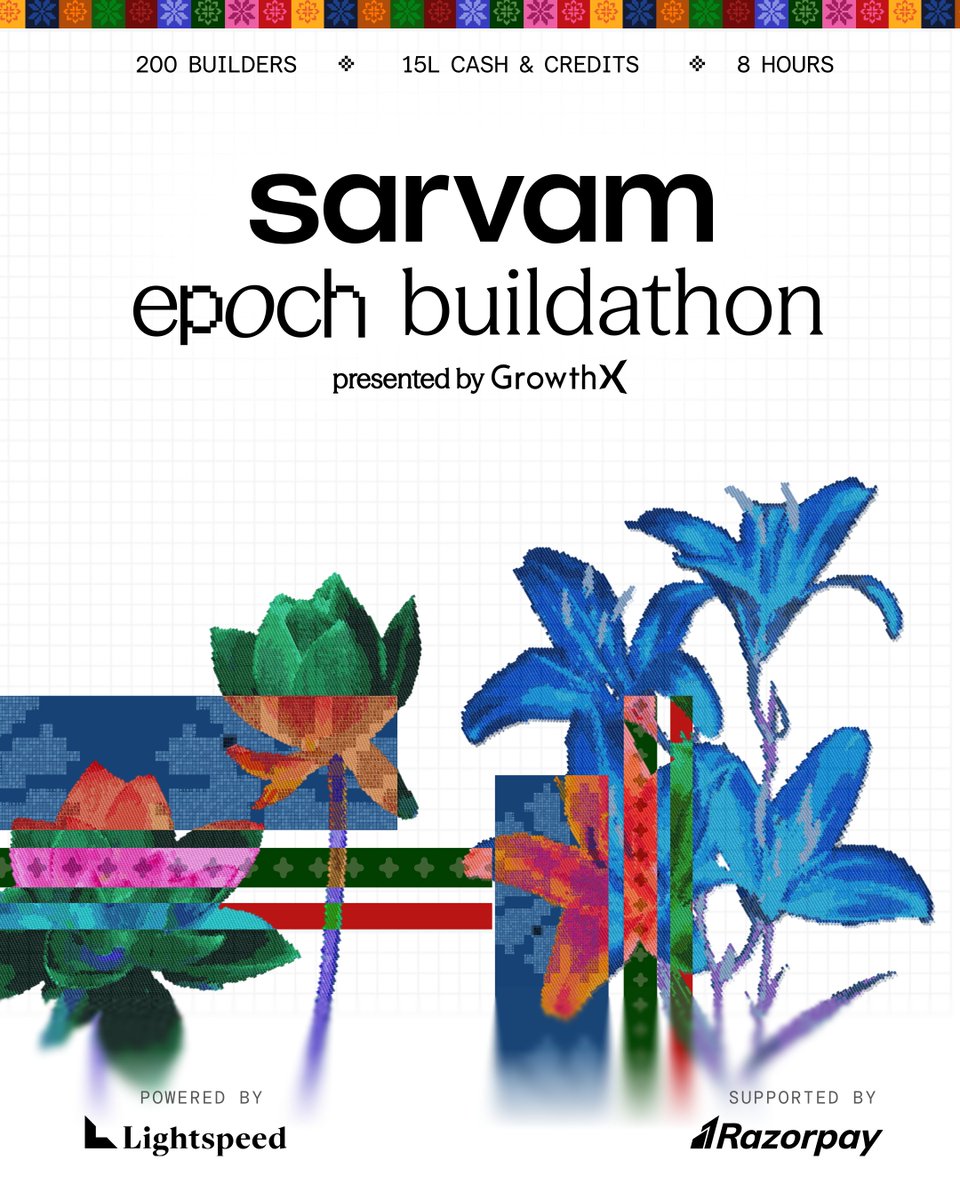
GrowthX presents
Sarvam Epoch Buildathon
200 builders. 8 hours. ₹3L in cash.
Really excited to co-host this with our partners - powered by Lightspeed & supported by Razorpay
Apart from the cash prizes, the top 10 teams present their projects at Epoch, in front of VCs, AI Leaders & AI Founders on July 30.
––– About the Buildathon
You get 8 hours to build voice, language, document, and multilingual AI products using Sarvam’s AI stack. You can use one product or combine all three.
Projects will be judged across four areas:
1/ Technical Depth
2/ Creativity
3/ Impact
4/ Delight
––– Who is this for?
1/ Founders building AI companies
2/ Engineers building models, agents, & products
3/ Product leaders taking AI to large user bases
4/ Researchers & technical generalists
5/ Growth engineers & FDEs
––– How to apply?
Click on the link in the thread
applications close in 48 hours.
Holy, Qwen 3.8 supposedly ahead of GPT-5.6 and only slightly behind Fable 5!
- 2.4t Parameters
- Open Source / Open Weight
- full release soon, already available for testing as Qwen 3.8 max-Max-Preview
What the frick, such insane release on a sunday?!
The gap between US closed source and chinese open source keeps closing friends!! Its getting more intense day by day and GLM is also upcoming with a new model!
Graviton and Quadeye is offering 25 Lakhs per month as Internship stipend to interns.
That means 3 months Internship get them 50 Lakh+ other benefits :)
Though, company want to convert them to full time and make them join them but this is insane🔥
A new tool called Vorflux launched today with a familiar pitch: an autopilot for software engineering that makes every rival look like a toy. Maybe it does.
What strikes me is the speed. Every few weeks a new best-coding-agent-ever arrives and quietly buries the last one. If your plan was to master one of these tools and ride it for a decade, that plan is already dead. They now expire faster than you can get good at them.
So the skill that keeps its value is not any single tool. It is taste. Knowing what is worth building, because the machine will handle the how, and change its mind about the how every month.
Day 49 — Becoming AI Engineer
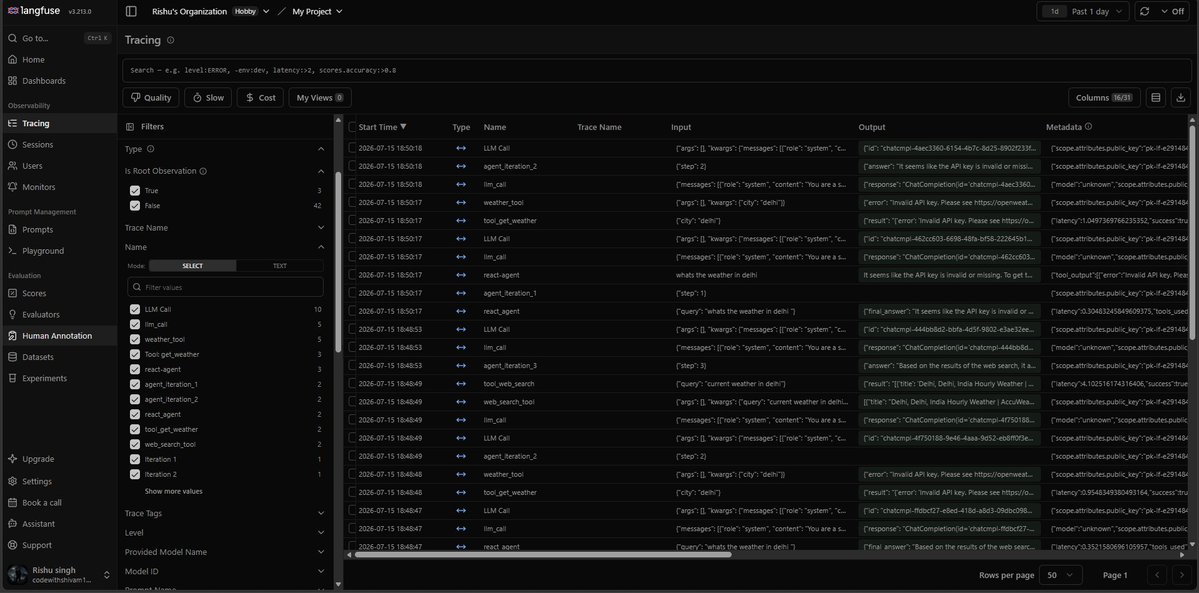
Today I explored AI Evaluation Systems, Evals, and Evaluation Harnesses to understand how production-grade AI applications are measured, tested, and improved.
The biggest insight:
Building an AI agent is not only about creating the agent architecture.
A reliable AI system requires two things working together:
Agent Development + Evaluation & Observability Infrastructure
The workflow looked like this:
Development → Evaluation → Production Monitoring → Feedback Loop → Continuous Improvement
While learning about Evals, I understood that:
Evals are the criteria or metrics used to measure AI system performance.
Examples:
• Accuracy
• Relevance
• Hallucination Detection
• Tool Usage
• Latency
• Cost
• Task Completion
• Reliability
Different AI applications require different evaluation metrics.
A chatbot, RAG system, single-agent system, and multi-agent system all have different goals and failure modes, so there cannot be one universal evaluation strategy for every AI application.
The next important concept was Evaluation Harness.
An evaluation harness is the software infrastructure that automates the evaluation process.
The workflow:
Test Dataset → Run AI Application → Apply Evaluation Metrics → Collect Results → Generate Reports → Compare Versions
The difference:
Evals define what to measure.
Harness defines how to measure it repeatedly at scale.
A simple analogy:
Evals = Exam paper + Grading criteria
Harness = Complete examination system that conducts exams, grades answers, stores results, and compares performance over time.
While exploring LangSmith and Langfuse, I understood that they are not just evaluation tools.
They provide complete infrastructure for:
• LLM Observability
• Tracing
• Prompt Management
• Evaluation Tracking
• Experimentation
• Monitoring Dashboards
Langfuse can be viewed as:
Observability + Prompt Management + Evaluations + Experiment Tracking + Dashboard Infrastructure
However, these tools are not a complete replacement for custom evaluation logic.
In real-world AI engineering:
First, engineers define custom evaluation metrics and create benchmark datasets.
Then, they use evaluation frameworks like LangSmith or Langfuse to automate testing, track results, compare different versions, and monitor system quality.
There is no single evaluation harness that works for every AI application.
Every AI system needs a customized evaluation strategy based on its purpose and failure patterns.
Today I also implemented my own understanding by building:
• Custom evaluation metrics
• Custom evaluation harness from basic components
• Evaluation workflow for running test cases
• Langfuse observability integration for tracking AI system behavior
One important production insight:
Evaluation harnesses are usually not part of every user request in production.
Instead, teams keep them as a quality testing system and run them whenever they:
• Change prompts
• Update models
• Modify agent logic
• Add new tools
• Improve system architecture
This ensures that new changes do not reduce AI system quality.
The biggest takeaway:
A production-ready AI agent is not only:
LLM + Tools + Memory + Workflow
It is:
Agent Architecture + Evaluation System + Observability + Feedback Loop
Whenever I build any GenAI application or Agentic AI system, I should build the agent and evaluation/observability infrastructure together.
Next: Deepening AI Evaluation Systems and exploring advanced evaluator design, automated benchmarking, and production monitoring.
#AI #AIEngineer #AgenticAI #LLM #LangGraph #Langfuse #LangSmith #GenerativeAI #Python #BuildInPublic #LearningInPublic #ArtificialIntelligence
my day is simple: I spend it explaining why product is asking for too much and engineering is building too much. fun fact - that is what tech leadership looks like.
🚨 Kimi K3 set to launch within hours
Moonshot AI may have accidentally revealed the date through its own Kimi API platform:
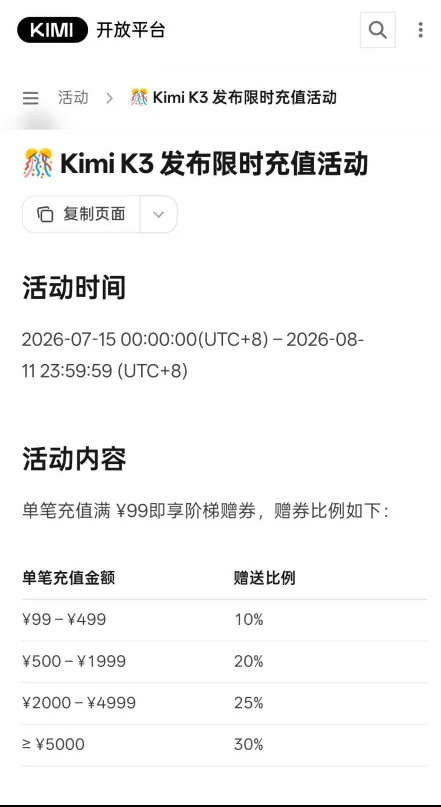
• An official page appeared titled “Kimi K3 launch limited-time recharge campaign”
• The campaign begins on July 15 at 00:00 China time
• The original page now redirects instead of displaying the announcement
• K3 will use a completely new architecture focused on long-horizon agent tasks
• Separate rumours suggest 2.5T parameters and a 1M-token context window
• No official benchmarks or model card have appeared yet
Do you think this model could become the strongest model from a Chinese AI lab?
SpaceXAI just dropped a statement regarding the data stealing on Grok Build.
They confirmed they are copying our entire env files and codebase.
Their only answer? Just turn off your privacy settings if you don't like it.
They've lost a lot of credibility today.
Satya Nadella just warned every company using AI: you are paying twice. Once with money. Again with something far more valuable.
He published an article introducing something called the Reverse Information Paradox.
And it changes how you think about every AI tool your company uses.
Nobel laureate Kenneth Arrow described the original paradox: a seller risks giving away knowledge just to sell it. Nadella says AI flips this completely.
In the AI age, the buyer gives away knowledge just to use what they bought.
Every time your team uses Claude or GPT at work, every prompt reveals what you are building. Every correction teaches the model what good looks like inside your company. Every eval shows what you value. Every trace exposes your workflow.
The model provider learns more about you with every interaction. You learn almost nothing about what they are learning in return. Your corrections are distilled institutional know-how. The kind a competitor could never buy.
And it leaks trace by trace, correction by correction, without you noticing.
His line: "You can offload a task. You can offload a job. But you can never offload your learning."
If the model provider disappears tomorrow, do you still own the intelligence your team built on top of it? Your evals. Your memory. Your traces. Your workflows. Or did all of that compound inside someone else's infrastructure?
In the cloud era, companies accumulated data. In the AI era, they accumulate learning. Right now, most of that learning is compounding inside the model provider. Not inside the company paying for it.
The CEO pushing AI harder than anyone just told you to protect your knowledge from the very tools he is selling you. That should tell you everything.
The official release of DeepSeek V4 may come as soon as this week. 🎉
It is expected to bring:
> better performance
> optimized coding and tool calling
> improvements in multi-turn agent workflows
I'm excited as the Flash preview model has been my daily driver for some time!